THE CLASSIC COLLECTION✦By the gods belovedCLASSIC FREE BOOKS
By the gods beloved
Emmuska Orczy, Baroness Orczy
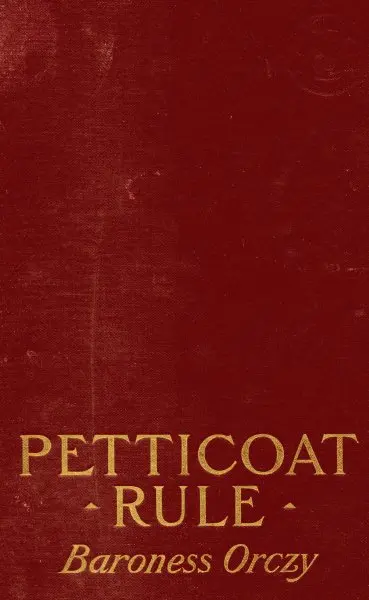
THE CLASSIC COLLECTION · 1909
"Petticoat Rule" by Baroness Emmuska Orczy is a historical novel written during the early 20th century. The story unfolds against the backdrop of 18th-century France, intertwining themes of love, ambition, and political intrigue. At its heart are Lydie d'Aumont, the passionate daughter of the French Prime Minister, and Charles Edward Stuart, the exiled English claimant to the throne, as well as other intrigues involving the lavish court where they navigate their fates. The opening of the novel begins with a farewell banquet held in honor of Charles Edward Stuart at the Château d'Aumont. Conversations at the banquet showcase the vibrant dynamics of the French court, where Lydie d'Aumont's spirited interactions with characters like the Marquise de Pompadour highlight her assertive nature and political awareness. As tensions rise regarding the aspirational causes for which the guests toast, the gathering reveals the broader implications of loyalty and ambition, signaling the intertwining fates of its characters as they maneuver through personal desires and political alliances. Lydie's strong-willed personality stands in contrast to others in the court, setting the stage for potential conflicts and relationships that will develop as the story progresses.
Introduction adapted from the source catalogue; source summaries may be automatically generated.
Free to read · English · 97,797 words · No account needed
MAKE TIME FOR A GOOD BOOK
On by default. Untick to stop anonymous reading totals. Each page counts after 10 seconds in view. How this works.
Anonymous counting is on unless you have switched it off.
"'Tis done, man! 'tis done!" said the gentle, perfectly even voice, "but in the name of Heaven provoke me no further, or it will be murder instead of fight. There!" he added, releasing the other man's wrist, who staggered back faint and giddy with the pain, "'tis true that I refused to meet you in combat yester e'en; the life of my friend, lonely and betrayed, out there in far-off Scotland, had been the price of delay if I did not ride out of Versailles before cock-crow, but now 'tis another matter," he added lightly, "and I am at your service."
"Aye!" sneered Gaston, still writhing with pain, "at my service now, when you hope that my broken wrist will ensure your impunity."
"Nay, sir, but at your service across the width of this table," responded Eglinton coldly, "a pair of pistols, one unloaded. . . . And we'll both use the left hand."
An exclamation of protest broke from Mortémar's lips.
"Impossible! . . ."
"Why so, Monsieur le Comte?"
"'Twere murder, milor!"
"Does M. le Comte de Stainville protest?" queried the other calmly.
"No! damn you! . . . Where are the pistols?"
"Yours, M. le Comte, an you will; surely you have not ridden all the way from Versailles without a pair in your holster."
"Well guessed, milor," quoth Gaston lightly. "Mortémar, I pray you, in the pocket of my coat . . . a pair of pistols."
Mortémar tried again to protest.
"Silence!" said Gaston savagely, "do you not see that I must kill
him?"
"'Tis obvious as the crescent moon yonder, M. de Mortémar," said Eglinton with a whimsical smile. "I entreat you, the pistols."
The young man obeyed in silence. He strode across the room to the place lately vacated by Gaston, and near which his cloak was lying close to his hat and whip. Mortémar groped in the pockets: he found the two pistols and then rejoined the antagonists.
"I used one against a couple of footpads in the early dawn," said Gaston, as he took the weapons from Mortémar's hands and placed them on the table.
"'Twas lucky, Monsieur le Comte," rejoined Eglinton gravely, "then all we need do is to throw for the choice."
"Dice," said Stainville curtly.
On a table close by there was a dice-box, left there by one of Jean Marie's customers: Mortémar, without a word, handed it to Eglinton. He could not understand the placidity of the man: Gaston's attitude was simple enough, primitive animal rage, blinding him to the possibility of immediate death; excitement too, giving him a sense of bravado, an arrogant disregard of the consequences of his own provocation.
Your reading position is saved on this browser. Take it to another device with a library code. Reading pages adapt to text, rather than matching a printed edition.
Emmuska Orczy, Baroness Orczy
Emmuska Orczy, Baroness Orczy
Emmuska Orczy, Baroness Orczy
Emmuska Orczy, Baroness Orczy
BEHIND THE BOOK
This eBook is for the use of anyone anywhere in the United States and most other parts of the world at no cost and with almost no restrictions whatsoever. You may copy it, give it away or re-use it under the terms of the Project Gutenberg License included with this eBook or online at www.gutenberg.org. If you are not located in the United States, you will have to check the laws of the country where you are located before using this eBook. Read the source licence.
The original source file, including credits and licence, is retained by this library. Request an original-format copy at no charge. Please include the book title and Project Gutenberg identifier #34660.
KEEP YOUR CURIOSITY GOING
Cécile Tormay

Moritz Busch
Coulson Kernahan
John L. Ransom

Maurice Baring
Frances Wright