THE CLASSIC COLLECTION✦By the gods belovedCLASSIC FREE BOOKS
By the gods beloved
Emmuska Orczy, Baroness Orczy
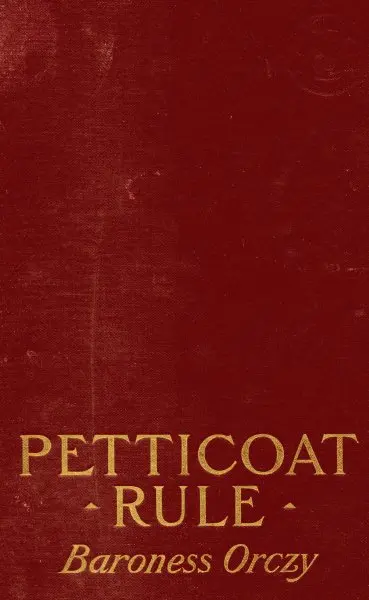
THE CLASSIC COLLECTION · 1909
"Petticoat Rule" by Baroness Emmuska Orczy is a historical novel written during the early 20th century. The story unfolds against the backdrop of 18th-century France, intertwining themes of love, ambition, and political intrigue. At its heart are Lydie d'Aumont, the passionate daughter of the French Prime Minister, and Charles Edward Stuart, the exiled English claimant to the throne, as well as other intrigues involving the lavish court where they navigate their fates. The opening of the novel begins with a farewell banquet held in honor of Charles Edward Stuart at the Château d'Aumont. Conversations at the banquet showcase the vibrant dynamics of the French court, where Lydie d'Aumont's spirited interactions with characters like the Marquise de Pompadour highlight her assertive nature and political awareness. As tensions rise regarding the aspirational causes for which the guests toast, the gathering reveals the broader implications of loyalty and ambition, signaling the intertwining fates of its characters as they maneuver through personal desires and political alliances. Lydie's strong-willed personality stands in contrast to others in the court, setting the stage for potential conflicts and relationships that will develop as the story progresses.
Introduction adapted from the source catalogue; source summaries may be automatically generated.
Free to read · English · 97,797 words · No account needed
MAKE TIME FOR A GOOD BOOK
On by default. Untick to stop anonymous reading totals. Each page counts after 10 seconds in view. How this works.
Anonymous counting is on unless you have switched it off.
Gaston watched his enemy for awhile as he now settled himself at the table, with Jean Marie ministering obsequiously to his wants. Soon mine host had arranged everything to his guest's liking, had placed a dish of stewed veal before him, a bottle of wine, some nice fresh bread, then retired walking backwards, so wonderfully deferential was he to the man who dealt with gold as others would with tin.
One grim thought had now risen in Stainville's mind, the revival of a memory, half-faded: an insult, a challenge, refused by that man, who had thwarted him!
A coward? Eh?
These English would not fight! 'twas well known; in battle, yes! but not in single combat, not in a meeting 'twixt gentlemen, after a heady bottle of wine when tempers wax hot, and swords skip almost of themselves out of the scabbard.
Aye! he would ride a hundred and eighty leagues, to frustrate a plan, or nathless to dip into the well-filled coffers of the Jacobite Alliance--such things were possible--but he would not fight!
Gaston hugged the thought! it was grim but delicious! revenge, bitter, awful, complete revenge was there, quite easy of accomplishment. Fortune was lost to him, but not revenge! Not before his hand had struck the cheek of his enemy.
This was his right. No one could blame him. Not even the King, sworn foe of duelling though he might profess to be.
A long laugh now broke from Gaston's burning throat! Was it not all ridiculous, senseless, and puerile?
His Majesty the King, Pompadour, the Duc d'Aumont, Prime Minister of France, and he himself, Gaston de Stainville, the most ruthlessly ambitious man in the kingdom, all fooled, stupidly fooled and tricked by that man, who was too great a coward to meet the rival whom he had insulted.
At Gaston's laugh Eglinton turned to look in his direction, and his eyes met those of de Mortémar fixed intently upon him.
"Surely it is M. le Contrôleur-Général," said the latter, jumping to
his feet.
He had paid no heed to his guest's curious outburst of merriment, putting it down as another expression of his strange humour, else to the potency of Jean Marie's wine; but he had been deeply interested in the elegant figure of the stranger, that perfect type of a high-born gentleman which the young man was quick enough to recognise. The face, the quaintly awkward manner, brought back certain recollections of two days spent at the Court of Versailles.
Now when Eglinton turned toward him, he at once recognised the handsome face, and those kind eyes, which always looked grave and perfectly straight at an interlocutor.
Your reading position is saved on this browser. Take it to another device with a library code. Reading pages adapt to text, rather than matching a printed edition.
Emmuska Orczy, Baroness Orczy
Emmuska Orczy, Baroness Orczy
Emmuska Orczy, Baroness Orczy
Emmuska Orczy, Baroness Orczy
BEHIND THE BOOK
This eBook is for the use of anyone anywhere in the United States and most other parts of the world at no cost and with almost no restrictions whatsoever. You may copy it, give it away or re-use it under the terms of the Project Gutenberg License included with this eBook or online at www.gutenberg.org. If you are not located in the United States, you will have to check the laws of the country where you are located before using this eBook. Read the source licence.
The original source file, including credits and licence, is retained by this library. Request an original-format copy at no charge. Please include the book title and Project Gutenberg identifier #34660.
KEEP YOUR CURIOSITY GOING
Cécile Tormay

Moritz Busch
Coulson Kernahan
John L. Ransom

Maurice Baring
Frances Wright