THE CLASSIC COLLECTION✦By the gods belovedCLASSIC FREE BOOKS
By the gods beloved
Emmuska Orczy, Baroness Orczy
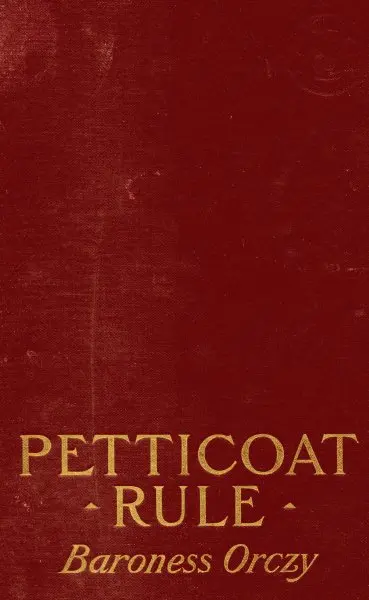
THE CLASSIC COLLECTION · 1909
"Petticoat Rule" by Baroness Emmuska Orczy is a historical novel written during the early 20th century. The story unfolds against the backdrop of 18th-century France, intertwining themes of love, ambition, and political intrigue. At its heart are Lydie d'Aumont, the passionate daughter of the French Prime Minister, and Charles Edward Stuart, the exiled English claimant to the throne, as well as other intrigues involving the lavish court where they navigate their fates. The opening of the novel begins with a farewell banquet held in honor of Charles Edward Stuart at the Château d'Aumont. Conversations at the banquet showcase the vibrant dynamics of the French court, where Lydie d'Aumont's spirited interactions with characters like the Marquise de Pompadour highlight her assertive nature and political awareness. As tensions rise regarding the aspirational causes for which the guests toast, the gathering reveals the broader implications of loyalty and ambition, signaling the intertwining fates of its characters as they maneuver through personal desires and political alliances. Lydie's strong-willed personality stands in contrast to others in the court, setting the stage for potential conflicts and relationships that will develop as the story progresses.
Introduction adapted from the source catalogue; source summaries may be automatically generated.
Free to read · English · 97,797 words · No account needed
MAKE TIME FOR A GOOD BOOK
On by default. Untick to stop anonymous reading totals. Each page counts after 10 seconds in view. How this works.
Anonymous counting is on unless you have switched it off.
Two years, and already the nation grumbled! A check was to be put on her extravagance--hers and that of King Louis! The parliaments demanded that some control be exercised over Royal munificence. Fewer jewels for Madame! And that palace at Fontainebleau not yet completed, the Parc aux Cerfs so magnificently planned and not even begun! Would the new Comptroller put a check on that?
At first she marvelled that Louis should consent. It was a humiliation for him as well as for her. The weakness in him which had served her own ends seemed monstrous when it yielded to pressure from others.
He had assured her that she should not suffer; jewels, palaces, gardens, she should have all as heretofore. Let Parliament insist and grumble, but the Comptroller would be appointed by D'Aumont, and D'Aumont was her slave.
D'Aumont, yes! but not his daughter--that arrogant girl with the severe eyes, unwomanly and dictatorial, who ruled her father just as she herself, Pompadour, ruled the King.
An enemy, that Lydie d'Aumont! Mme. la Marquise, whilst framing a witticism at which the King smiled, frowned because in a distant alcove she spied the haughty figure of Lydie.
And there were others! The friends of the Queen and her clique, of course; they were not here to-night; at least not in great numbers; still, even the present brilliant company, though smiling and obsequious in the presence of the King, was not by any means a close phalanx of friends.
M. d'Argenson, for instance--he was an avowed enemy; and Marshal de Noailles, too--oh! and there were others.
One of them, fortunately, was going away; Charles Edward Stuart, aspiring King of England; he had been no friend of Pompadour. Even now, as he stood close by, lending an obviously inattentive ear to M. le Duc d'Aumont, she could see that he still looked gloomy and out of humour, and that whenever his eyes rested upon her and the King he frowned with wrathful impatience.
"You are distraite, ma mie!" said Louis, with a yawn.
"I was thinking, sire," she replied, smiling into his drowsy eyes.
"For God's sake, I entreat, do not think!" exclaimed the King, with mock alarm. "Thought produces wrinkles, and your perfect mouth was only fashioned for smiles."
"May I frame a suggestion?" she queried archly.
"No, only a command."
"This Comptroller of Finance, your future master, Louis, and mine----"
"Your slave," he interrupted lazily, "and he values his life."
"Why not milor Eglinton?"
"Le petit Anglais?" and Louis's fat body was shaken with sudden immoderate laughter. "Par Dieu, ma mie! Of all your witty sallies this one hath pleased us most."
"Why?" she asked seriously.
Your reading position is saved on this browser. Take it to another device with a library code. Reading pages adapt to text, rather than matching a printed edition.
Emmuska Orczy, Baroness Orczy
Emmuska Orczy, Baroness Orczy
Emmuska Orczy, Baroness Orczy
Emmuska Orczy, Baroness Orczy
BEHIND THE BOOK
This eBook is for the use of anyone anywhere in the United States and most other parts of the world at no cost and with almost no restrictions whatsoever. You may copy it, give it away or re-use it under the terms of the Project Gutenberg License included with this eBook or online at www.gutenberg.org. If you are not located in the United States, you will have to check the laws of the country where you are located before using this eBook. Read the source licence.
The original source file, including credits and licence, is retained by this library. Request an original-format copy at no charge. Please include the book title and Project Gutenberg identifier #34660.
KEEP YOUR CURIOSITY GOING
Cécile Tormay

Moritz Busch
Coulson Kernahan
John L. Ransom

Maurice Baring
Frances Wright