THE CLASSIC COLLECTION✦By the gods belovedCLASSIC FREE BOOKS
By the gods beloved
Emmuska Orczy, Baroness Orczy
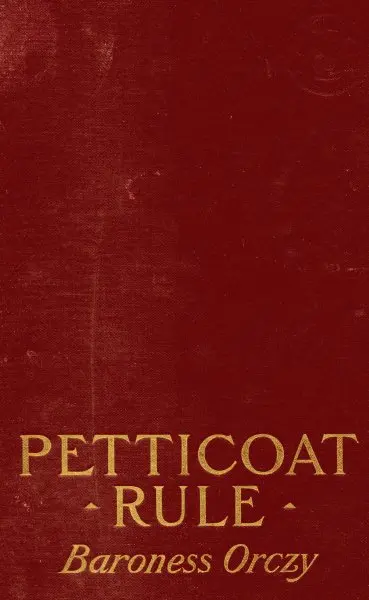
THE CLASSIC COLLECTION · 1909
"Petticoat Rule" by Baroness Emmuska Orczy is a historical novel written during the early 20th century. The story unfolds against the backdrop of 18th-century France, intertwining themes of love, ambition, and political intrigue. At its heart are Lydie d'Aumont, the passionate daughter of the French Prime Minister, and Charles Edward Stuart, the exiled English claimant to the throne, as well as other intrigues involving the lavish court where they navigate their fates. The opening of the novel begins with a farewell banquet held in honor of Charles Edward Stuart at the Château d'Aumont. Conversations at the banquet showcase the vibrant dynamics of the French court, where Lydie d'Aumont's spirited interactions with characters like the Marquise de Pompadour highlight her assertive nature and political awareness. As tensions rise regarding the aspirational causes for which the guests toast, the gathering reveals the broader implications of loyalty and ambition, signaling the intertwining fates of its characters as they maneuver through personal desires and political alliances. Lydie's strong-willed personality stands in contrast to others in the court, setting the stage for potential conflicts and relationships that will develop as the story progresses.
Introduction adapted from the source catalogue; source summaries may be automatically generated.
Free to read · English · 97,797 words · No account needed
MAKE TIME FOR A GOOD BOOK
On by default. Untick to stop anonymous reading totals. Each page counts after 10 seconds in view. How this works.
Anonymous counting is on unless you have switched it off.
She was taken at a disadvantage, since she had undoubtedly been asleep--if only for a moment--and she was not quite sure if her pose, when Gaston first caught sight of her, was sufficiently dignified.
"I am afraid I have disturbed you," he said humbly.
"I was meditating," she replied coldly, as she smoothed down her
skirts and mechanically put a hand to her hair, lest a curl had gone
astray.
Then she made as if she would rise.
"Surely you are not going?" he pleaded.
"I have my work to do. I only stayed here a moment, in order to rest."
"And I am intruding?"
"Oh, scarcely," she replied quietly. "I was about to return to my
work."
"Is it so urgent?"
"The business of a nation, M. le Comte, is always urgent."
"So urgent that you have no time now to give to old friends," he said
bitterly.
She shrugged her shoulders with a quick, sarcastic laugh.
"Old friends? . . . Oh! . . ."
"Yes, old friends," he rejoined quietly. "We were children together,
Lydie."
"Much has occurred since then, Monsieur le Comte."
"Only one great and awful fault, which meseems hath been its own
expiation."
"Need we refer to that now?" she asked calmly.
"Indeed, indeed, we must," he replied earnestly. "Lydie, am I never to
be forgiven?"
"Is there aught for me to forgive?"
"Yes. An error, a grave error . . . a fault, if you will call it so
. . ."
"I prefer to call it a treachery," she said.
"Without one word of explanation, without listening to a single word
from me. Is that just?"
"There is nothing that you could say now, Monsieur le Comte, that I should have the right to hear."
"Why so?" he said with sudden vehemence, as he came nearer to her, and in a measure barred the way by which she might have escaped. "Even a criminal at point of death is allowed to say a few words in self-defence. Yet I was no criminal. If I loved you, Lydie, was that wrong? . . . I was an immeasurable fool, I own that," he added more calmly, being quick to note that he only angered her by his violence, "and it is impossible for a high-minded woman like yourself to understand the pitfalls which beset the path of a man, who has riches, good looks mayhap and a great name, all of which will tempt the cupidity of certain designing women, bent above all on matrimony, on influence and independence. Into one of these pitfalls I fell, Lydie . . . fell clumsily, stupidly, I own, but not inexcusably."
"You seem to forget, M. le Comte," she said stiffly, "that you are
speaking of your wife."
Your reading position is saved on this browser. Take it to another device with a library code. Reading pages adapt to text, rather than matching a printed edition.
Emmuska Orczy, Baroness Orczy
Emmuska Orczy, Baroness Orczy
Emmuska Orczy, Baroness Orczy
Emmuska Orczy, Baroness Orczy
BEHIND THE BOOK
This eBook is for the use of anyone anywhere in the United States and most other parts of the world at no cost and with almost no restrictions whatsoever. You may copy it, give it away or re-use it under the terms of the Project Gutenberg License included with this eBook or online at www.gutenberg.org. If you are not located in the United States, you will have to check the laws of the country where you are located before using this eBook. Read the source licence.
The original source file, including credits and licence, is retained by this library. Request an original-format copy at no charge. Please include the book title and Project Gutenberg identifier #34660.
KEEP YOUR CURIOSITY GOING
Cécile Tormay

Moritz Busch
Coulson Kernahan
John L. Ransom

Maurice Baring
Frances Wright