
The Writing of News A Handbook with Chapters on Newspaper Correspondence and Copy Reading
Charles G. (Charles Griffith) Ross
THE CLASSIC COLLECTION · 1872
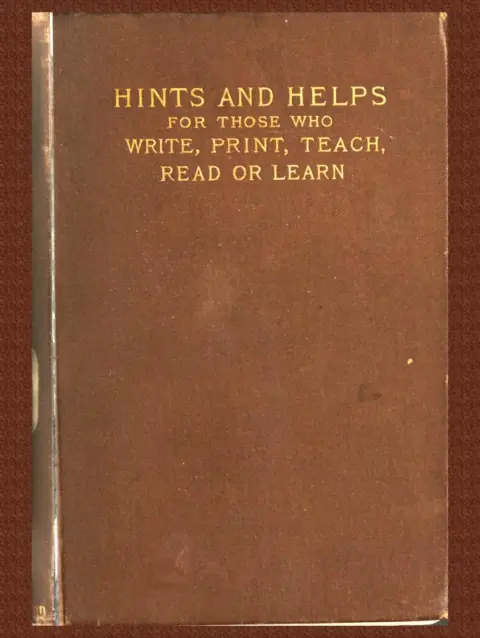
"PENS AND TYPES" by Benjamin Drew is a practical guide for aspiring authors, printers, and educators, likely written in the late 19th century. This text serves both as a manual and a reference work, aimed at offering practical advice on writing, printing, and teaching the English language. It covers various topics including proof-reading, punctuation, orthography, and capitalization, making it beneficial for anyone involved in the creation or dissemination of written content. At the start of the book, Drew emphasizes the critical role of clear and legible writing for effective communication in printing and publishing. Through examples of humorous misprints and errors caused by illegibility, he illustrates how a writer's carelessness can lead to significant misunderstandings. This opening section sets the tone for the rest of the work, establishing the importance of clarity and professionalism in written documents. Drew's insights not only cater to individuals directly involved with the press but also extend to those teaching language skills, highlighting the interconnectedness of reading and writing proficiency.
Introduction adapted from the source catalogue; source summaries may be automatically generated.
Free to read · English · 51,463 words · No account needed
MAKE TIME FOR A GOOD BOOK
On by default. Untick to stop anonymous reading totals. Each page counts after 10 seconds in view. How this works.
Anonymous counting is on unless you have switched it off.
Tables, form of; size of type; style of captions, etc., sometimes furnished to compositors and proof-readers, 38.
Technical terms used in this book, 202–204.
Tout-ensemble survey of a proof-sheet, 40.
To wit, namely, viz., ending paragraph, how punctuated, 82.
Two “Chapter V.’s,” 30.
Type, how distributed, 34.
Umlaut, 122.
Uniformity—very important in some works, of no consequence in others,
52.
Use of comma, in many cases, depends upon taste, 80.
Varieties of style, 61–63.
Various marks used in writing and printing, 118.
Various sizes of type—modern, 205.
Various sizes of type—old style, 205.
Viz., namely, to wit; ending paragraph, how punctuated, 83.
Viz., namely, to wit; how punctuated, 82.
Webster’s preferred columns of words of doubtful orthography, 127–140.
Worcester’s preferred columns of words of doubtful orthography,
141–154.
Words connected with a No. of designation, 182.
Words doubtful, query, 31.
Words ending in able, 155–164; in ible, 165–167.
Words ending in ise, 168, 169.
Words from dead and foreign languages, 56–58.
Words ending in cion, 169.
Words l. c. when spelled in full, u. c. when contracted, 181.
Words, not English, to be printed in italics, 57, 58.
Words, not English, to be printed in roman, 58.
Write plain English, 26.
Writers for press should understand technics of proof-reading, 42.
Writing, bad, robs compositors, 21–23.
Writing becomes automatic, 19.
Writing for the press, 15–32.
Writing legibly, imperative, 21.
Writing, illegibility of the, protects printers in suits for damages,
15.
{p215}
Prepared by Professor LEWIS B. MONROE Founder of the Boston School of
Oratory
HUMOROUS READINGS In prose and verse. For the use of schools reading-clubs public and parlor entertainments $1.50
“The book is readable from the first page to the last, and every article contained in it is worth more than the price of the volume.”—Providence Herald.
MISCELLANEOUS READINGS In prose and verse $1.50
“We trust this book may find its way into many schools, not to be used as a book for daily drill, but as affording the pupil occasionally an opportunity of leaving the old beaten track.”—Rhode-Island Schoolmaster.
DIALOGUES AND DRAMAS For the use of dramatic and reading clubs and for public social and school entertainments $1.50
“If the acting of dramas such as are contained in this book, could be introduced into private circles, there would be an inducement for the young to spend their evenings at home, instead of resorting to questionable public places.”—Nashua Gazette.
YOUNG FOLKS’ READINGS For social and public entertainment $1.50
“Professor Monroe is one of the most successful teachers of elocution, as well as a very popular public reader. In this volume he has given an unusually fine selection for home and social reading, as well as for public entertainments.”—Boston Home Journal.
DIALOGUES FROM DICKENS Arranged for schools and home amusement By W. ELIOT FETTE A.M. First series $1.00
Your reading position is saved on this browser. Take it to another device with a library code. Reading pages adapt to text, rather than matching a printed edition.
BEHIND THE BOOK
This eBook is for the use of anyone anywhere in the United States and most other parts of the world at no cost and with almost no restrictions whatsoever. You may copy it, give it away or re-use it under the terms of the Project Gutenberg License included with this eBook or online at www.gutenberg.org. If you are not located in the United States, you will have to check the laws of the country where you are located before using this eBook. Read the source licence.
The original source file, including credits and licence, is retained by this library. Request an original-format copy at no charge. Please include the book title and Project Gutenberg identifier #60126.
KEEP YOUR CURIOSITY GOING
Charles G. (Charles Griffith) Ross
Hannah Webster Foster

Emily Lawless
Edwin Hamlin Carr

Charles De Lano Hine
Andrew Ure