
The Writing of News A Handbook with Chapters on Newspaper Correspondence and Copy Reading
Charles G. (Charles Griffith) Ross
THE CLASSIC COLLECTION · 1872
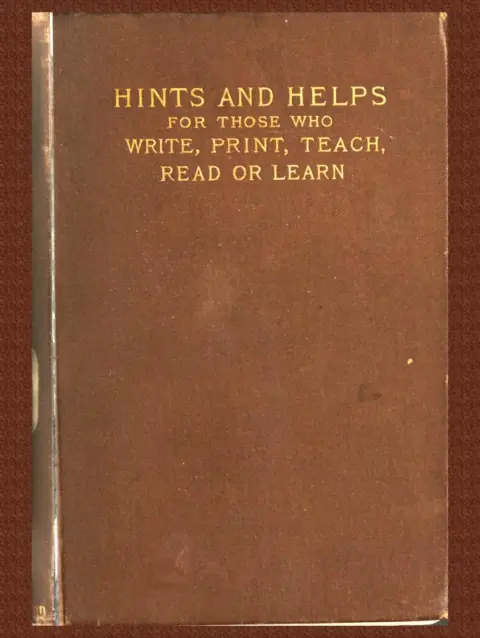
"PENS AND TYPES" by Benjamin Drew is a practical guide for aspiring authors, printers, and educators, likely written in the late 19th century. This text serves both as a manual and a reference work, aimed at offering practical advice on writing, printing, and teaching the English language. It covers various topics including proof-reading, punctuation, orthography, and capitalization, making it beneficial for anyone involved in the creation or dissemination of written content. At the start of the book, Drew emphasizes the critical role of clear and legible writing for effective communication in printing and publishing. Through examples of humorous misprints and errors caused by illegibility, he illustrates how a writer's carelessness can lead to significant misunderstandings. This opening section sets the tone for the rest of the work, establishing the importance of clarity and professionalism in written documents. Drew's insights not only cater to individuals directly involved with the press but also extend to those teaching language skills, highlighting the interconnectedness of reading and writing proficiency.
Introduction adapted from the source catalogue; source summaries may be automatically generated.
Free to read · English · 51,463 words · No account needed
MAKE TIME FOR A GOOD BOOK
On by default. Untick to stop anonymous reading totals. Each page counts after 10 seconds in view. How this works.
Anonymous counting is on unless you have switched it off.
We forbear inserting a list of the sacred names, too often written and uttered “in vain.” The reader is probably {p177} familiar with them from listening to Sabbath services, and reading religious books with which, we hope, his library abounds.
The word “providence” should be put down or up, according to its meaning, as may be seen in the two following sentences:
But behold now another providence of God; a ship came into the harbor. . . . This ship had store of English beads and some knives.—New England’s Memorial.
The world was all before them, where to choose Their place of rest, and Providence their guide.—Milton.
Nouns ordinarily common become proper when written as names of the
Supreme Being.
I hope my merciful Judge will bear in mind my heavy punishment on earth.—Pickwick Papers, ch. 44.
Emerson refers “all productions at last to an aboriginal
Power.”—Century Maga.
Plato said, that in all nations certain minds dwell on the “fundamental Unity,” and “lose all being in one Being.”—Ib.
In the above examples, the effect of capitals in conveying the idea of personality is strikingly illustrated.
Pronouns referring to the Deity are not usually put up,—excepting the personals “He,” “Him.”
O thou, whose justice reigns on high.—Watts.
O thou, Most High—Ps. 56 : 2.
Father of all mercies, we, thine unworthy servants, do give thee most humble and hearty thanks for all thy goodness.—Common Prayer.
Thou, whose, thine, thy, properly lower-case.
Usage is ununiform as to capitalizing the pronoun of the third person, when referring to the Deity; some using the capital in all three cases (He, His, Him), while others capitalize the nominative and objective, and put “his” down; and still others put all the cases down.
God does love us. As any loving father or mother, He wants us to want His society, and to love to be with and talk with Him.—Congregationalist.
Small letter in the possessive, capital in the objective: {p178}
All the works of God . . . declare the glory of his perfections. . . . But how gross are the conceptions generally entertained of the character of Him “in whom we live and move!”
Dick. Improv’t Soc. § VI.
All the cases down:
. . . They can know but little . . . of that happiness which God has prepared for them that love him; but . . . this suffices them, that they shall see him as he is, etc. . . . the expectation founded upon his own gracious promise, etc.—Rev. John Newton’s Sermon on the “happy recovery” of King George (modern reprint).
Your reading position is saved on this browser. Take it to another device with a library code. Reading pages adapt to text, rather than matching a printed edition.
BEHIND THE BOOK
This eBook is for the use of anyone anywhere in the United States and most other parts of the world at no cost and with almost no restrictions whatsoever. You may copy it, give it away or re-use it under the terms of the Project Gutenberg License included with this eBook or online at www.gutenberg.org. If you are not located in the United States, you will have to check the laws of the country where you are located before using this eBook. Read the source licence.
The original source file, including credits and licence, is retained by this library. Request an original-format copy at no charge. Please include the book title and Project Gutenberg identifier #60126.
KEEP YOUR CURIOSITY GOING
Charles G. (Charles Griffith) Ross
Hannah Webster Foster

Emily Lawless
Edwin Hamlin Carr

Charles De Lano Hine
Andrew Ure