
The Writing of News A Handbook with Chapters on Newspaper Correspondence and Copy Reading
Charles G. (Charles Griffith) Ross
THE CLASSIC COLLECTION · 1872
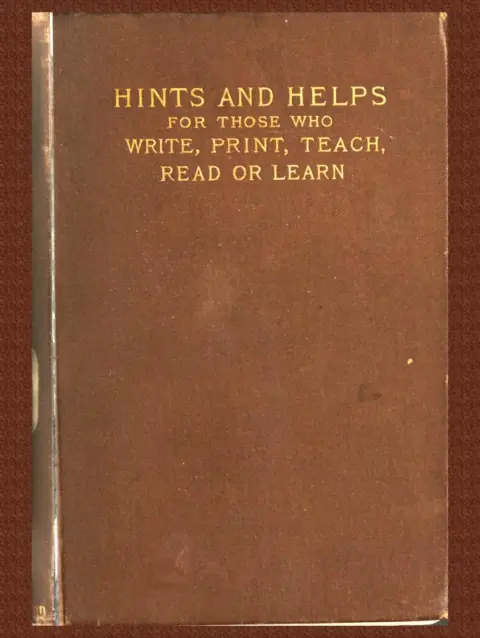
"PENS AND TYPES" by Benjamin Drew is a practical guide for aspiring authors, printers, and educators, likely written in the late 19th century. This text serves both as a manual and a reference work, aimed at offering practical advice on writing, printing, and teaching the English language. It covers various topics including proof-reading, punctuation, orthography, and capitalization, making it beneficial for anyone involved in the creation or dissemination of written content. At the start of the book, Drew emphasizes the critical role of clear and legible writing for effective communication in printing and publishing. Through examples of humorous misprints and errors caused by illegibility, he illustrates how a writer's carelessness can lead to significant misunderstandings. This opening section sets the tone for the rest of the work, establishing the importance of clarity and professionalism in written documents. Drew's insights not only cater to individuals directly involved with the press but also extend to those teaching language skills, highlighting the interconnectedness of reading and writing proficiency.
Introduction adapted from the source catalogue; source summaries may be automatically generated.
Free to read · English · 51,463 words · No account needed
MAKE TIME FOR A GOOD BOOK
On by default. Untick to stop anonymous reading totals. Each page counts after 10 seconds in view. How this works.
Anonymous counting is on unless you have switched it off.
Parenthesis, marks of, 120.
Pauses and sense both indicated by punctuation, 75, 76.
Period, or full point, 96.
Personified things capitalized, 182.
Physicians’ chirography, 27.
Plurals, when denoted by apostrophe and s, 94, 95.
Pointing—close, liberal, 80.
Points, capitals, etc., method of reading by copy-holder, 46.
Points mark sense as well as pauses, 75, 76.
Possessive case of nouns singular ending in s, 94.
Preambles, resolves, and provisos, how punctuated, 81.
Preferred spelling, Webster’s, of 1500+ words of various orthography,
127–140.
Preferred spelling, Worcester’s, of 1500+ words of various
orthography, 141–154.
Principal words capitalized, 175, 176.
Printers, usually best proof-readers, 35.
Professional men “at the case,” 36.
Proof-reader and Dr. Johnson, 32.
Proof-readers and compositors punctuate, 36.
Proof-reader, to query doubtful words, etc., 31.
Proof-reading, 33–58.
Proof-sheets, marks used in correcting, 43, 45.
Proof-sheets, numbered in regular sequence, 46.
Proof-sheets of Records of Court, 51.
Proof-sheets, second reading and revising of, 47.
Proofs, routine in regard to, 37.
Proper nouns, having common form, put down, 183.
Propinquity a reason for putting up or putting down, 189–192.
Provisos, preambles, and resolutions, how punctuated, 81.
Punctuation, 71–124; a modern art, 73.
Punctuation, ancient and modern methods of, 73–75.
Punctuation by compositor and proof-reader, 36.
Punctuation, by one reader only, 47.
Punctuation of viz., namely, to wit, 82.
Punctuation, rules of, not fixed, 75.
Punctuation, uniformity of, not attainable, 123.
“Put down” and “Put up,” meaning of, 171, 172.
Quantity, marks of, 121, 122.
Quotation marks, 119, 120.
Reading final proof before printing, 49–51.
Reading Greek, 53–56.
Reading points and capitals, 46.
Recapitulation of rules for right use of capitals, 192–194.
Recipes—Greek and Latin, 27, 28.
Records of Court, no alterations in, allowable, except clerical errors
in punctuation, 51.
Records of Court, transcripts of, with extraneous documents, 25.
Records of Court, uniform style in, not to be sought at expense of
departing from copy, 51.
Reference marks to footnotes and sidenotes, 123.
Resolutions, preambles, and provisos, how punctuated, 81.
Restoring canceled words, 29.
Revising, 47.
Revising, in, great care required, 47.
Rhetorical points, 72.
Rules of punctuation, 96–118.
Rules of punctuation not fixed, 75.
Rules for capitalization very bendable, 190.
Samples or directions and notes to printers, 38–40.
Second proof, 46.
Second reading of proof by copy, 47.
Second, third, etc., revision of proof-sheets, 48.
Section mark (§), 123.
Semicolon, 98–100.
Semicolon before as, when particulars follow a general statement, 82.
Sense and pauses, both indicated by points, 75, 76.
Sentences difficult and involved, compositor and proof-reader to follow copy carefully, 123, 124.
Separation of words in manuscripts, 74.
Size of type; captions; form of tables, etc., directions for, to be
supplied, 38.
Slips of proof, numbered in sequence, 46.
Space before and after dash, 91.
Spanish ñ, 122.
Specimen of first proof, 44.
“Spectator” of 1711 wished for an Academy to settle differences between grammar and idiom, 65.
Spelling, errors in, silently corrected, 36.
“Stet,” 29.
Style, 59–65.
Style of the office, 40.
Style of writing in the fifth century, 74.
Style, peculiarities of, to be noted by proof-reader, for reference,
37.
Styles, mingling of, 40.
Styles; Worcester, Webster, and Office, 61.
Subject and predicate, no comma between, except to prevent ambiguity,
77–79.
Suggestions to writers for press, 28.
Supreme Being, names, etc., of, capitalized, 176–180.
Syllabication, 87–89.
Your reading position is saved on this browser. Take it to another device with a library code. Reading pages adapt to text, rather than matching a printed edition.
BEHIND THE BOOK
This eBook is for the use of anyone anywhere in the United States and most other parts of the world at no cost and with almost no restrictions whatsoever. You may copy it, give it away or re-use it under the terms of the Project Gutenberg License included with this eBook or online at www.gutenberg.org. If you are not located in the United States, you will have to check the laws of the country where you are located before using this eBook. Read the source licence.
The original source file, including credits and licence, is retained by this library. Request an original-format copy at no charge. Please include the book title and Project Gutenberg identifier #60126.
KEEP YOUR CURIOSITY GOING
Charles G. (Charles Griffith) Ross
Hannah Webster Foster

Emily Lawless
Edwin Hamlin Carr

Charles De Lano Hine
Andrew Ure