
The Writing of News A Handbook with Chapters on Newspaper Correspondence and Copy Reading
Charles G. (Charles Griffith) Ross
THE CLASSIC COLLECTION · 1872
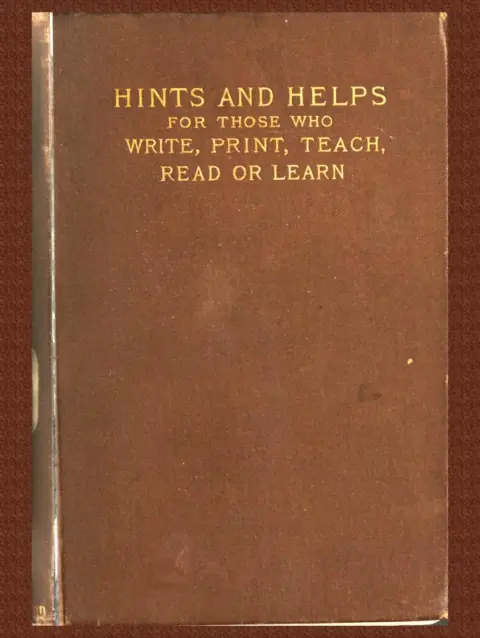
"PENS AND TYPES" by Benjamin Drew is a practical guide for aspiring authors, printers, and educators, likely written in the late 19th century. This text serves both as a manual and a reference work, aimed at offering practical advice on writing, printing, and teaching the English language. It covers various topics including proof-reading, punctuation, orthography, and capitalization, making it beneficial for anyone involved in the creation or dissemination of written content. At the start of the book, Drew emphasizes the critical role of clear and legible writing for effective communication in printing and publishing. Through examples of humorous misprints and errors caused by illegibility, he illustrates how a writer's carelessness can lead to significant misunderstandings. This opening section sets the tone for the rest of the work, establishing the importance of clarity and professionalism in written documents. Drew's insights not only cater to individuals directly involved with the press but also extend to those teaching language skills, highlighting the interconnectedness of reading and writing proficiency.
Introduction adapted from the source catalogue; source summaries may be automatically generated.
Free to read · English · 51,463 words · No account needed
MAKE TIME FOR A GOOD BOOK
On by default. Untick to stop anonymous reading totals. Each page counts after 10 seconds in view. How this works.
Anonymous counting is on unless you have switched it off.
But certain suffixes, whether spelled in full or contracted, are put up or down, or in small caps, capitalized, according to the style of the words to which they are suffixed; as, for instance, the words “junior” and “esquire,” which are put one degree less in dignity than the words to which they are attached; as:
John Smith, jr., esq., [or “junior, esquire.”]
The person’s name being lower-case capitalized, “jr.” and “esq.” are
put down.
JOHN DOE, Jr. Esq., [or “Junior, Esquire.”]
The names being small caps, capitalized, the “jr.” and “esq.” are put
up.
RICHARD ROE, JR. ESQ., [or “JUNIOR, ESQUIRE.”]
The names being in capitals, the suffixes are capitals and small
capitals.
But “D.D.” “LL.D.” “M.D.” etc., are put in large or small capitals according to office style, or a style adapted for the work in which they appear: as— {p182}
John Doe, LL.D.; RICHARD ROE, PH.D.; J. SMITH, M.D.; ABEL MONEY, F.R.S.
Words connected with a number of designation are often put up,—and this is the better way. So, though the words “Bay,” “Dock,” etc., in the following examples may properly be put down if the office style require it, yet the unfettered compositor and reader will prefer to put up those, and all words similarly placed; as:
The planks of Bay No. 6 on Chelsea Bridge have been replaced by ordinary boards purchased at Dock No. 8.
We arrived at Station 16, and proceeded thence through Lock 12 to Dam
No. 8.
8. Names of persons, of things personified, of nations, countries, cities, towns, streets, ships, etc., should be put up.
Capt. Samuel Jones sailed in ship Minerva, from Sandy Hook to Tanjong Bolus, the most southerly point of the continent of Asia.
A charming and spirituelle Frenchwoman said of Julius Mohl, that Nature, in forming his character, had skimmed the cream of the three nationalities to which he belonged by birth, by adoption, and by marriage; making him “deep as a German, spirituel as a Frenchman, and loyal as an Englishman.”—Atlantic Monthly.
Charles, Susan, William, Henrietta Matilda, Benjamin Harrison Smith,
come in, this minute!
Under this rule proper adjectives may also be classed; as:
The French and American Claims Commission.
He is familiar with the German, French, Russian, Bengalee, Chinese,
and Grebo languages.
Is the Monroe doctrine heartily concurred in by European nations?
Names of political parties should be put up.
Democrat, Democratic, Democracy, Republican, Republicanism, Woman-Suffragists, Women’s Rights party, Locofocos, Whigs, Tories, Free-Soilers, Liberals, Independents, etc. {p183}
But when any of these words are used in a general sense, they should be
put down; as:
Your reading position is saved on this browser. Take it to another device with a library code. Reading pages adapt to text, rather than matching a printed edition.
BEHIND THE BOOK
This eBook is for the use of anyone anywhere in the United States and most other parts of the world at no cost and with almost no restrictions whatsoever. You may copy it, give it away or re-use it under the terms of the Project Gutenberg License included with this eBook or online at www.gutenberg.org. If you are not located in the United States, you will have to check the laws of the country where you are located before using this eBook. Read the source licence.
The original source file, including credits and licence, is retained by this library. Request an original-format copy at no charge. Please include the book title and Project Gutenberg identifier #60126.
KEEP YOUR CURIOSITY GOING
Charles G. (Charles Griffith) Ross
Hannah Webster Foster

Emily Lawless
Edwin Hamlin Carr

Charles De Lano Hine
Andrew Ure