
The Writing of News A Handbook with Chapters on Newspaper Correspondence and Copy Reading
Charles G. (Charles Griffith) Ross
THE CLASSIC COLLECTION · 1872
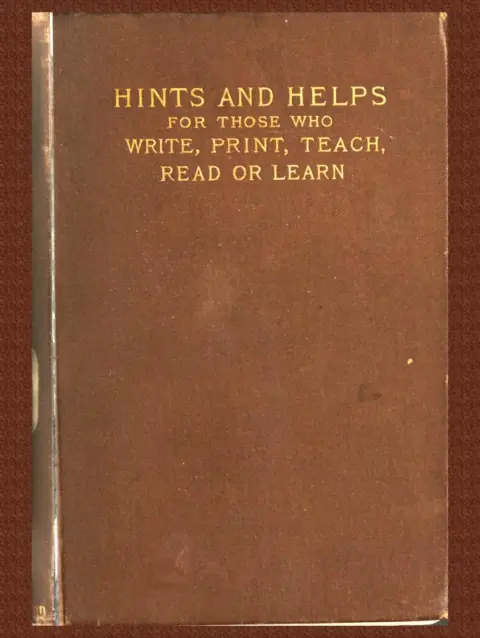
"PENS AND TYPES" by Benjamin Drew is a practical guide for aspiring authors, printers, and educators, likely written in the late 19th century. This text serves both as a manual and a reference work, aimed at offering practical advice on writing, printing, and teaching the English language. It covers various topics including proof-reading, punctuation, orthography, and capitalization, making it beneficial for anyone involved in the creation or dissemination of written content. At the start of the book, Drew emphasizes the critical role of clear and legible writing for effective communication in printing and publishing. Through examples of humorous misprints and errors caused by illegibility, he illustrates how a writer's carelessness can lead to significant misunderstandings. This opening section sets the tone for the rest of the work, establishing the importance of clarity and professionalism in written documents. Drew's insights not only cater to individuals directly involved with the press but also extend to those teaching language skills, highlighting the interconnectedness of reading and writing proficiency.
Introduction adapted from the source catalogue; source summaries may be automatically generated.
Free to read · English · 51,463 words · No account needed
MAKE TIME FOR A GOOD BOOK
On by default. Untick to stop anonymous reading totals. Each page counts after 10 seconds in view. How this works.
Anonymous counting is on unless you have switched it off.
Take now the hand we so often have shaken,
Speak from our feelings so hard to subdue,
Send him in joyfulness out from our circle,
Give him a hearty God-speed and adieu.
Still Webster’s style of one word, lower-case, is, we think,
preferable, and most used.
The word “gospel” when used generally,—in the sense of good tidings,—should be down; as “Woe is me, if I {p180} preach not the gospel.” But when used as part of a title to a specific book, it goes up; as “The Gospel according to St. Matthew”; “The Apocryphal Gospel of St. Thomas”; “The Gospel of St. Luke.”
5. Names of ancient Greek and Roman divinities, and of all pagan and heathen gods, should be put up.
When the word “god” or “goddess” is applied to a paganic divinity, it is put down. This remark and our Rule 5 are both exemplified in Darwin’s lines,—
First two dread snakes, at Juno’s vengeful nod, Climbed round the cradle of the sleeping god.
Botanic Garden.
So, also, 1 Kings 11 : 33:
Worshipped Ashtoreth the goddess of the Zidonians, Chemosh the god of the Moabites, and Milcom the god of the children of Ammon.
The names applied to evil spirits should be put up:
And Satan came also among them.—Job 1 : 6.
Then Apollyon said unto Christian, “Here will I spill thy
soul.”—Bunyan.
During a violent thunderstorm, the converted Chinese steward disappeared. The captain found him below, making prostrations before a gilded image. “How is this?” demanded the astonished captain; “I thought you were a Christian.” The Chinaman replied, “Your God velly well, fine weather; stolm like this, want Joss.”
In the above example, the objects of Christian and pagan worship are
properly capitalized.
From the foregoing remarks, etc., especially under Rule 4, it will be perceived that capitalization is, in the department of theology as in all others, mostly regulated by office style. But in forming a style, the above rules and examples may be found serviceable.
6. The pronoun I, and the interjection O, should always be put up.
{p181}
I scarcely knew how long I had sat there when I became aware of a
recognition.
Praise the Lord, O my soul.—Ps. cxlvi.
But in Latin the “O” is frequently put down.
Huc ades, ô formosa puer.—Virgil.
Adestes o Maria, o Angele, o Patroni castitatis meæ.—
Libellus Precum, Georgiopoli, D.C.
7. Some words which are put down when spelled in full, are put up when
contracted.
The Dr. called upon me. Need I say, I regretted the happiness of
seeing the doctor?
“Patent-office, number 16” may be written, “Patent-office, No. 16.”
The honorable the Secretary of the Navy.
The Hon. the Secretary of the Navy.
Your reading position is saved on this browser. Take it to another device with a library code. Reading pages adapt to text, rather than matching a printed edition.
BEHIND THE BOOK
This eBook is for the use of anyone anywhere in the United States and most other parts of the world at no cost and with almost no restrictions whatsoever. You may copy it, give it away or re-use it under the terms of the Project Gutenberg License included with this eBook or online at www.gutenberg.org. If you are not located in the United States, you will have to check the laws of the country where you are located before using this eBook. Read the source licence.
The original source file, including credits and licence, is retained by this library. Request an original-format copy at no charge. Please include the book title and Project Gutenberg identifier #60126.
KEEP YOUR CURIOSITY GOING
Charles G. (Charles Griffith) Ross
Hannah Webster Foster

Emily Lawless
Edwin Hamlin Carr

Charles De Lano Hine
Andrew Ure