THE CLASSIC COLLECTION✦My diaries, being a personal narrative of events 1888-1914, Part 2 (1900-1914)CLASSIC FREE BOOKS
My diaries, being a personal narrative of events 1888-1914, Part 2 (1900-1914)
Wilfrid Scawen Blunt
THE CLASSIC COLLECTION · 1862
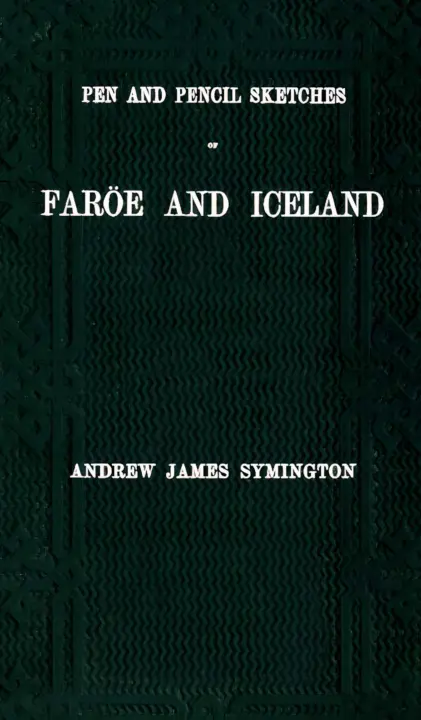
"Pen and Pencil Sketches of Faröe and Iceland" by Andrew James Symington is a travelogue written in the mid-19th century. This work combines personal diary entries with observations made during Symington's journey to the remote islands of Faröe and Iceland, aiming to capture the natural beauty and cultural richness of these northern climes. The book features sketches and insights about Icelandic life, landscapes, and the author's interactions with local inhabitants, all presented in an engaging and picturesque style. The opening portion of the travelogue introduces readers to Symington's preparations for his voyage to Iceland, detailing his contemplation of different travel options and the eventual choice to board the mail steamer "Arcturus." He vividly describes the ship's departure from Leith, the atmosphere on board with fellow passengers, and his feelings of anticipation and wonder as they journey through the North Sea. In addition, Symington begins to share his impressions of the landscapes, local life, and the natural phenomena that characterize both Faröe and Iceland, setting the stage for a rich exploration of these extraordinary places throughout the remainder of his narrative.
Introduction adapted from the source catalogue; source summaries may be automatically generated.
Free to read · English · 85,163 words · No account needed
MAKE TIME FOR A GOOD BOOK
On by default. Untick to stop anonymous reading totals. Each page counts after 10 seconds in view. How this works.
Anonymous counting is on unless you have switched it off.
Few subjects possess greater interest for the British race than the Scandinavian North, with its iron-bound rampart of wave-lashed rocks, its deeply indented fiords, bold cliffs, rocky promontories, abrupt headlands, wild skerries, crags, rock-ledges, and caves, all alive with gulls, puffins and kittiwakes; and in short, the general and striking picturesqueness of its scenery, to say nothing of the higher human interest of its stirring history, and the rich treasures of its grand old literature.
The British race has been called Anglo-Saxon; made up however, as it is, of many elements—Ancient Briton, Roman, Anglo-Saxon, Dane, Norman, and Scandinavian—the latter predominates so largely over the others as to prove by evidence, external and internal, and not to be gainsaid, that the Scandinavians are our true progenitors.
The Germans are a separate branch of the same great Gothic family, industrious, but very unlike us in many respects. The degree of resemblance and affinity may be settled by styling them honest but unenterprising inland friends, whose ancestors and ours were first cousins upwards of a thousand years ago.
To the old Northmen—hailing from the sea-board of Norway, Sweden, and Denmark—may be traced the germs of all that is most characteristic of the modern Briton, whether personal, social, or national. The configuration of the land, and the numerous arms of the sea with which the north-west of Europe is indented, necessitated boats and seamanship. From these coasts, the Northmen—whether bent on piratical plundering expeditions, or peacefully seeking refuge from tyrannical oppression at home—sallied forth in their frail barks or skiffs, which could live in the wildest sea, visiting and settling in many lands. We here mention, in geographical order, Normandy, England, Scotland, Orkney, Shetland, Faröe, and Iceland. Wherever they have been, they have left indelible traces behind them, these ever getting more numerous and distinct as we go northwards.
Anglen, from which the word England is derived, still forms part of Holstein a province in Denmark; and the preponderance of the direct Scandinavian element in the language itself has been shewn by Dean Trench, who states, that of a hundred English words, sixty come from the Scandinavian, thirty from the Latin, five from the Greek, and five from other sources.
In Scotland many more Norse words, which sound quite foreign to an English ear, yet linger amongst the common people; while, as in England, the original Celtic inhabitants were driven to the west before the Northmen, who landed for the most part on the east. In certain districts of the Orkneys a corrupt dialect of Norse was spoken till recently, and the Scandinavian type of features is there often to be met with.
Your reading position is saved on this browser. Take it to another device with a library code. Reading pages adapt to text, rather than matching a printed edition.
BEHIND THE BOOK
This eBook is for the use of anyone anywhere in the United States and most other parts of the world at no cost and with almost no restrictions whatsoever. You may copy it, give it away or re-use it under the terms of the Project Gutenberg License included with this eBook or online at www.gutenberg.org. If you are not located in the United States, you will have to check the laws of the country where you are located before using this eBook. Read the source licence.
The original source file, including credits and licence, is retained by this library. Request an original-format copy at no charge. Please include the book title and Project Gutenberg identifier #71936.
KEEP YOUR CURIOSITY GOING
Wilfrid Scawen Blunt
Wilfrid Scawen Blunt

E. W. (Edgar Watson) Howe

Maurice Baring
Francis Greenleaf Allinson & Anne C. E. (Anne Crosby Emery) Allinson
Cyrenus Cole