THE CLASSIC COLLECTION✦My diaries, being a personal narrative of events 1888-1914, Part 2 (1900-1914)CLASSIC FREE BOOKS
My diaries, being a personal narrative of events 1888-1914, Part 2 (1900-1914)
Wilfrid Scawen Blunt
THE CLASSIC COLLECTION · 1862
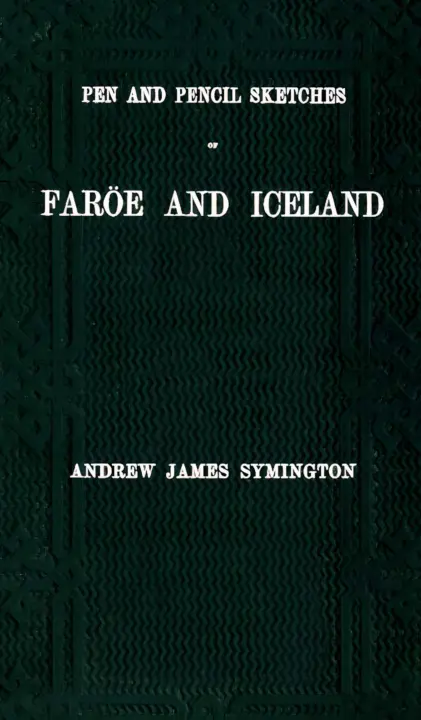
"Pen and Pencil Sketches of Faröe and Iceland" by Andrew James Symington is a travelogue written in the mid-19th century. This work combines personal diary entries with observations made during Symington's journey to the remote islands of Faröe and Iceland, aiming to capture the natural beauty and cultural richness of these northern climes. The book features sketches and insights about Icelandic life, landscapes, and the author's interactions with local inhabitants, all presented in an engaging and picturesque style. The opening portion of the travelogue introduces readers to Symington's preparations for his voyage to Iceland, detailing his contemplation of different travel options and the eventual choice to board the mail steamer "Arcturus." He vividly describes the ship's departure from Leith, the atmosphere on board with fellow passengers, and his feelings of anticipation and wonder as they journey through the North Sea. In addition, Symington begins to share his impressions of the landscapes, local life, and the natural phenomena that characterize both Faröe and Iceland, setting the stage for a rich exploration of these extraordinary places throughout the remainder of his narrative.
Introduction adapted from the source catalogue; source summaries may be automatically generated.
Free to read · English · 85,163 words · No account needed
MAKE TIME FOR A GOOD BOOK
On by default. Untick to stop anonymous reading totals. Each page counts after 10 seconds in view. How this works.
Anonymous counting is on unless you have switched it off.
The Norse language is still understood and frequently spoken in Shetland, where the stalwart, manly forms of the fishermen, the characteristic prevalence of blue eyes and light flaxen hair, the universal observance of the Norse Yule, and many other old-world customs, together with the oriental and almost affecting regard paid to the sacred rites of hospitality, on the part of the islanders, all plainly tell their origin.
The language of the Faröe islanders is a dialect of the Norse, approaching Danish, and peculiar to themselves. It is called Faröese. The peaceful inhabitants not only resemble, but are Northmen.
In Iceland we have pure Norse, as imported from Norway in the ninth century, the lone northern sea having guarded it, and many other interesting features, from those modifications to which the Norwegian, Danish, and Swedish have been subjected by neighbouring Teutonic or German influences. This language, the parent, or at least the oldest and purest form of the various Scandinavian dialects with which we are acquainted, has been at different times named Dönsk-tunga, Norræna, or Norse, but latterly it has been simply called Icelandic, because peculiar to that island.
The language, history, and literature of our ancestors having been thus preserved in the north, we are thereby enabled to revisit the past, read it in the light of the present, and make both subservient for good in the future.
Herodotus mentions that tin was procured from Britain. Strabo informs us that the Phœnicians traded to our island, receiving tin and skins in exchange for earthenware, salt, and vessels of brass; but our first authentic particulars regarding the ancient Britons are derived from Julius Cæsar, whose landing on the southern portion of our island, and hard-won battles, were but transient and doubtful successes. The original inhabitants were Celts from France and Spain; but, as we learn from him, these had long before been driven into the interior and western portion of the island by Belgians, who crossed the sea, made good their footing, settled on the east and south-eastern shores of England, and were now known as Britons. With these Cæsar had to do. The intrepid bravery of the well-trained and regularly disciplined British warriors commanded respect, and left his soldiers but little to boast of. The Roman legions never felt safe unless within their entrenchments, and, even there, were sometimes surprised. Strange to realise such dire conflicts raging at the foot of the Surrey hills, probably in the neighbourhood of Penge, Sydenham, and Norwood, where the Crystal Palace now peacefully stands. Even in these dark Druid days, the Britons, although clothed in skins, wearing long hair, and stained blue with woad, were no mere painted savages as they have sometimes been represented, but were in possession of regularly-constituted forms of government. They had naval, military, agricultural and commercial resources to depend upon, and were acquainted with many of the important arts of life. The Briton was simple in his manners, frugal in his habits, and loved freedom above all things. Had the brave Caswallon headed the men of Kent, in their attack upon the Roman maritime camp, Cæsar and his hosts would never, in all likelihood, have succeeded in reaching their ships, but would have found graves on our shores. His admirable commentaries would not have seen the light of day, and the whole current of Roman, nay, of the world’s history might have been changed.
Your reading position is saved on this browser. Take it to another device with a library code. Reading pages adapt to text, rather than matching a printed edition.
BEHIND THE BOOK
This eBook is for the use of anyone anywhere in the United States and most other parts of the world at no cost and with almost no restrictions whatsoever. You may copy it, give it away or re-use it under the terms of the Project Gutenberg License included with this eBook or online at www.gutenberg.org. If you are not located in the United States, you will have to check the laws of the country where you are located before using this eBook. Read the source licence.
The original source file, including credits and licence, is retained by this library. Request an original-format copy at no charge. Please include the book title and Project Gutenberg identifier #71936.
KEEP YOUR CURIOSITY GOING
Wilfrid Scawen Blunt
Wilfrid Scawen Blunt

E. W. (Edgar Watson) Howe

Maurice Baring
Francis Greenleaf Allinson & Anne C. E. (Anne Crosby Emery) Allinson
Cyrenus Cole