THE CLASSIC COLLECTION✦My diaries, being a personal narrative of events 1888-1914, Part 2 (1900-1914)CLASSIC FREE BOOKS
My diaries, being a personal narrative of events 1888-1914, Part 2 (1900-1914)
Wilfrid Scawen Blunt
THE CLASSIC COLLECTION · 1862
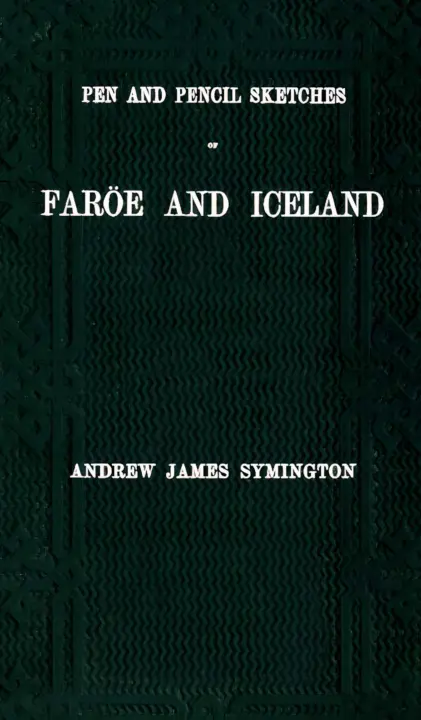
"Pen and Pencil Sketches of Faröe and Iceland" by Andrew James Symington is a travelogue written in the mid-19th century. This work combines personal diary entries with observations made during Symington's journey to the remote islands of Faröe and Iceland, aiming to capture the natural beauty and cultural richness of these northern climes. The book features sketches and insights about Icelandic life, landscapes, and the author's interactions with local inhabitants, all presented in an engaging and picturesque style. The opening portion of the travelogue introduces readers to Symington's preparations for his voyage to Iceland, detailing his contemplation of different travel options and the eventual choice to board the mail steamer "Arcturus." He vividly describes the ship's departure from Leith, the atmosphere on board with fellow passengers, and his feelings of anticipation and wonder as they journey through the North Sea. In addition, Symington begins to share his impressions of the landscapes, local life, and the natural phenomena that characterize both Faröe and Iceland, setting the stage for a rich exploration of these extraordinary places throughout the remainder of his narrative.
Introduction adapted from the source catalogue; source summaries may be automatically generated.
Free to read · English · 85,163 words · No account needed
MAKE TIME FOR A GOOD BOOK
On by default. Untick to stop anonymous reading totals. Each page counts after 10 seconds in view. How this works.
Anonymous counting is on unless you have switched it off.
Footnote 20:
Longest interval.
Footnote 21:
Shortest interval.
Footnote 22:
Most important eruption.
Footnote 23:
‘In estimating the seriousness of such a loss, it is necessary to bear in mind that the hay harvest is, so far as the vegetable kingdom is concerned, the only harvest in Iceland; and that hay is almost the sole provender for horses, sheep, and cattle during three-fourths of the year.’
Footnote 24:
Founding his statements on the manuscript of the Surgeon Sveinn Pálsson, and on Horrebow’s Natural History of Iceland—p. 12: London 1758.
Footnote 25:
From the Greek επι and ζωον—a term applied to diseases among animals; e.g. murrain, in which cattle are preyed upon by parasites.
Footnote 26:
‘The celebrated agitation of the waters of our own Loch Ness occurred contemporaneously with the great earthquake of Lisbon, here also referred to.’
Footnote 27:
Stukesley’s “Philosophy of Earthquakes,” 3d ed., London 1756, 8vo, pp.
9-30.
Footnote 28:
“Journal of a Tour in Iceland in the Summer of 1809,” 2d ed., 2 vols., London 1813, by Sir William Jackson Hooker, K.H., D.C.L., L.L.D., &c., the present distinguished Director of the Royal Botanic Garden at Kew.
Footnote 29:
See Dasent’s admirable translation of “Burnt Njal,” since published.
Footnote 30:
Mr. Brynjúlfsson had the following lines—intimating the hopelessness of searching for the treasure concealed below—repeated to him, when recently visiting the locality. They are thus literally rendered by him into English.
“Thrasa kista audug er “Thrasi’s chest wealthy is Under forsi Skoga Under foss of Skogar; Hver sem thángad fyrsti fer Whosoever thither first goes Fiflsku hefir nóga.” Foolishness has enough.”
Footnote 31:
There was a slight eruption of this mountain on March 23, 1861, which only lasted a few days. The smoke and sulphurous gases which it exhaled tarnished metal at 50 miles distance.
Footnote 32:
See illustration, p. 160.
Footnote 33:
See illustration p. 134, where Skaptár is represented as rising in the distance, over a hill-range on the other side of a level plain, which in the wood-cut resembles and might be mistaken for water.
Footnote 34:
This also happened during the eruption of Hekla in 1693.
Footnote 35:
“Greenland, Iceland, and Faröe,” pp. 38-42: chiefly abridged from Stephenson’s “Account of the Eruption,” published at Copenhagen in 1785, which will be found translated in Hooker’s Journal, vol. ii., 124-261. See also Henderson, vol. i., pp. 272-290; and Gliemann, pp. 107-109.
Footnote 36:
Second ed. published in 1841.
Footnote 37:
Should be Kötlugjá. A.J.S.
Your reading position is saved on this browser. Take it to another device with a library code. Reading pages adapt to text, rather than matching a printed edition.
BEHIND THE BOOK
This eBook is for the use of anyone anywhere in the United States and most other parts of the world at no cost and with almost no restrictions whatsoever. You may copy it, give it away or re-use it under the terms of the Project Gutenberg License included with this eBook or online at www.gutenberg.org. If you are not located in the United States, you will have to check the laws of the country where you are located before using this eBook. Read the source licence.
The original source file, including credits and licence, is retained by this library. Request an original-format copy at no charge. Please include the book title and Project Gutenberg identifier #71936.
KEEP YOUR CURIOSITY GOING
Wilfrid Scawen Blunt
Wilfrid Scawen Blunt

E. W. (Edgar Watson) Howe

Maurice Baring
Francis Greenleaf Allinson & Anne C. E. (Anne Crosby Emery) Allinson
Cyrenus Cole