THE CLASSIC COLLECTION✦My diaries, being a personal narrative of events 1888-1914, Part 2 (1900-1914)CLASSIC FREE BOOKS
My diaries, being a personal narrative of events 1888-1914, Part 2 (1900-1914)
Wilfrid Scawen Blunt
THE CLASSIC COLLECTION · 1862
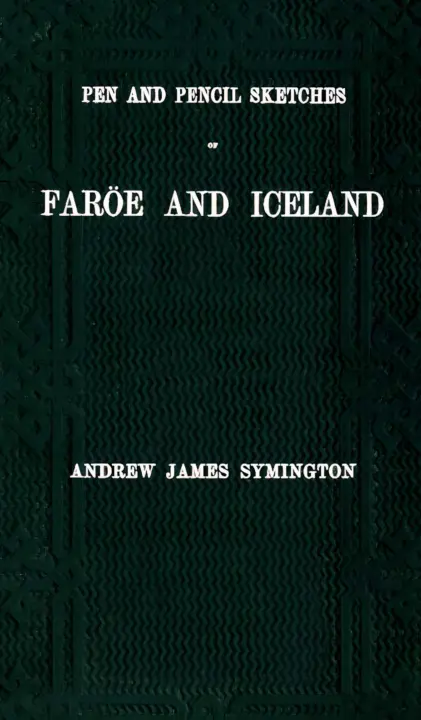
"Pen and Pencil Sketches of Faröe and Iceland" by Andrew James Symington is a travelogue written in the mid-19th century. This work combines personal diary entries with observations made during Symington's journey to the remote islands of Faröe and Iceland, aiming to capture the natural beauty and cultural richness of these northern climes. The book features sketches and insights about Icelandic life, landscapes, and the author's interactions with local inhabitants, all presented in an engaging and picturesque style. The opening portion of the travelogue introduces readers to Symington's preparations for his voyage to Iceland, detailing his contemplation of different travel options and the eventual choice to board the mail steamer "Arcturus." He vividly describes the ship's departure from Leith, the atmosphere on board with fellow passengers, and his feelings of anticipation and wonder as they journey through the North Sea. In addition, Symington begins to share his impressions of the landscapes, local life, and the natural phenomena that characterize both Faröe and Iceland, setting the stage for a rich exploration of these extraordinary places throughout the remainder of his narrative.
Introduction adapted from the source catalogue; source summaries may be automatically generated.
Free to read · English · 85,163 words · No account needed
MAKE TIME FOR A GOOD BOOK
On by default. Untick to stop anonymous reading totals. Each page counts after 10 seconds in view. How this works.
Anonymous counting is on unless you have switched it off.
Eyafialla Jökul continued in eruption from A.D. 1821 till 1822. In July 1823 it again began to burn. In the same month Kötlugjá, covered nearly 100 miles of ground with sand and ashes. “In July 1825, both sides of the island were visited by earthquakes, accompanied by destructive hurricanes and floods; whilst on the 13th of February 1827, there was an eruption of the Skeidará Jökul.”
The subjoined list of Icelandic volcanoes, with the dates of their eruptions, is transcribed from the same source, and presented to the reader, not by any means as complete, but as the best to which I at present have access. It will aid him in realizing the fearful results of these terrific energies so frequently at work.
“Hekla, 1004, 1029, 1105, 1113, 1157, 1206, 1222, 1294, 1300, 1340, 1374, 1390, 1436, 1510, 1554, 1583, 1619, 1625, 1636, 1693, 1728, 1754, 1766.
Guldbringu Syssel, 1000.
Eyafialla Jökul, 1821.
Solheima Jökul, about 900, 1245, 1262, 1717.
Kötlugjá or Myrdals-Jökul, 894, 1311, 1416, 1580, 1625, 1661,
1721, 1727, 1755, 1823.
Skaptár-Jökul, 1783.
Sida-Jökul, in tenth century, and in 1753.
Skeidarár-Jökul, 1725, 1727, 1827.
Oræfa-Jökul, 1362, 1720, 1727, 1755.
Hnappafell’s-Jökul, 1332, 1772.
Heinaberg’s-Jökul, 1362.
Trolladynger, 1151, 1188, 1340, 1359, 1475, 1510.
Herdubreid, 1340, 1510, 1717.
Krabla, and Leirhnukr, 1725-1730.
Grimsvatn, 1716.
Eldborg, end of ninth or beginning of tenth century.
Submarine eruption, Breida fiord, 1345.
Submarine Reykjanes, 1211, 1226, 1238, 1240, 12—, 1340, 1422,
1583, 1783, 1831.”
Here are records of nineteen vents and seventy-seven eruptions. “These have occurred in about ten centuries, or, on an average, one in thirteen years. The most violent paroxysms seem to have occurred in 1340, 1362, 1725-1730, and 1754-1755. To complete this view of internal activity, we may add, that the following years were distinguished by violent earthquakes; 1181, 1182, 1211, 1260, 1261, 1294, 1300, 1311, 1313, 1339, 1370, 1390, 1391, 1552, 1554, 1578, 1597, 1614, 1633, 1657, 1661, 1706, 1755, 1784, 1789, 1808, 1815, 1825.”
Footnote 18:
“Iceland, Greenland, and the Faröe Islands,” p. 37.
Footnote 19:
Since our visit, there has been another eruption of Kötlugjá in 1860, the particulars of which have been collected by Lauder Lindsay, Esq. M.D., F.L.S. &c., and published in the Edinburgh “Philosophical Journal” for January. From his interesting and admirable scientific paper, which treats the subject largely, we learn that this eruption, like that of 1823, was “mild and innocuous.” It began on the 8th, and continued to the 28th or 29th of May, and was preceded for several days by earthquakes. On the morning of the eighth a dark cloud was seen to rise from the mountain, which at the same moment sent forth an enormous flood of water, with very large pieces of ice, running with the water-stream into the sea. Some of the pieces of ice were so large that they were stranded at a twenty fathom depth in the sea. On the 12th of May the flames could be seen from Reykjavik, although this town is no less than about eighty English miles distant. During the evenings flashes of lightning were seen in the same direction. On the 16th May, the smoke was about twenty-four thousand (?) feet high; it was sometimes of a dark colour, but at other times it resembled steam. At this time the fire was seen from several places at a distance of about 80 English miles. The wind being northerly during the eruption, the sand and ashes fell chiefly in Myrdals-sand, which was the direction also taken by the water-floods. Sulphur was found floating in the sea, and the fish disappeared from certain parts of the neighbouring coasts. A large quantity of cinders was mixed with the water-floods. Cinders and balls of fire, as well as smoke, were thrown up; but the cinders and ashes, from being carried by the wind partly into the sea and partly to the neighbouring snow-fields, did comparatively little damage to the lowland farms; although the well-known devastations of former eruptions, especially those of 1665 and 1755, gave rise to extreme alarm and the most serious apprehensions among the poor inhabitants.
Your reading position is saved on this browser. Take it to another device with a library code. Reading pages adapt to text, rather than matching a printed edition.
BEHIND THE BOOK
This eBook is for the use of anyone anywhere in the United States and most other parts of the world at no cost and with almost no restrictions whatsoever. You may copy it, give it away or re-use it under the terms of the Project Gutenberg License included with this eBook or online at www.gutenberg.org. If you are not located in the United States, you will have to check the laws of the country where you are located before using this eBook. Read the source licence.
The original source file, including credits and licence, is retained by this library. Request an original-format copy at no charge. Please include the book title and Project Gutenberg identifier #71936.
KEEP YOUR CURIOSITY GOING
Wilfrid Scawen Blunt
Wilfrid Scawen Blunt

E. W. (Edgar Watson) Howe

Maurice Baring
Francis Greenleaf Allinson & Anne C. E. (Anne Crosby Emery) Allinson
Cyrenus Cole