THE CLASSIC COLLECTION✦A Christmas Carol The original manuscriptCLASSIC FREE BOOKS
A Christmas Carol The original manuscript
Charles Dickens
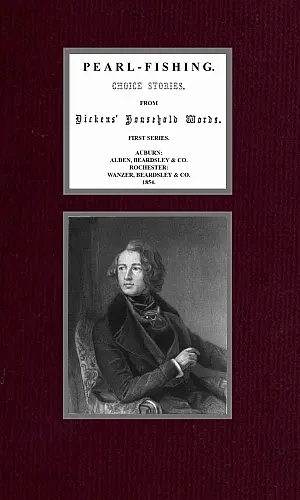
THE CLASSIC COLLECTION · 1854
"Pearl-Fishing; Choice Stories from Dickens' Household Words; First Series" is a collection of short stories compiled from the publication "Dickens’ Household Words," likely written in the mid-19th century. The stories reflect themes of human experience and emotion, with an emphasis on social commentary and moral lessons, typical of Charles Dickens’ work. The opening piece sets the tone, focusing on complex characters and their intertwined fates, particularly exploring the notions of love, deception, and societal expectations. The beginning of the collection introduces a narrative titled "Loaded Dice," where two friends, Mrs. Markham and her companion, embark on a journey to visit a place from their past. They discover the tragic backstory of Mr. Lovell, a clergyman who once enjoyed a simple life filled with contentment and love but is now engulfed in despair and loss. As the story unfolds, it reveals the detrimental impact of gambling on the family, leading to a tragic end for young Charles Lovell and deepening the overarching themes of sacrifice and the consequences of one's choices. The story establishes a glimpse into the emotional depths and social struggles that will be explored throughout the collection.
Introduction adapted from the source catalogue; source summaries may be automatically generated.
Free to read · English · 60,738 words · No account needed
MAKE TIME FOR A GOOD BOOK
On by default. Untick to stop anonymous reading totals. Each page counts after 10 seconds in view. How this works.
Anonymous counting is on unless you have switched it off.
The old man covered his face with his hands, and rocked himself to and
fro.
“Where is he now?” at length he asked, in a hoarse voice.
“Locked up safe in the inner store-room; the master intends sending him to gaol early to-morrow morning.”
“He will not,” said Gahan slowly, “kill the boy that saved his
life!--no, no.”
“Poor fellow! the grief is setting his mind astray--and sure no wonder!” said the cook, compassionately.
“I’m not astray!” cried the old man, fiercely.
“Where’s the master?--take me to him.”
“Come with me,” said the butler, “and I’ll ask him will he see you?”
With faltering steps the father complied; and when they reached the parlor, he trembled exceedingly, and leant against the wall for support, while the butler opened the door, and said:
“Gahan is here, Sir, and wants to know will you let him speak to you for
a minute?”
“Tell him to come in,” said Mr. Hewson, in a solemn tone of sorrow, very different from his ordinary cheerful voice.
“Sir,” said the steward, advancing, “they tell me you are going to send my boy to prison,--is it true?”
“Too true, indeed, Gahan. The lad who was reared in my house, whom my wife watched over in health, and nursed in sickness--whom we loved almost as if he were our own, has robbed us, and that not once or twice, but many times. He is silent, and sullen, too, and refuses to tell why he stole the money, which was never withheld from him when he wanted it. I can make nothing of him, and must only give him up to justice in the morning.”
“No, Sir, no. The boy saved your life; you can’t take his.”
“You’re raving, Gahan.”
“Listen to me, Sir, and you won’t say so. You remember this night twenty years? I came here with my motherless child, and yourself and the mistress pitied us, and spoke loving words to him. Well for us all you did so! That night--little you thought it!--I was banded with them that were sworn to take your life. They were watching you outside the window, and I was sent to inveigle you out, that they might shoot you. A faint heart I had for the bloody business, for you were ever and always a good master to me; but I was under an oath to them that I darn’t break, supposing they ordered me to shoot my own mother. Well! the hand of God was over you, and you wouldn’t come with me. I ran out to them, and I said--“Boys, if you want to shoot him, you must do it through the window,” thinking they’d be afeard of that; but they weren’t--they were daring fellows, and one of them, sheltered by the angle of the window, took deadly aim at you. That very moment you took Billy on your knee, and I saw his fair head on a line with the musket. I don’t know exactly then what I said or did, but I remember I caught the man’s hand, threw it up, and pointed to the child. Knowing I was a determined man, I believe they didn’t wish to provoke me; so they watched you for awhile, and when you didn’t put him down they got daunted, hearing the sound of soldiers riding by the road, and they stole away through the grove. Most of that gang swung on the gallows, but the last of them died this morning quietly in his bed. Up to yesterday he used to make me give him money,--sums of money to buy his silence--and it was for that I made my boy a thief. It was wearing out his very life. Often he went down on his knees to me, and said: ‘Father, I’d die myself sooner than rob my master, but I can’t see you disgraced. Oh, let us fly the country!’ Now, Sir, I have told you all--do what you like with me--send me to gaol, I deserve it--but spare my poor, deluded, innocent boy!”
Your reading position is saved on this browser. Take it to another device with a library code. Reading pages adapt to text, rather than matching a printed edition.
Charles Dickens
Samuel McChord Crothers & Charles Dickens

Rebecca Harding Davis & Thomas De Quincey & Charles Dickens & Nathaniel Hawthorne & Edward Bulwer Lytton, Baron Lytton & Edgar Allan Poe & Harriet Elizabeth Prescott Spofford

Charles Dickens
BEHIND THE BOOK
This eBook is for the use of anyone anywhere in the United States and most other parts of the world at no cost and with almost no restrictions whatsoever. You may copy it, give it away or re-use it under the terms of the Project Gutenberg License included with this eBook or online at www.gutenberg.org. If you are not located in the United States, you will have to check the laws of the country where you are located before using this eBook. Read the source licence.
The original source file, including credits and licence, is retained by this library. Request an original-format copy at no charge. Please include the book title and Project Gutenberg identifier #49927.
KEEP YOUR CURIOSITY GOING
Coulson Kernahan

Maurice Baring
Frances Wright
Cécile Tormay

Frederic Jesup Stimson

W. H. P. (William Henry Pope) Jarvis