THE CLASSIC COLLECTION✦A Christmas Carol The original manuscriptCLASSIC FREE BOOKS
A Christmas Carol The original manuscript
Charles Dickens
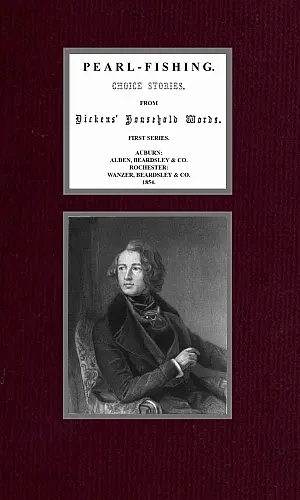
THE CLASSIC COLLECTION · 1854
"Pearl-Fishing; Choice Stories from Dickens' Household Words; First Series" is a collection of short stories compiled from the publication "Dickens’ Household Words," likely written in the mid-19th century. The stories reflect themes of human experience and emotion, with an emphasis on social commentary and moral lessons, typical of Charles Dickens’ work. The opening piece sets the tone, focusing on complex characters and their intertwined fates, particularly exploring the notions of love, deception, and societal expectations. The beginning of the collection introduces a narrative titled "Loaded Dice," where two friends, Mrs. Markham and her companion, embark on a journey to visit a place from their past. They discover the tragic backstory of Mr. Lovell, a clergyman who once enjoyed a simple life filled with contentment and love but is now engulfed in despair and loss. As the story unfolds, it reveals the detrimental impact of gambling on the family, leading to a tragic end for young Charles Lovell and deepening the overarching themes of sacrifice and the consequences of one's choices. The story establishes a glimpse into the emotional depths and social struggles that will be explored throughout the collection.
Introduction adapted from the source catalogue; source summaries may be automatically generated.
Free to read · English · 60,738 words · No account needed
MAKE TIME FOR A GOOD BOOK
On by default. Untick to stop anonymous reading totals. Each page counts after 10 seconds in view. How this works.
Anonymous counting is on unless you have switched it off.
Several years ago, I made a tour through some of the Southern Counties of England with a friend. We travelled in an open carriage, stopping for a few hours a day, or a week, as it might be, wherever there was anything to be seen; and we generally got through one stage before breakfast, because it gave our horses rest, and ourselves the chance of enjoying the brown bread, new milk, and fresh eggs of those country road-side inns, which are fast becoming subjects for archæological investigation.
One evening my friend said, “To-morrow we will breakfast at T----. I want to inquire about a family named Lovell, who used to live there. I met the husband and wife, and two lovely children, one summer at Exmouth. We became very intimate, and I thought them particularly interesting people, but I have never seen them since.”
The next morning’s sun shone as brightly as heart could desire, and after a delightful drive, we reached the outskirts of the town about nine o’clock.
“Oh, what a pretty inn!” said I, as we approached a small white house, with a sign swinging in front of it, and a flower-garden on one side.
“Stop, John,” cried my friend, “we shall get a much cleaner breakfast here than in the town, I dare say; and if there is anything to be seen there, we can walk to it;” so we alighted, and were shown into a neat little parlor, with white curtains, where an unexceptionable rural breakfast was soon placed before us.
“Pray do you happen to know anything of a family called Lovell?” inquired my friend, whose name, by the way, was Markham. “Mr. Lovell was a clergyman.”
“Yes, Ma’am,” answered the girl who attended us, apparently the landlord’s daughter, “Mr. Lovell is the vicar of our parish.”
“Indeed! and does he live near here?”
“Yes, Ma’am, he lives at the vicarage. It’s just down that lane opposite, about a quarter of a mile from here; or you can go across the fields, if you please, to where you see that tower; it’s close by there.”
“And which is the pleasantest road?” inquired Mrs. Markham.
“Well, Ma’am, I think by the fields is the pleasantest, if you don’t mind a stile or two; and, besides, you get the best view of the Abbey by going that way.”
“Is that tower we see part of the Abbey?”
“Yes, Ma’am,” answered the girl, “and the vicarage is just the other
side of it.”
Your reading position is saved on this browser. Take it to another device with a library code. Reading pages adapt to text, rather than matching a printed edition.
Charles Dickens
Samuel McChord Crothers & Charles Dickens

Rebecca Harding Davis & Thomas De Quincey & Charles Dickens & Nathaniel Hawthorne & Edward Bulwer Lytton, Baron Lytton & Edgar Allan Poe & Harriet Elizabeth Prescott Spofford

Charles Dickens
BEHIND THE BOOK
This eBook is for the use of anyone anywhere in the United States and most other parts of the world at no cost and with almost no restrictions whatsoever. You may copy it, give it away or re-use it under the terms of the Project Gutenberg License included with this eBook or online at www.gutenberg.org. If you are not located in the United States, you will have to check the laws of the country where you are located before using this eBook. Read the source licence.
The original source file, including credits and licence, is retained by this library. Request an original-format copy at no charge. Please include the book title and Project Gutenberg identifier #49927.
KEEP YOUR CURIOSITY GOING
Coulson Kernahan

Maurice Baring
Frances Wright
Cécile Tormay

Frederic Jesup Stimson

W. H. P. (William Henry Pope) Jarvis