THE CLASSIC COLLECTION✦A Christmas Carol The original manuscriptCLASSIC FREE BOOKS
A Christmas Carol The original manuscript
Charles Dickens
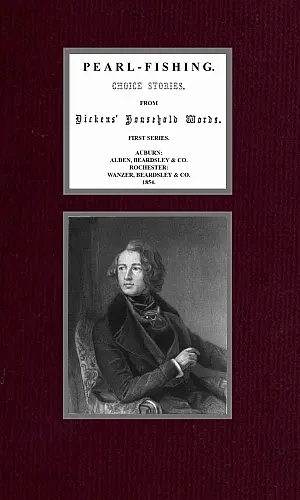
THE CLASSIC COLLECTION · 1854
"Pearl-Fishing; Choice Stories from Dickens' Household Words; First Series" is a collection of short stories compiled from the publication "Dickens’ Household Words," likely written in the mid-19th century. The stories reflect themes of human experience and emotion, with an emphasis on social commentary and moral lessons, typical of Charles Dickens’ work. The opening piece sets the tone, focusing on complex characters and their intertwined fates, particularly exploring the notions of love, deception, and societal expectations. The beginning of the collection introduces a narrative titled "Loaded Dice," where two friends, Mrs. Markham and her companion, embark on a journey to visit a place from their past. They discover the tragic backstory of Mr. Lovell, a clergyman who once enjoyed a simple life filled with contentment and love but is now engulfed in despair and loss. As the story unfolds, it reveals the detrimental impact of gambling on the family, leading to a tragic end for young Charles Lovell and deepening the overarching themes of sacrifice and the consequences of one's choices. The story establishes a glimpse into the emotional depths and social struggles that will be explored throughout the collection.
Introduction adapted from the source catalogue; source summaries may be automatically generated.
Free to read · English · 60,738 words · No account needed
MAKE TIME FOR A GOOD BOOK
On by default. Untick to stop anonymous reading totals. Each page counts after 10 seconds in view. How this works.
Anonymous counting is on unless you have switched it off.
Thus, though for a time Mr. and Mrs. Hewson regarded Gahan with some doubt, the feeling gradually wore away, and the steward regained his former influence.
After the lapse of a few stormy months the rebellion was quelled: all the prisoners taken up were severally disposed of by hanging, transportation or acquittal, according to the nature and amount of the evidence brought against them; and the country became as peaceful as it is in the volcanic nature of our Irish soil ever to be.
The Hewsons’ kindness towards Gahan’s child was steady and unchanged. They took him into their house, and gave him a plain but solid education; so that William, while yet a boy, was enabled to be of some use to his patron, and daily enjoyed more and more of his confidence.
Another Evening, the twentieth anniversary of that with which this narrative commenced, came round. Mr. and Mrs. Hewson were still hale and active, dwelling in their hospitable home. About eight o’clock at night, Tim Gahan, now a stooping, gray-haired man, entered Mr. Hewson’s kitchen, and took his seat on the corner of the settle, near the fire.
The cook directing a silent significant glance of compassion towards her
fellow-servants, said:
“Would you like a drink of cider, Tim, or will you wait and take a cup of tay with myself and Kitty?”
The old man’s eyes were fixed on the fire, and a wrinkled hand was planted firmly on each knee, as if to check their involuntary trembling. “I’ll not drink anything this night, thank you kindly, Nelly,” he said, in a slow musing manner, dwelling long on each word.
“Where’s Billy?” he asked, after a pause, in a quick hurried tone, looking up suddenly at the cook, with an expression in his eyes, which, as she afterwards said, “took away her breath.”
“Oh, never heed Billy! I suppose he’s busy with the master.”
“Where’s the use, Nelly,” said the coachman, “in hiding it from him? Sure, sooner or later he must know it. Tim,” he continued, “God knows ’tis sorrow to my heart this blessed night to make yours sore,--but the truth is, that William has done what he oughtn’t to do to the man that was all one as a father to him.”
“What has he done? what will you dar say again my boy?”
“Taken money, then,” replied the coachman, “that the master had marked and put by in his desk; for he suspected this some time past that gold was missing. This morning ’twas gone; a search was made, and the marked guineas were found with your son William.”
Your reading position is saved on this browser. Take it to another device with a library code. Reading pages adapt to text, rather than matching a printed edition.
Charles Dickens
Samuel McChord Crothers & Charles Dickens

Rebecca Harding Davis & Thomas De Quincey & Charles Dickens & Nathaniel Hawthorne & Edward Bulwer Lytton, Baron Lytton & Edgar Allan Poe & Harriet Elizabeth Prescott Spofford

Charles Dickens
BEHIND THE BOOK
This eBook is for the use of anyone anywhere in the United States and most other parts of the world at no cost and with almost no restrictions whatsoever. You may copy it, give it away or re-use it under the terms of the Project Gutenberg License included with this eBook or online at www.gutenberg.org. If you are not located in the United States, you will have to check the laws of the country where you are located before using this eBook. Read the source licence.
The original source file, including credits and licence, is retained by this library. Request an original-format copy at no charge. Please include the book title and Project Gutenberg identifier #49927.
KEEP YOUR CURIOSITY GOING
Coulson Kernahan

Maurice Baring
Frances Wright
Cécile Tormay

Frederic Jesup Stimson

W. H. P. (William Henry Pope) Jarvis