THE CLASSIC COLLECTION✦The PanGerman Plot Unmasked: Berlin’s formidable peace-trap of “the drawn war”CLASSIC FREE BOOKS
The PanGerman Plot Unmasked: Berlin’s formidable peace-trap of “the drawn war”
André Chéradame
THE CLASSIC COLLECTION · 1917
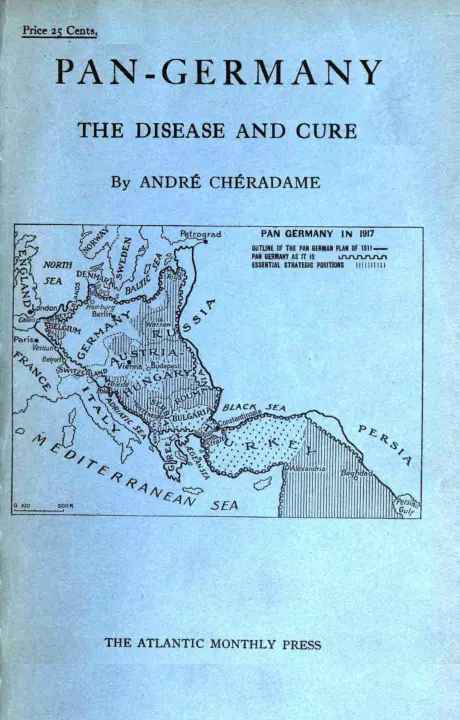
"Pan-Germany: The Disease and Cure" by André Chéradame is a political treatise written in the early 20th century. The book critically analyzes Germany's ambitious plans during World War I to dominate Europe, portraying these intentions as a grave threat to global peace and liberty. Through a detailed examination of Germany's strategies, the work reveals how the country has maneuvered politically and militarily to extend its influence over neighboring regions. The opening of the book sets the stage by outlining the author’s purpose: to alert the people of New Hampshire, and by extension the wider public, about the peril posed by Germany’s expansionist ambitions. Chéradame recounts his past predictions regarding Germany's tactics in the war, emphasizing how deceptive slogans like “peace without annexations or indemnities” have gained traction among Allied constituents, leading to misguided perceptions of the conflict. He argues that these ideas, which mask the underlying realities of German aggression and conquest, pose significant dangers not only to the Allies but to the fundamental freedoms of nations worldwide. The author’s rigorous critique establishes a foundational understanding of why vigilance against such ideologies is essential for the maintenance of international order.
Introduction adapted from the source catalogue; source summaries may be automatically generated.
Free to read · English · 28,781 words · No account needed
MAKE TIME FOR A GOOD BOOK
On by default. Untick to stop anonymous reading totals. Each page counts after 10 seconds in view. How this works.
Anonymous counting is on unless you have switched it off.
I believe that I have demonstrated, in earlier chapters of this book that, because of the advantages, economic and military, which the existence of Central Pan-Germany guarantees to Germany for both present and future, the essential, vital problem that the Allies have to solve—a problem which sums up all the others—is, how to destroy this Central Pan-Germany.
It is infinitely easier to destroy than is generally supposed among the Allies, because it contains potent sources of dissolution. The Allied leaders seem not to have bestowed upon this situation the extremely careful attention which it deserves. In any event, down to the present time they have not sought to take advantage of a state of affairs which is eminently favorable to them.
To understand this situation, and how it may be utilized at once, we must set out from the following starting-point. Of about 176,000,000 inhabitants of Pan-Germany in 1917, about 73,000,000 Germans, with the backing of only 21,000,000 vassals—Magyars, Bulgars, Turks,—have to-day reduced to slavery the immense number of 82,000,000 allied subjects—Slavs, Latins, or Semites, belonging to thirteen different nationalities, all of whom desire the victory of the Entente, since that alone will assure their liberation. In addition, a considerable portion of Germany’s vassals would, under certain conditions, gladly throw off the yoke of Berlin.
Among the 176,000,000 people of Pan-Germany we distinguish the
following three groups.
Group 1. Slaves of the Germans or of their vassals capable of immediate action favorable to the Entente—say, 63,000,000, made up as follows:—
(a) In Turkey,—
Arabs 8,000,000
Generally speaking the Arabs detest the Turks. A portion of them have risen in revolt in Arabia, under the leadership of the King of Hedjaz.
(b) In Central Europe,—
Polish-Lithuanians 22,000,000
Ruthenians 5,500,000
Czechs 8,500,000
Jugo-Slavs 11,000,000
Roumanians 8,000,000
——————————
55,000,000
There are, then, in Central Europe alone, 55,000,000 people determinedly hostile to Germanism, forming an enormous, favorably grouped mass, occupying a vast territory, commanding a part of the German lines of communication, and comparatively far from the fronts where the bulk of the German military forces is.
Your reading position is saved on this browser. Take it to another device with a library code. Reading pages adapt to text, rather than matching a printed edition.
BEHIND THE BOOK
This eBook is for the use of anyone anywhere in the United States and most other parts of the world at no cost and with almost no restrictions whatsoever. You may copy it, give it away or re-use it under the terms of the Project Gutenberg License included with this eBook or online at www.gutenberg.org. If you are not located in the United States, you will have to check the laws of the country where you are located before using this eBook. Read the source licence.
The original source file, including credits and licence, is retained by this library. Request an original-format copy at no charge. Please include the book title and Project Gutenberg identifier #70909.
KEEP YOUR CURIOSITY GOING
Cécile Tormay

Moritz Busch
John L. Ransom
Frances Wright
Cécile Tormay

Mabel Potter Daggett