THE CLASSIC COLLECTION✦The PanGerman Plot Unmasked: Berlin’s formidable peace-trap of “the drawn war”CLASSIC FREE BOOKS
The PanGerman Plot Unmasked: Berlin’s formidable peace-trap of “the drawn war”
André Chéradame
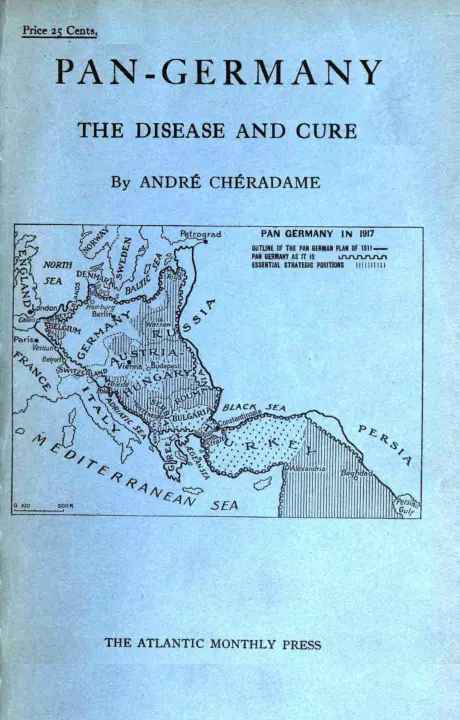
THE CLASSIC COLLECTION · 1917
"Pan-Germany: The Disease and Cure" by André Chéradame is a political treatise written in the early 20th century. The book critically analyzes Germany's ambitious plans during World War I to dominate Europe, portraying these intentions as a grave threat to global peace and liberty. Through a detailed examination of Germany's strategies, the work reveals how the country has maneuvered politically and militarily to extend its influence over neighboring regions. The opening of the book sets the stage by outlining the author’s purpose: to alert the people of New Hampshire, and by extension the wider public, about the peril posed by Germany’s expansionist ambitions. Chéradame recounts his past predictions regarding Germany's tactics in the war, emphasizing how deceptive slogans like “peace without annexations or indemnities” have gained traction among Allied constituents, leading to misguided perceptions of the conflict. He argues that these ideas, which mask the underlying realities of German aggression and conquest, pose significant dangers not only to the Allies but to the fundamental freedoms of nations worldwide. The author’s rigorous critique establishes a foundational understanding of why vigilance against such ideologies is essential for the maintenance of international order.
Introduction adapted from the source catalogue; source summaries may be automatically generated.
Free to read · English · 28,781 words · No account needed
MAKE TIME FOR A GOOD BOOK
On by default. Untick to stop anonymous reading totals. Each page counts after 10 seconds in view. How this works.
Anonymous counting is on unless you have switched it off.
Germany is getting direct war-profits from the enemy territories occupied by her. These territories, listed in the ascending order of their richness, are: Montenegro, 14,000 square kilometres; Albania, 20,000; Serbia, 87,000; Roumania, 70,000 (Bulgaria and Austria-Hungary share the pillage of these four territories); dependent territories of Russia, 260,000; Belgium, 29,000; and France, 20,000; making a grand total of 500,000 square kilometres.
In order to realize as clearly as possible the importance of the booty wrung by Germany from this enormous area, we may establish by means of examples or statistics that this plunder comes from nine principal sources:—
Seizure of Human Material.—Throughout these 500,000 square kilometres of occupied territory, the Germans have scientifically enslaved 42,000,000 human beings, who furnish a vast amount of labor—this labor being all the cheaper because, as we shall see, the slaves are robbed in various ways.
Seizure of War-Material.—By reason of their lightning advances in Belgium, France, Serbia, and Roumania the Germans have taken possession of vast stores of war-material: cannon, rifles, munitions, wagons, locomotives, cars, as well as thousands of kilometres of railway, of which they make full use, representing a certain value of billions of francs. (The Belgian railway system alone is worth three billions.)
Seizure of Food-stuffs.—The official report of April 12, 1917, on the acts committed by the Germans in France contrary to international law, states: ‘The inhabitants, subjected as they were to annoyances of every sort, watched daily the theft of such food-stuffs as they happened to possess.’ Everywhere the Germans steal horses, cattle, domestic animals, grain, potatoes, food-products of all kinds, sugar, alcohol, all of which constitute the reserve supply of the occupied countries. Their harvests, too, are appropriated through the cultivation of productive lands by means of labor obtained almost without cost from the enslaved peoples.
Theft of Raw Materials.—Throughout the length and breadth of the occupied territories, the Germans, at the dictates of expediency, have seized raw materials: coal and iron ore, copper, petroleum, and so forth. Metals—bronze, zinc, lead, copper, tin—have been taken from private citizens, as well as textile fabrics—wool, cotton cloth, and the like. When one learns that from the cities of the North of France alone the Germans stole 550 million francs’ worth of wool, it is easy to see that this single source of plunder has been worth a number of billions to them.
Your reading position is saved on this browser. Take it to another device with a library code. Reading pages adapt to text, rather than matching a printed edition.
BEHIND THE BOOK
This eBook is for the use of anyone anywhere in the United States and most other parts of the world at no cost and with almost no restrictions whatsoever. You may copy it, give it away or re-use it under the terms of the Project Gutenberg License included with this eBook or online at www.gutenberg.org. If you are not located in the United States, you will have to check the laws of the country where you are located before using this eBook. Read the source licence.
The original source file, including credits and licence, is retained by this library. Request an original-format copy at no charge. Please include the book title and Project Gutenberg identifier #70909.
KEEP YOUR CURIOSITY GOING
Cécile Tormay

Moritz Busch
John L. Ransom
Frances Wright
Cécile Tormay

Mabel Potter Daggett