THE CLASSIC COLLECTION✦The PanGerman Plot Unmasked: Berlin’s formidable peace-trap of “the drawn war”CLASSIC FREE BOOKS
The PanGerman Plot Unmasked: Berlin’s formidable peace-trap of “the drawn war”
André Chéradame
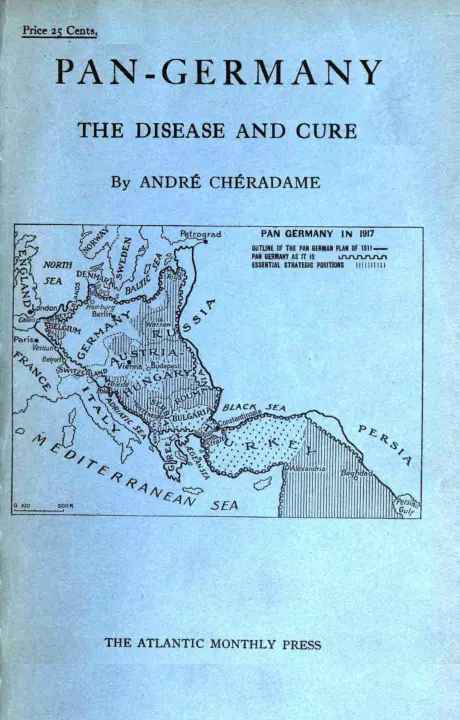
THE CLASSIC COLLECTION · 1917
"Pan-Germany: The Disease and Cure" by André Chéradame is a political treatise written in the early 20th century. The book critically analyzes Germany's ambitious plans during World War I to dominate Europe, portraying these intentions as a grave threat to global peace and liberty. Through a detailed examination of Germany's strategies, the work reveals how the country has maneuvered politically and militarily to extend its influence over neighboring regions. The opening of the book sets the stage by outlining the author’s purpose: to alert the people of New Hampshire, and by extension the wider public, about the peril posed by Germany’s expansionist ambitions. Chéradame recounts his past predictions regarding Germany's tactics in the war, emphasizing how deceptive slogans like “peace without annexations or indemnities” have gained traction among Allied constituents, leading to misguided perceptions of the conflict. He argues that these ideas, which mask the underlying realities of German aggression and conquest, pose significant dangers not only to the Allies but to the fundamental freedoms of nations worldwide. The author’s rigorous critique establishes a foundational understanding of why vigilance against such ideologies is essential for the maintenance of international order.
Introduction adapted from the source catalogue; source summaries may be automatically generated.
Free to read · English · 28,781 words · No account needed
MAKE TIME FOR A GOOD BOOK
On by default. Untick to stop anonymous reading totals. Each page counts after 10 seconds in view. How this works.
Anonymous counting is on unless you have switched it off.
Since the beginning of hostilities there has been a formidable extension of Prussian militarism. At first, it held in its grasp only the sixty-eight million people of the German Empire. By April, 1915, it had extended and organized its influence among the thirty millions of Austro-Hungarians, who until that time had taken orders from their own independent military chiefs. After October-November, 1915,—the date of Serbia’s downfall,—the Prussian system reached out to Bulgaria and Turkey. By taking account of these extensions and adding together the populations of the territories occupied by Germany, together with those of her infatuated allies, one finds that to-day Prussian militarism no longer controls sixty-eight million souls, as at the beginning of the war, but about one hundred and seventy-six million European and Ottoman subjects.
This is the brutal, overwhelming fact which Americans must face if they wish to learn the sole solution of the war which will assure to them, as well as to the rest of the world, a durable peace.
The following figures will show how the three groups of the population of Pan-Germany were divided at the beginning of 1917:—
1. THE MASTERS
Germans 73,000,000
2. THE VASSALS
Magyars 10,000,000 }
Bulgars 5,000,000 } 21,000,000
Turks 6,000,000 }
3. THE SLAVES
French (about) 3,000,000 }
Belgians 7,500,000 }
Alsatians, Lorrainers 1,500,000 }
Danes 200,000 }
Poles, Lithuanians 22,000,000 }
Ruthenians 5,500,000 }
Czechs 8,500,000 } 82,000,000
Jugo-Slavs 11,000,000 }
Roumanians 8,000,000 }
Italians 800,000 }
Armenians 2,000,000 }
Levantines 2,000,000 }
Ottoman Greeks 2,000,000 }
Arabs 8,000,000 }
———————————
Total 176,000,000
To sum up, seventy-three million Germans rule over twenty-one million vassals and eighty-two million slaves,—Latin, Slavic, Semitic, belonging to thirteen different nationalities,—who are bearing the most cruel and unjustifiable yoke that the world has ever known.
It is undeniable, moreover, that each extension of Prussian militarism over a new territory has enabled Germany to prolong the struggle by obtaining new supplies of food, new reinforcements to press into her service and territory to exploit, new civil populations, whose labor is made use of even in works of a military nature. As a result, the technical problem now confronting the Allies in Europe is, through the mistakes of their former leaders, infinitely more complicated than at the outbreak of hostilities.
To-day Berlin, by means of Prussian terrorism methodically and pitilessly employed, disposes of the military and economic resources of one hundred and seventy-six million people, occupying a strategic position in the centre of Europe which is all to her profit. It is this very state of things, founded on the slavery of eighty-two millions of human beings, which is intolerable.
Your reading position is saved on this browser. Take it to another device with a library code. Reading pages adapt to text, rather than matching a printed edition.
BEHIND THE BOOK
This eBook is for the use of anyone anywhere in the United States and most other parts of the world at no cost and with almost no restrictions whatsoever. You may copy it, give it away or re-use it under the terms of the Project Gutenberg License included with this eBook or online at www.gutenberg.org. If you are not located in the United States, you will have to check the laws of the country where you are located before using this eBook. Read the source licence.
The original source file, including credits and licence, is retained by this library. Request an original-format copy at no charge. Please include the book title and Project Gutenberg identifier #70909.
KEEP YOUR CURIOSITY GOING
Cécile Tormay

Moritz Busch
John L. Ransom
Frances Wright
Cécile Tormay

Mabel Potter Daggett