THE CLASSIC COLLECTION✦Letters on LiteratureCLASSIC FREE BOOKS
Letters on Literature
Andrew Lang
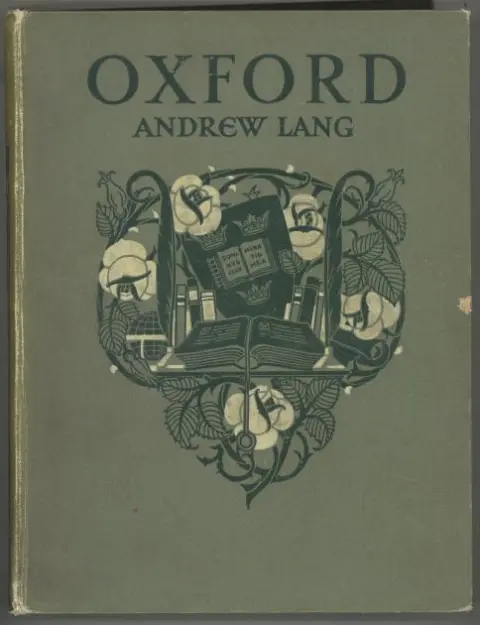
THE CLASSIC COLLECTION · 1910
"Oxford" by Andrew Lang is a historical account written in the early 20th century. The work captures the rich tapestry of life at the University of Oxford, exploring its diverse history through personal impressions and descriptions from various eras. Lang does not aim to provide a comprehensive history but instead offers snapshots of its evolving landscape and culture, reflecting on how Oxford influences and is influenced by its scholars and society over time. The beginning of "Oxford" sets the stage with a contemplative preface that reflects on the city's historical significance and its transitions across different ages. Lang likens the town to a palimpsest, suggesting that its identity has been shaped by its continuous use and modification through time. The opening chapter discusses the early history of Oxford, highlighting its geographical advantages and strategic importance as a center for trade, learning, and religion. It references figures like St. Frideswyde and the shifting dynamics among the early inhabitants, capturing the essence of the relationship between the town and its academic institution. Overall, this opening portion invites readers to ponder the depth of Oxford's historical context while illustrating its unique charm and significance in the realm of education.
Introduction adapted from the source catalogue; source summaries may be automatically generated.
Free to read · English · 31,567 words · No account needed
MAKE TIME FOR A GOOD BOOK
On by default. Untick to stop anonymous reading totals. Each page counts after 10 seconds in view. How this works.
Anonymous counting is on unless you have switched it off.
Thus, in the great quarrel with the Legate in 1238, John Currey, of Scotland, boarded with Will Maynard, while Hugh le Verner abode in the house of Osmund the Miller, with Raynold the Irishman and seven of his fellows. John Mortimer and Rob Norensis lodged with Augustine Gosse, and Adam de Wolton lodged in Cat Street, where you can still see the curious arched doorway of Catte’s, or St. Catherine’s Hall. By the time of my hero, Walter Stoke, the King had not yet decreed that all scholars of years of discretion should live in the house of some sufficient principal (1421); so let him lodge at Catte Hall, at the corner of the street that leads to New College out of the modern Broad Street, which was then the City Ditch. It is six o’clock on a summer morning, and the bells waken Stoke, who is sleeping on a flock bed, in his little camera. His room, though he is not one of the luxurious clerks whom the University scolds in various statutes, is pretty well furnished. His bed alone is worth not less than fifteenpence; he has a ‘cofer’ valued at twopence (we have plenty of those old valuations), and in his cofer are his black coat, which no one would think dear at fourpence, his tunic, cheap at tenpence, ‘a roll of the seven Psalms,’ and twelve books only ‘at his beddes heed.’ Stoke has not
‘Twenty bookes, clothed in blak and reed,
Of Aristotil and of his philosophie,’
like Chaucer’s Undergraduate, who must have been a bibliophile. There are not many records of ‘as many as twenty bookes’ in the old valuations. The great ornament of the room is a neat trophy of buckler, bow, arrows, and two daggers, all hanging conveniently on the wall. Stoke opens his eyes, yawns, looks round for his clothes, and sees, with no surprise, that his laundress has not sent home his clean linen. No; Christina, of the parish of St. Martin, who used to be Stoke’s lotrix, has been detected at last. ‘Under pretence of washing for scholars, multa mala perpetrata fuerunt,’ she has committed all manner of crimes, and is now in the Spinning House, carcerata fuit. Stoke wastes a malediction on the laundress, and, dressing as well as he may, runs down to Parson’s Pleasure, I hope, and has a swim, for I find no tub in his room, or, indeed, in the camera of any other scholar. It is now time to go, not to chapel—for Catte’s has no chapel—but to parish Church, and Stoke goes very devoutly to St. Peter’s, where we shall find him again, later in the day, in another mood. About eight o’clock he ‘commonises’ with a Paris man, Henricus de Bourges, who has an admirable mode of cooking omelettes, which makes his company much sought after at breakfast-time. The University, in old times, was full of French students, as Paris was thronged by Englishmen. Lectures begin at nine, and first there is lecture in the hall by the principal of Catte’s. That scholar receives his pupils in a bare room, where it is very doubtful whether the students are allowed to sit down. From the curious old seal of the University of St. Andrews, however, it appears that the luxury of forms was permitted, in Scotland, to all but the servitors, who held the lecturer’s candles. The principal of Catte’s is in academic dress, and wears a black cape, boots, and a hood. The undergraduates have no distinguishing costume. After an hour or two of vivâ voce exercises in the grammar of Priscian, preparatory lecture is over, and a reading man will hurry off to the ‘schools,’ a set of low-roofed buildings between St. Mary’s and Brasenose. There he will find the Divinity ‘school’ or lecture-room in the place of honour, with Medicine on one hand and Law on the other; the lecture-rooms for grammar, rhetoric, logic, arithmetic, music, geometry, and astronomy, for metaphysics, ethics, and ‘the tongues,’ stretching down School Street on either side. Here the Prælectors are holding forth, and all newly made Masters of Arts are bound to teach their subject regere scholas, whether they like it or not. Our friend, Master Stoke, however, is on pleasure bent, and means to pay his fine of twopence for omitting lecture, and go off to the festival of his nation (he is of the Southern nation, and hates Scotch, Welsh, and Irish) in the parish Church. He stops in the Flower Market and at a barber’s shop on his way to St. Peter’s, and comes forth a wonderful pagan figure with a Bacchic mask covering his honest countenance, with horns protruding through a wig of tow, with vine-leaves twisted in and out of the horns, and roses stuck wherever there is room for roses. Henricus de Bourges, and half a dozen Picardy men, with some merry souls from the Southern side of the Thames, are jigging down the High, playing bag-pipes and guitars. To these Stoke joins himself, and they waltz joyously into the church, and in and out of the gateways of the different halls, singing,—
Your reading position is saved on this browser. Take it to another device with a library code. Reading pages adapt to text, rather than matching a printed edition.
Andrew Lang
Andrew Lang
Andrew Lang

Andrew Lang
BEHIND THE BOOK
This eBook is for the use of anyone anywhere in the United States and most other parts of the world at no cost and with almost no restrictions whatsoever. You may copy it, give it away or re-use it under the terms of the Project Gutenberg License included with this eBook or online at www.gutenberg.org. If you are not located in the United States, you will have to check the laws of the country where you are located before using this eBook. Read the source licence.
The original source file, including credits and licence, is retained by this library. Request an original-format copy at no charge. Please include the book title and Project Gutenberg identifier #2444.
KEEP YOUR CURIOSITY GOING
Cécile Tormay

Moritz Busch
John L. Ransom
Frances Wright
Cécile Tormay

Mabel Potter Daggett