
Last letters from the living dead man
David Patterson (Spirit) Hatch
THE CLASSIC COLLECTION · 1901
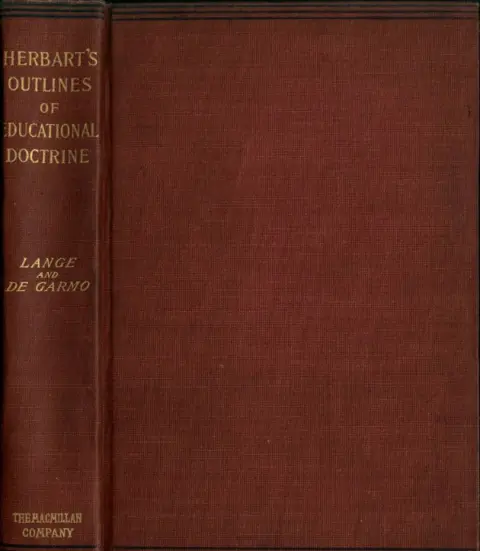
"Outlines of Educational Doctrine" by Johann Friedrich Herbart is a scientific publication written in the early 20th century. This work serves as a comprehensive examination of educational philosophy and its practical applications, focusing on the integration of ethics and psychology in pedagogy. Herbart aims to elucidate the principles guiding effective teaching and character formation, emphasizing the importance of fostering moral and intellectual growth in students. At the start of the manuscript, Herbart establishes the foundational concept of "plasticity" in pupils, positing that the ability to be molded is inherent to their educability. He discusses the relationship between ethics and psychology as the bases for pedagogical theory, arguing that educators must balance individual will and external influences in fostering moral character. Through initial explorations of virtue as the ultimate educational goal and the psychological processes underlying learning, Herbart lays the groundwork for systematic instruction aimed at cultivating a complete and socially responsible individual.
Introduction adapted from the source catalogue; source summaries may be automatically generated.
Free to read · English · 79,274 words · No account needed
MAKE TIME FOR A GOOD BOOK
On by default. Untick to stop anonymous reading totals. Each page counts after 10 seconds in view. How this works.
Anonymous counting is on unless you have switched it off.
Pampering, 45.
Passions, 180, 181;
prevention of by training, 314;
what they lead to, 308.
Paulsen, 3, 73.
“Pedagogical Seminary,” 178.
Pedagogics, ethical basis of, 8–19;
psychological basis of, 20–44;
outlines of general, 45–231.
Perez, 195.
Perfection, idea of, definition, 10;
importance of, 17;
false idea of, 18;
in children, 207–210.
Perfice te, 17.
Pestalozzi, 112, 114.
Physical activity, need of, 46.
Physical weakness, consideration for, 159.
Physics, elementary, 261.
Plan of instruction, 131–135.
Play, love of, 295.
Playground, need for, 132.
Plasticity, limited, 4.
Pleasure and pain, sources of, 168.
Praise and censure, 189–190.
Premature fixation of ideas, 218.
Preparation, 70.
Presentation, 70, 119.
Presentative instruction, its present function, 109.
Presentative method, meaning of, 106.
Preyer, 195.
Primacy of ideas, 73, 143;
of will, 73, 143.
Principles vs. inclinations, 193.
Private vs. public schools, 334.
Process of instruction, 105–130.
Proficiency in knowledge a late acquirement, 127.
Prudence, 145.
Psychological basis of pedagogics, 8–19.
Psychology as instrument, 2.
“Psychology of Number,” 253.
Public opinion, respect for, 306.
Public vs. private schools, 334.
Punishment, 51–53.
Pupil’s interest, how to measure and secure it, 101.
Quality vs. quantity, in securing interest, 101.
Questions, childish, 213;
character of, 342.
Quietude of mind, 176.
Rationality, growth of, 296.
Reading, 273–275.
Realia, advantage of, 101.
Recitations, number per week, 133.
Records, of conduct, 50.
Recreations, 132.
Reflection and absorption, 66.
Reform, school, 103.
Regulative principles, establishment of, 173.
Regulative training, 172.
Religion, 232–238.
Religious culture with boys, 222.
Religious feeling, beginnings of, 236.
Religious instruction, 94;
in England, Germany, and the United States, 181.
Religious training, need of, 19.
Reminders, 192.
Repetition, what it accomplishes, 118.
Reproduction, 109.
Rest and action, 156.
Restlessness, 297;
under control, 305.
Restraint, 55;
and freedom, 186.
Revelation of the world, moral, 167.
Reviews, conduct of, 117.
Rigidity of mind, 300.
Rosenkranz, 66.
“Rousing word,” the, 175.
Rudeness vs. instruction, 35.
Russell, “German Higher Schools,” 279.
Savings banks, 170.
“School and Society,” Dr. John Dewey, 38.
School hygiene, literature of, 132.
Schoolrooms, need for spacious, 132.
Schools, organization of, 338–347.
School system, 338.
Scientific instruction, a branch of education, 37.
Scientific vs. classical education, 85.
Seclusion vs. society, 168.
Secondary education in United States, its brevity, 103.
Self-activity, 71.
Self-defence, 183.
Self-determination, 26.
Sensibility, kindness of, 152.
Sensual impulses, 298.
Sequence, common view, 96;
of studies, 128.
Series of ideas, 121.
Severity for concealed offences, 316.
Simulation of ethical judgments, 317.
Sin, 338.
Six-year high school course, 103.
Skill vs. interest, 289.
Sluggishness of pupils, 165.
Smith, David Eugene, 255, 256.
Social cheerfulness, 211.
Social circle, relation of child to, 208.
Social ends of training, 160.
Social environment of pupils, 94.
Social faults, correction for, 327.
Social intercourse, 78.
Social pressure in government, 161.
Social relations the source of will, 318.
Social, the, in conduct, 62.
Society vs. seclusion, 168.
Source of ideas, 36.
Special applications of pedagogics, 232–293;
religion, 232–238;
history, 239–251;
mathematics and natural science, 252–262;
geography, 263–268;
the mother-tongue, 269–275.
Speer, 253.
Spencer, Herbert, 85, 157.
Spinoza, 3.
Spy, the teacher as, 317.
Standards of honor, 169.
State, its attitude toward the individual, 331.
Strife, 182.
Structure of groups of ideas, 31.
Studies, social function of, 62;
as social instruments, 64;
for boys, 225.
Study of literary masterpieces, 76.
Style of speaking, 108.
Subjects to be taught, 100.
Supervision, 48;
strictness of, 49, 50.
Sweetmeats, educational, 99.
Syntax, Latin, 284.
Synthetic instruction, definition, 106;
nature and course of, 125–126.
System, 67;
promoted by connected discourse, 69;
of laws and rewards, 14;
of civilization, 16.
Your reading position is saved on this browser. Take it to another device with a library code. Reading pages adapt to text, rather than matching a printed edition.
BEHIND THE BOOK
This eBook is for the use of anyone anywhere in the United States and most other parts of the world at no cost and with almost no restrictions whatsoever. You may copy it, give it away or re-use it under the terms of the Project Gutenberg License included with this eBook or online at www.gutenberg.org. If you are not located in the United States, you will have to check the laws of the country where you are located before using this eBook. Read the source licence.
The original source file, including credits and licence, is retained by this library. Request an original-format copy at no charge. Please include the book title and Project Gutenberg identifier #44905.
KEEP YOUR CURIOSITY GOING
David Patterson (Spirit) Hatch
Coulson Kernahan

Ralph Waldo Emerson
Frances Wright

Edwin Abbott Abbott

Joseph Droz