
Last letters from the living dead man
David Patterson (Spirit) Hatch
THE CLASSIC COLLECTION · 1901
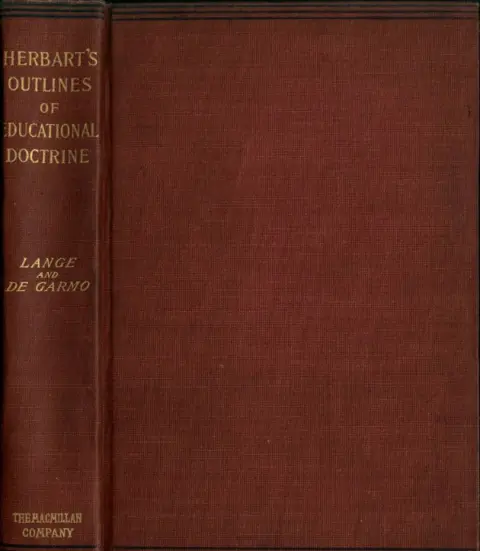
"Outlines of Educational Doctrine" by Johann Friedrich Herbart is a scientific publication written in the early 20th century. This work serves as a comprehensive examination of educational philosophy and its practical applications, focusing on the integration of ethics and psychology in pedagogy. Herbart aims to elucidate the principles guiding effective teaching and character formation, emphasizing the importance of fostering moral and intellectual growth in students. At the start of the manuscript, Herbart establishes the foundational concept of "plasticity" in pupils, positing that the ability to be molded is inherent to their educability. He discusses the relationship between ethics and psychology as the bases for pedagogical theory, arguing that educators must balance individual will and external influences in fostering moral character. Through initial explorations of virtue as the ultimate educational goal and the psychological processes underlying learning, Herbart lays the groundwork for systematic instruction aimed at cultivating a complete and socially responsible individual.
Introduction adapted from the source catalogue; source summaries may be automatically generated.
Free to read · English · 79,274 words · No account needed
MAKE TIME FOR A GOOD BOOK
On by default. Untick to stop anonymous reading totals. Each page counts after 10 seconds in view. How this works.
Anonymous counting is on unless you have switched it off.
Ideas, groups of, 29;
their source, 36;
equilibrium of, 75;
degree of strength, 102.
“Iliad” and “Odyssey,” 283.
Imaginary and complex numbers, 256.
Imagination, 22.
Incapacity, feeling of, in children, 216.
Inclinations vs. principles, 193.
Individuality, modification of, 41;
differences of, 54.
Individual traits, permanency of, 295.
Indolence of youth, 227.
Inequalities, correction of, 60.
Infancy, 195–202.
Inherent faults, 294.
Inner freedom, aspects of, 187.
Instability of ideas, 301.
Instruction, 56–135;
relation to government and training, 56–61;
aim of, 62–65;
conditions of many-sidedness in, 66–70;
conditions determining interest in, 71–82;
as information giving, 35;
and rudeness, 35;
in relation to pupils’ ideas and disposition, 36;
branches of, 36;
its good beginning, 105.
Insertion vs. continuation, 129.
Insight, definition, 8;
harmony of with volition, 9.
Intercourse, social, 78.
Interest, conditions of, 71–82;
main kinds of, 83–94;
many-sidedness of, 62;
direct and indirect, 63;
vs. effort, 63;
bearing of on virtue, 64;
classification of, 83;
not sole guide to selection of studies, 135;
compared with skill, 289.
Inventions, 251.
Irritability, 297.
James, quoted, 175.
Judgment, 23;
of moral quality of actions, 9;
ethical, 25.
Justice and equality with boys, 221.
Kant, 3;
his views on moral obedience, 173.
Lange’s “Apperception,” 74.
Language lessons vs. grammar, 271.
Languages, difficulties of, 129.
Larned, method of using text-books, 247.
Latin and Greek, 277–285;
time for beginning, 103;
composition in, 285.
Latin, increase in study of, 278;
reasons for teaching, 279;
authors to be read, 282.
Letter writing, 276.
Listlessness, 158.
Literary masterpieces, study of, 76.
Logarithms, 254.
Love, 53.
Magnitudes in mathematics, 252.
Main kinds of interest, 83–94;
materials of, 95–104;
process of, 105–130;
plan of, 131–135.
Manly games, effects of on boys, 183.
Manual training, 259;
effect of on discipline, 56.
Many-sidedness, 66–70;
of interest, 62.
Materials of instruction, 95–104.
Mathematics, 252–257;
linked to nature, 39;
correlation of, 39;
aptitude for, 252.
Mathematical teaching, order of, 255.
Maxims, origin of, 310.
McLellan and Dewey, 253.
McMurray, 74.
Measuring, 253.
Mediæval history, 249.
Memorizing, 81, 108.
Memory of will, 161.
Mental faculties, names for, 27.
Mental instability, 301.
Mephistopheles, 83.
Method, 67.
Mob spirit, the, 168.
Mobility of ideas, 35.
Modern history, 250.
Modern languages, arguments for their study, 98.
Modern methods of using text-books in history, 247.
Money, teaching the use of, 170.
Moodiness in the teacher, 166.
Moods and whims, 147.
Moral eccentricity, 307.
Moral freedom, possibility of, 173.
Moral education in strict sense, 188.
Moral judgment, contempt of, 312.
Moral revelation of the world, 167.
Morality, demand of upon youth, 231.
Mother-tongue, the, 269.
Motives of youth, 229.
Musical instruments, study of, 179.
Narration, art of, 76;
historical, 239–243.
Natorp, 143.
Natural science, 258–262.
Nature study, 258–262;
apperceptive basis for, 258;
and history, 258.
Niemeyer, 112, 113.
Obedience, 48;
to authority, 173;
promptness of, 309.
Object lessons, how to teach, 114–116.
Observation, of children, 33, 34;
exercises, 215;
which does not observe, 111.
Occupations, 47, 98;
self-chosen, 134.
“Odyssey,” 283.
Offences, concealed, 316.
One-sidedness, 86.
Order, restoration of, 324.
Organization of pupil’s ideas, 31, 32;
of education, 330–347.
Outlines of general pedagogics, 45–231.
Outside occupations, 134.
Overburdening of pupils, 97, 226.
Your reading position is saved on this browser. Take it to another device with a library code. Reading pages adapt to text, rather than matching a printed edition.
BEHIND THE BOOK
This eBook is for the use of anyone anywhere in the United States and most other parts of the world at no cost and with almost no restrictions whatsoever. You may copy it, give it away or re-use it under the terms of the Project Gutenberg License included with this eBook or online at www.gutenberg.org. If you are not located in the United States, you will have to check the laws of the country where you are located before using this eBook. Read the source licence.
The original source file, including credits and licence, is retained by this library. Request an original-format copy at no charge. Please include the book title and Project Gutenberg identifier #44905.
KEEP YOUR CURIOSITY GOING
David Patterson (Spirit) Hatch
Coulson Kernahan

Ralph Waldo Emerson
Frances Wright

Edwin Abbott Abbott

Joseph Droz