
Last letters from the living dead man
David Patterson (Spirit) Hatch
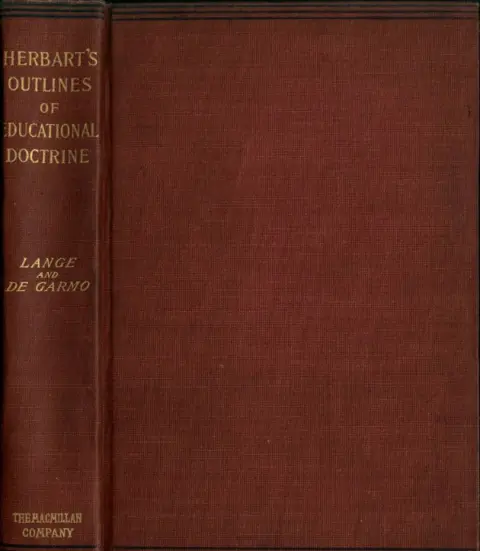
THE CLASSIC COLLECTION · 1901
"Outlines of Educational Doctrine" by Johann Friedrich Herbart is a scientific publication written in the early 20th century. This work serves as a comprehensive examination of educational philosophy and its practical applications, focusing on the integration of ethics and psychology in pedagogy. Herbart aims to elucidate the principles guiding effective teaching and character formation, emphasizing the importance of fostering moral and intellectual growth in students. At the start of the manuscript, Herbart establishes the foundational concept of "plasticity" in pupils, positing that the ability to be molded is inherent to their educability. He discusses the relationship between ethics and psychology as the bases for pedagogical theory, arguing that educators must balance individual will and external influences in fostering moral character. Through initial explorations of virtue as the ultimate educational goal and the psychological processes underlying learning, Herbart lays the groundwork for systematic instruction aimed at cultivating a complete and socially responsible individual.
Introduction adapted from the source catalogue; source summaries may be automatically generated.
Free to read · English · 79,274 words · No account needed
MAKE TIME FOR A GOOD BOOK
On by default. Untick to stop anonymous reading totals. Each page counts after 10 seconds in view. How this works.
Anonymous counting is on unless you have switched it off.
Tardiness, 161.
Teacher as spy, 317.
Teachers’ conferences, 339.
Temperaments, 295.
Temper, violent, 298.
Tests by the state, 332.
Text-book methods, barrenness of, 243.
Text-book vs. oral presentation of history, 239.
Themes for composition, 124.
The mob spirit, 168.
The mother-tongue, 269–276.
Thoughtlessness of pupils, 164.
Time, amount to be given to instruction, 132.
Training, 136–194;
definition, 136, 141;
relation to government and instruction, 136–140;
aim of, 141–142;
differentiation of character, 143–147;
differentiation in morality, 148–150;
helps in, 151–159;
general method, 160–194;
blended with government, 140;
function of, 151.
Transfer of pupils, 52.
Translation, difficulty of, for German children, 103.
Trigonometry, 254.
Tutors, place of, 335.
Unification, 65, 66.
Use of things, how taught, 114.
Vendettas, 13.
Violin, value of use of, 179.
Virility in the school, 183.
Virtue, definition, 8, 62;
unevenness of development, 8;
its relation to interest, 64.
Viva vox docet, 107.
Volition, harmony with insight, 9;
of the moment, 311.
Wiget, 70.
Will, memory of, 161.
Women teachers and fighting pupils, 183.
Work vs. drudgery, 63.
Written exercises in the mother-tongue, 276.
Written work, tediousness of, 59;
correction of, 123.
Wundt, 74.
By J. G. FITCH, M.A.
WITH AN INTRODUCTORY PREFACE BY THOMAS HUNTER, Ph.D., President of the Normal College, New York
16mo. Cloth. $1.00
“This is eminently the work of a man of wisdom and experience. He takes a broad and comprehensive view of the work of the teacher, and his suggestions on all topics are worthy of the most careful consideration.”--New England Journal of Education.
“The lectures will be found most interesting, and deserve to be carefully studied, not only by persons directly concerned with instruction, but by parents who wish to be able to exercise an intelligent judgment in the choice of schools and teachers for their children. For ourselves, we could almost wish to be of school age again, to learn history and geography from some one who could teach them after the pattern set by Mr. Fitch to his audience. But perhaps Mr. Fitch’s observations on the general conditions of school work are even more important than what he says on this or that branch of study.”--Saturday Review.
16mo. Cloth. 60 cents
“Mr. Fitch is a wise and enthusiastic student of pedagogy, the author of some specially excellent Lectures on Teaching delivered in the University of Cambridge, and a rarely good observer of new facts.... The book is a treasure of clever description, shrewd comment, and instructive comparison of the English system and our own.”--The Churchman.
The Meaning of Education
=And Other Essays and Addresses=. By =Nicholas Murray Butler=, Columbia University. Cloth. 12mo. $1.00.
Social Phases of Education in the School and the Home
By =Samuel T. Dutton=, Superintendent of Schools, Brookline, Mass. Cloth. 12mo. $1.25.
Education of the Central Nervous System
Your reading position is saved on this browser. Take it to another device with a library code. Reading pages adapt to text, rather than matching a printed edition.
BEHIND THE BOOK
This eBook is for the use of anyone anywhere in the United States and most other parts of the world at no cost and with almost no restrictions whatsoever. You may copy it, give it away or re-use it under the terms of the Project Gutenberg License included with this eBook or online at www.gutenberg.org. If you are not located in the United States, you will have to check the laws of the country where you are located before using this eBook. Read the source licence.
The original source file, including credits and licence, is retained by this library. Request an original-format copy at no charge. Please include the book title and Project Gutenberg identifier #44905.
KEEP YOUR CURIOSITY GOING
David Patterson (Spirit) Hatch
Coulson Kernahan

Ralph Waldo Emerson
Frances Wright

Edwin Abbott Abbott

Joseph Droz