
Last letters from the living dead man
David Patterson (Spirit) Hatch
THE CLASSIC COLLECTION · 1901
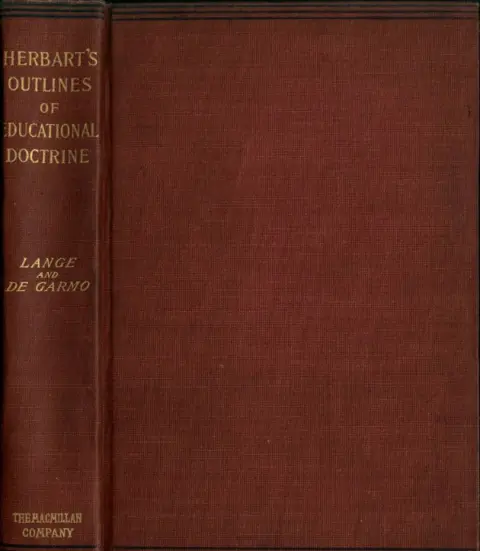
"Outlines of Educational Doctrine" by Johann Friedrich Herbart is a scientific publication written in the early 20th century. This work serves as a comprehensive examination of educational philosophy and its practical applications, focusing on the integration of ethics and psychology in pedagogy. Herbart aims to elucidate the principles guiding effective teaching and character formation, emphasizing the importance of fostering moral and intellectual growth in students. At the start of the manuscript, Herbart establishes the foundational concept of "plasticity" in pupils, positing that the ability to be molded is inherent to their educability. He discusses the relationship between ethics and psychology as the bases for pedagogical theory, arguing that educators must balance individual will and external influences in fostering moral character. Through initial explorations of virtue as the ultimate educational goal and the psychological processes underlying learning, Herbart lays the groundwork for systematic instruction aimed at cultivating a complete and socially responsible individual.
Introduction adapted from the source catalogue; source summaries may be automatically generated.
Free to read · English · 79,274 words · No account needed
MAKE TIME FOR A GOOD BOOK
On by default. Untick to stop anonymous reading totals. Each page counts after 10 seconds in view. How this works.
Anonymous counting is on unless you have switched it off.
Dates, 247.
Delegated authority, 319.
Demonstrations, 256.
Depression and elevation, 156.
Desire and passion, 176;
bodily, 177;
gratification of, 155.
Determining influence of training, 167.
Dewey, Dr. John, 38, 63, 73, 150;
and McLellan, 253.
Differences, individual and sex, 219.
Discipline, social basis of, 55;
of consequence, 157.
Diffusion of thought, 35.
Disorder as index of failure, 55.
Disposition, cheerful, 137.
Divided attention, 63.
“Dogma of Formal Culture,” Hinsdale, 279.
Dörpfeld, 70.
Drudgery vs. work, 63.
Duel, 13.
Dulness, 299.
Ease of government, 54.
Easy before the difficult, 127.
Eckoff, Wm. J., 254.
Educability of pupils, 1.
Education according to age, 195–231;
first three years, 195–202;
from four to eight, 203–216;
boyhood, 217–226;
youth, 227–231.
Education as home task, 333.
Educational bookkeeping, 50.
Educative instruction, 59, 100;
value in fixing curriculum, 100.
Election, basis of, 65.
Electives, 89.
Elevation and depression, 156.
Employment, the foundation of government, 46;
for children, 56.
Endurance, 154.
English schools, effect on character of boys, 183.
Environment, influence of, 5, 55;
of pupils, 94.
Equilibrium of ideas, 75.
Equity, definition, 13.
Erratic mental movements, 302.
Estrangement and its removal, 66.
Ethical Basis of Pedagogics, 8–19.
Ethical judgment, 25.
Ethical life, range of, 292.
Ethics, the goal of education, 2.
Examination vs. review, 117.
Experience, limits of, 110.
Explication, 67.
Expulsion, 52.
Evil, exclusion of, 149.
Faculties, 20, 21, 22, 23;
names for, 27.
Family, its interest in the individual, 288;
its lack of vigor, 333.
Fatalism, 1, 3.
Fatigue, produced by instruction, 70.
Favoritism, 184.
Faults of children and their treatment, 294–329;
general differentiation, 294–303;
sources of moral weakness, 304–313;
effects of training upon, 314–319;
special faults, 320–329;
habitual, 326;
minor, 321;
committed vs. faults possessed, 320.
Faust, 83.
First offences, treatment of, 323.
Fiske, method of using text-books of history, 247.
“Five windows of the Soul,” 37.
Fixation of ideas, premature, 218.
Formal Culture, Dogma of, Hinsdale, 279.
Formal steps, 67.
Frankness, lack of, 26;
need of, 322.
Freedom and restraint, 156.
Friendliness, with children, 211.
Games, the supervision of, 178;
coöperative, 178.
General notions, definition, 30.
Generalizations, 92.
Gentle measures, 43.
Geography, 263–268;
home geography, 263;
an associating science, 264;
narration in, 265;
the old vs. the new, 266;
reviews in, 267.
Geographical aspects of history, 245.
Geographical vs. historical studies, 293.
Geometry, advantages of association, 102.
Good will, definition, 11;
in children, 206;
two aspects of, 185.
Golden rule, 148.
Goldsmith on the moody teacher, 166.
Government of children, 45–55.
Grading, 344–345.
Grammar, amount to be given, 130.
Greek and Latin, 277–285;
time for beginning, 277–278;
manner of teaching, 279.
Greek and Roman history, priority of, 246;
vs. American history, 246.
Greek, authors to be used, 283;
relation of, to religious impressions, 233.
Groups of ideas, 29.
Gumplowicz, 5.
Gymnastic exercises, excessive, 132.
Harris, Dr. Wm. T., 37, 143.
Harmony of insight and volition, 9.
Heavenly bodies, observation of, 259.
Herbert Spencer, 85, 157.
Herodotus, stories of, 243.
Higher education, the comparative study of branches, 89.
Higher vs. lower schools, 340.
High school, six-year course in, 103.
Hinsdale, “Dogma of Formal Culture,” 279.
History, 239–251;
prevailing error of young teachers of, 239;
American vs. Greek and Roman, 241;
mediæval, 249;
modern, 250.
Historical instruction, a branch of education, 37.
Home education, 330–337.
Home work, not a saving of labor, 123.
Homogeneity of pupils, 112.
Honor, standards of, 169;
a feeling of, 223.
Humaniora vs. realia, 99.
Your reading position is saved on this browser. Take it to another device with a library code. Reading pages adapt to text, rather than matching a printed edition.
BEHIND THE BOOK
This eBook is for the use of anyone anywhere in the United States and most other parts of the world at no cost and with almost no restrictions whatsoever. You may copy it, give it away or re-use it under the terms of the Project Gutenberg License included with this eBook or online at www.gutenberg.org. If you are not located in the United States, you will have to check the laws of the country where you are located before using this eBook. Read the source licence.
The original source file, including credits and licence, is retained by this library. Request an original-format copy at no charge. Please include the book title and Project Gutenberg identifier #44905.
KEEP YOUR CURIOSITY GOING
David Patterson (Spirit) Hatch
Coulson Kernahan

Ralph Waldo Emerson
Frances Wright

Edwin Abbott Abbott

Joseph Droz