
Last letters from the living dead man
David Patterson (Spirit) Hatch
THE CLASSIC COLLECTION · 1901
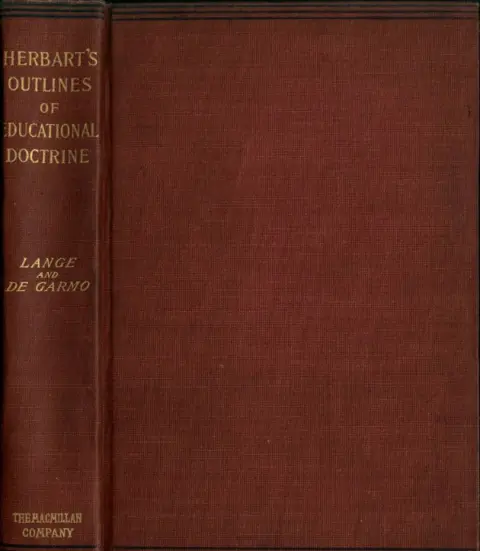
"Outlines of Educational Doctrine" by Johann Friedrich Herbart is a scientific publication written in the early 20th century. This work serves as a comprehensive examination of educational philosophy and its practical applications, focusing on the integration of ethics and psychology in pedagogy. Herbart aims to elucidate the principles guiding effective teaching and character formation, emphasizing the importance of fostering moral and intellectual growth in students. At the start of the manuscript, Herbart establishes the foundational concept of "plasticity" in pupils, positing that the ability to be molded is inherent to their educability. He discusses the relationship between ethics and psychology as the bases for pedagogical theory, arguing that educators must balance individual will and external influences in fostering moral character. Through initial explorations of virtue as the ultimate educational goal and the psychological processes underlying learning, Herbart lays the groundwork for systematic instruction aimed at cultivating a complete and socially responsible individual.
Introduction adapted from the source catalogue; source summaries may be automatically generated.
Free to read · English · 79,274 words · No account needed
MAKE TIME FOR A GOOD BOOK
On by default. Untick to stop anonymous reading totals. Each page counts after 10 seconds in view. How this works.
Anonymous counting is on unless you have switched it off.
346. Reports of such single defects will as a rule lead only to correspondingly partial improvements in the system and to relief from the most onerous perplexities, since it is seldom found possible to organize the system of a whole province at once in such a way as to make one harmonious whole.
347. But in case comprehensive reforms of the school system were undertaken, it would be necessary not merely to tolerate great multiformity, but even to create it purposely. For division of labor is in all human performance the right path to better things; and the preceding discussion must have shown with sufficient clearness how much depends on a more discriminating segregation of pupils.
A, B, C, of Perception, 253.
Absorption and Reflection, 66.
Action, clandestine, 315.
Action and Rest, 156.
Administrative System, 15.
Adolescence, and obedience, 161;
bibliography for, 231.
Æsthetics, 93.
Affection, 24.
Algebra, history of, 255.
Alertness of mind, superficial, 301.
American History vs. that of Greece and Rome, 241.
Analytic instruction, definition, 106;
first stages of, 111;
other forms of, 117;
with children, 214.
Ancient Languages, their use as employment, 98;
labor of mastering, 103.
Apperceiving attention, capacity for, 129.
Application, 67;
a stage of method, 70.
Approbation, 151.
Arguing with children, evils of, 164.
Arithmetic, with boys, 223–224.
Arranging of objects, 215.
Arrested development, 171.
Art of narration, 76.
Arts, 251.
Assistance, gradual withdrawal, 204.
Association, 67;
promoted by conversation, 69.
Athletics, over-valuation of, 169.
Attention, divided, 63;
forced and spontaneous, 73;
primitive and apperceiving, 74.
Authority, 53–163;
delegated, 319.
Aversion, 24.
Bad conduct of adults, 187.
Baldwin, quoted, 168, 195.
Barrenness of text-book method, 243.
Barriers to education, 5.
Bennett and Bristol, “The teaching of Latin and Greek,” 279.
Bible stories, 234.
Biblical stories vs. Mythology, 237.
Boundary between boyhood and adolescence, 217.
Boyhood, boundary between, and adolescence, 217.
Brown, George P., 271.
Capacity for education in children, 33.
Caprice of will, 1, 3.
Categorical imperative, not the true source of maxims, 313.
Censure, 151.
Character, development of, 64;
objective side of, 143;
subjective side of, 143;
strength of, 147.
Cheerfulness, social, 211.
Children, government of, 45–55.
Childhood, 203–216.
Child study, 33, 34.
Choice, content of, 167;
of subject-matter, 95.
Choosing, 167.
Chronology in history, 240.
Clandestine action, 315.
Classical vs. scientific education, 85.
Classification of interests, 83;
how to provide for, 135.
Clearness, 67.
Combats between teacher and pupils, 163.
Commands, sweeping, 48.
Committing to memory, 81.
Communion, 232.
Comparative study, 89.
Complication of ideas, 30.
Composition, true nature of, 123;
in Latin and Greek, 285.
Concealed offences, severity for, 316.
Concert work, 69.
Conduct, becoming, 137.
Conferences, teachers’, 339.
Confirmation, 232.
Conjunctions, children’s use of, 31.
Consequences, discipline of, 157.
Consistency of action, 174.
Contempt of moral judgment, 312.
Contention, why it pleases children, 183.
Continuity of education, 7.
Contrasts in pupils, 28.
Control, restlessness under, 305.
Conversation, 67.
Corporal punishment, 51.
Correlation of studies, 65;
limits of, 219.
Courage, 296.
Culture, Dogma of Formal, Hinsdale, 279.
Cynics, 83.
Cyrenaics, 83.
Your reading position is saved on this browser. Take it to another device with a library code. Reading pages adapt to text, rather than matching a printed edition.
BEHIND THE BOOK
This eBook is for the use of anyone anywhere in the United States and most other parts of the world at no cost and with almost no restrictions whatsoever. You may copy it, give it away or re-use it under the terms of the Project Gutenberg License included with this eBook or online at www.gutenberg.org. If you are not located in the United States, you will have to check the laws of the country where you are located before using this eBook. Read the source licence.
The original source file, including credits and licence, is retained by this library. Request an original-format copy at no charge. Please include the book title and Project Gutenberg identifier #44905.
KEEP YOUR CURIOSITY GOING
David Patterson (Spirit) Hatch
Coulson Kernahan

Ralph Waldo Emerson
Frances Wright

Edwin Abbott Abbott

Joseph Droz