THE CLASSIC COLLECTION✦Letters to His ChildrenCLASSIC FREE BOOKS
Letters to His Children
Theodore Roosevelt
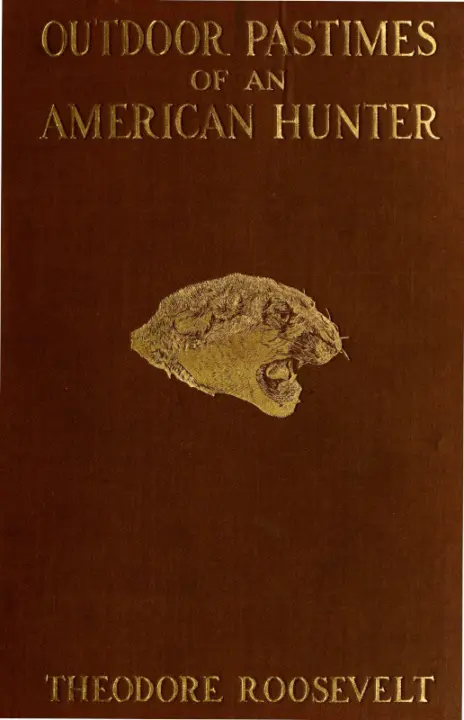
THE CLASSIC COLLECTION · 1908
"Outdoor Pastimes of an American Hunter" by Theodore Roosevelt is a collection of personal accounts and observations regarding hunting and outdoor life written in the late 19th century. The book reflects Roosevelt's passion for nature and wildlife, showcasing his hunting experiences on various adventures, particularly focusing on cougars and other big game in the American wilderness. It serves as both a memoir and a commentary on the natural world, steeped in the author's vivid recollections and insights into the behavior of both the animals and the ecosystem. The opening of the book presents an engaging narrative of Roosevelt's winter cougar hunt in the harsh terrain of Northwest Colorado, accompanied by companions and expertly trained hounds. He recounts the challenges they faced from the cold weather and rugged environment while illustrating the unique bond between the hunters and their dogs, who play a vital role in the chase. Roosevelt takes the reader through the thrilling experiences of tracking and confronting cougars, weaving in descriptions of the majestic landscape and the importance of conservation for wildlife. This initial chapter sets the tone for the rest of the book, blending adventure with an appreciation for the wilderness.
Introduction adapted from the source catalogue; source summaries may be automatically generated.
Free to read · English · 122,861 words · No account needed
MAKE TIME FOR A GOOD BOOK
On by default. Untick to stop anonymous reading totals. Each page counts after 10 seconds in view. How this works.
Anonymous counting is on unless you have switched it off.
Only a few men, comparatively speaking, lead their lives in the wilderness; only a few others, again speaking comparatively, are able to take their holidays in the shape of hunting trips in the wilderness. But all who live in the country, or who even spend a month now and then in the country, can enjoy outdoor life themselves, and can see that their children enjoy it in the hardy fashion which will do them good. Camping out, and therefore the cultivation of the capacity to live in the open, and the education of the faculties which teach observation, resourcefulness, self-reliance, are within the reach of all who really care for the life of the woods, the fields, and the waters. Marksmanship with the rifle can be cultivated with small cost or trouble; and if any one passes much time in the country he can, if only he chooses, learn much about horsemanship.
But aside from any such benefit, it is an incalculable added pleasure to any one’s sum of happiness if he or she grows to know, even slightly and imperfectly, how to read and enjoy the wonder-book of nature. All hunters should be nature lovers. It is to be hoped that the days of mere wasteful, boastful slaughter, are past, and that from now on the hunter will stand foremost in working for the preservation and perpetuation of the wild life, whether big or little.
The Audubon Society and kindred organizations have done much for the proper protection of birds and of wild creatures generally; they have taken the lead in putting a stop to wanton or short-sighted destruction, and in giving effective utterance to the desires of those who wish to cultivate a spirit as far removed as possible from that which brings about such destruction. Sometimes, however, in endeavoring to impress upon a not easily aroused public the need for action, they in their zeal overstate this need. This is a very venial error compared to the good they have done; but in the interest of scientific accuracy it is to be desired that their cause should not be buttressed in such manner. Many of our birds have diminished lamentably in numbers, and there is every reason for taking steps to preserve them. There are water birds, shore birds, game birds, and an occasional conspicuous bird of some other kind, which can only be preserved by such agitation. It is also most desirable to prevent the slaughter of small birds in the neighborhood of towns. But I question very much whether there has been any diminution of small-bird life throughout the country at large. Certainly no such diminution has taken place during the past thirty years in any region of considerable size with which I am personally acquainted. Take Long Island, for instance. During this period there has been a lamentable decrease in the waders—the shore-birds—which used to flock along its southern shore. But in northern Long Island, in the neighborhood of my own home, birds, taken as a whole, are quite as plentiful as they were when I was a boy. There are one or two species which have decreased in numbers, notably the woodcock; while the passenger pigeon, which was then a rarely seen straggler, does not now appear at all. Bobwhites are less plentiful. On the other hand, some birds have certainly increased in numbers. This is true, for instance, of the conspicuously beautiful and showy scarlet tanager. I think meadow larks are rather more plentiful than they were, and wrens less so. Bluebirds have never been common with us, but are now rather more common than formerly. It seems to me as if the chickadees were more numerous than formerly. Purple grackles are more plentiful than when I was a boy, and the far more attractive redwing blackbirds less so. But these may all be, and doubtless some must be, purely local changes, which apply only to our immediate neighborhood. As regards most of the birds, it would be hard to say that there has been any change. Of course, obvious local causes will now and then account for a partial change. Thus, while the little green herons are quite as plentiful as formerly in our immediate neighborhood, the white-crowned night herons are not as plentiful, because they abandoned their big heronry on Lloyd’s Neck upon the erection of a sand-mill close by. The only ducks which are now, or at any time during the last thirty years have been, abundant in our neighborhood are the surf-ducks or scoters, and the old-squaws, sometimes known as long-tailed or sou’-sou’-southerly ducks. From late fall until early spring the continuous musical clangor of the great flocks of sou’-sou’-southerlies, sounding across the steel-gray, wintry waves, is well known to all who sail the waters of the Sound.
Your reading position is saved on this browser. Take it to another device with a library code. Reading pages adapt to text, rather than matching a printed edition.
Theodore Roosevelt
Theodore Roosevelt
Theodore Roosevelt

Theodore Roosevelt & Kermit Roosevelt
BEHIND THE BOOK
This eBook is for the use of anyone anywhere in the United States and most other parts of the world at no cost and with almost no restrictions whatsoever. You may copy it, give it away or re-use it under the terms of the Project Gutenberg License included with this eBook or online at www.gutenberg.org. If you are not located in the United States, you will have to check the laws of the country where you are located before using this eBook. Read the source licence.
The original source file, including credits and licence, is retained by this library. Request an original-format copy at no charge. Please include the book title and Project Gutenberg identifier #61935.
KEEP YOUR CURIOSITY GOING

Fanny Van de Grift Stevenson

Isabel Anderson
Charles King
Henry Vizetelly
Randall Parrish
James De Mille