THE CLASSIC COLLECTION✦Letters to His ChildrenCLASSIC FREE BOOKS
Letters to His Children
Theodore Roosevelt
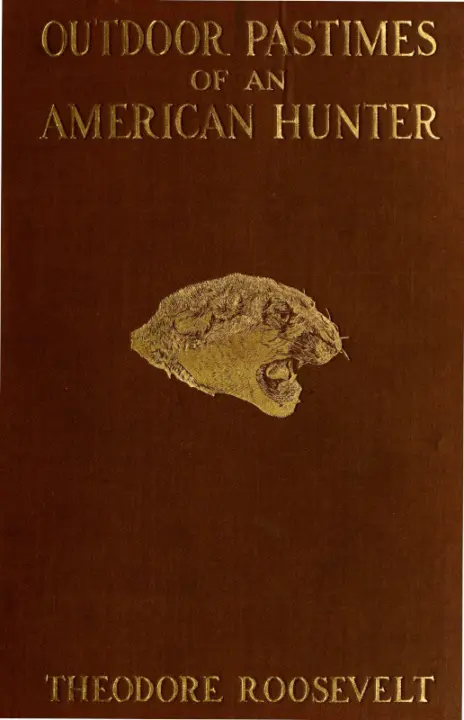
THE CLASSIC COLLECTION · 1908
"Outdoor Pastimes of an American Hunter" by Theodore Roosevelt is a collection of personal accounts and observations regarding hunting and outdoor life written in the late 19th century. The book reflects Roosevelt's passion for nature and wildlife, showcasing his hunting experiences on various adventures, particularly focusing on cougars and other big game in the American wilderness. It serves as both a memoir and a commentary on the natural world, steeped in the author's vivid recollections and insights into the behavior of both the animals and the ecosystem. The opening of the book presents an engaging narrative of Roosevelt's winter cougar hunt in the harsh terrain of Northwest Colorado, accompanied by companions and expertly trained hounds. He recounts the challenges they faced from the cold weather and rugged environment while illustrating the unique bond between the hunters and their dogs, who play a vital role in the chase. Roosevelt takes the reader through the thrilling experiences of tracking and confronting cougars, weaving in descriptions of the majestic landscape and the importance of conservation for wildlife. This initial chapter sets the tone for the rest of the book, blending adventure with an appreciation for the wilderness.
Introduction adapted from the source catalogue; source summaries may be automatically generated.
Free to read · English · 122,861 words · No account needed
MAKE TIME FOR A GOOD BOOK
On by default. Untick to stop anonymous reading totals. Each page counts after 10 seconds in view. How this works.
Anonymous counting is on unless you have switched it off.
The mule-deer is found from the rough country which begins along the eastern edges of the great plains, across the Rocky Mountains to the eastern slopes of the coast ranges, and into southern California. It extends into Canada on the north and Mexico on the south. On the west it touches, and here and there crosses, the boundaries of the Coast blacktail. The whitetail is found in places throughout its habitat from east to west and from north to south. But there are great regions in this territory which are peculiarly fitted for the mule-deer, but in which the whitetail is never found, as the habits of the two are entirely different. In the mountains of western Colorado and Wyoming, for instance, the mule-deer swarms, but the whole region is unfit for the whitetail, which is accordingly only found in a very few narrowly restricted localities.
The mule-deer does not hold its own as well as the whitetail in the presence of man, but it is by no means as quickly exterminated as the wapiti. The outside limits of its range have not shrunk materially in the century during which it has been known to white hunters. It was never found until the fertile, moist country of the Mississippi Valley was passed and the dry plains region to the west of it reached, and it still exists in some numbers here and there in this country, as, for instance, in the Bad Lands along the Little Missouri, and in the Black Hills. But although its limits of distribution have not very sensibly diminished, there are large portions of the range within these limits from which it has practically vanished, and in most places its numbers have been woefully thinned. It holds its own best among the more inaccessible mountain masses of the Rockies, and from Chihuahua to Alberta there are tracts where it is still abundant. Yet even in these places the numbers are diminishing, and this process can be arrested only by better laws, and above all, by a better administration of the law. The national Government could do much by establishing its forest reserves as game reserves, and putting on a sufficient number of forest rangers who should be empowered to prevent all hunting on the reserves. The State governments can do still more. Colorado has good laws, but they are not well enforced. The easy method of accounting for this fact is to say that it is due to the politicians; but in reality the politicians merely represent the wishes, or more commonly the indifference, of the people. As long as the good citizens of a State are indifferent to game protection, or take but a tepid interest in it, the politicians, through their agents, will leave the game laws unenforced. But if the people of Colorado, Wyoming, and Montana come to feel the genuine interest in the enforcement of these laws that the people of Maine and Vermont have grown to take during the past twenty years, that the people of Montana and Wyoming who dwell alongside the Yellowstone Park are already taking—then not only will the mule-deer cease to diminish, but it will positively increase. It is a mistake to suppose that such a change would only be to the advantage of well-to-do sportsmen. Men who are interested in hunting for hunting’s sake, men who come from the great cities remote from the mountains in order to get three or four weeks’ healthy, manly holiday, would undoubtedly be benefited; but the greatest benefit would be to the people of the localities, of the neighborhoods round about. The presence of the game would attract outsiders who would leave in the country money, or its equivalent, which would many times surpass in value the game they actually killed; and furthermore, the preservation of the game would mean that the ranchmen and grangers who live near its haunts would have in perpetuity the chance of following the pleasantest and healthiest of all out-of-door pastimes; whereas, if through their short-sightedness they destroy, or permit to be destroyed, the game, they are themselves responsible for the fact that their children and children’s children will find themselves forever debarred from a pursuit which must under such circumstances become the amusement only of the very rich. If we are really alive to our opportunities under our democratic social and political system, we can keep for ourselves—and by “ourselves” I mean the enormous bulk of men whose means range from moderate to very small—ample opportunity for the enjoyment of hunting and shooting, of vigorous and blood-stirring out-of-doors sport. If we fail to take advantage of our possibilities, if we fail to pass, in the interest of all, wise game laws, and to see that these game laws are properly enforced, we shall then have to thank ourselves if in the future the game is only found in the game preserves of the wealthy; and under such circumstances only these same wealthy people will have the chance to hunt it.
Your reading position is saved on this browser. Take it to another device with a library code. Reading pages adapt to text, rather than matching a printed edition.
Theodore Roosevelt
Theodore Roosevelt
Theodore Roosevelt

Theodore Roosevelt & Kermit Roosevelt
BEHIND THE BOOK
This eBook is for the use of anyone anywhere in the United States and most other parts of the world at no cost and with almost no restrictions whatsoever. You may copy it, give it away or re-use it under the terms of the Project Gutenberg License included with this eBook or online at www.gutenberg.org. If you are not located in the United States, you will have to check the laws of the country where you are located before using this eBook. Read the source licence.
The original source file, including credits and licence, is retained by this library. Request an original-format copy at no charge. Please include the book title and Project Gutenberg identifier #61935.
KEEP YOUR CURIOSITY GOING

Fanny Van de Grift Stevenson

Isabel Anderson
Charles King
Henry Vizetelly
Randall Parrish
James De Mille