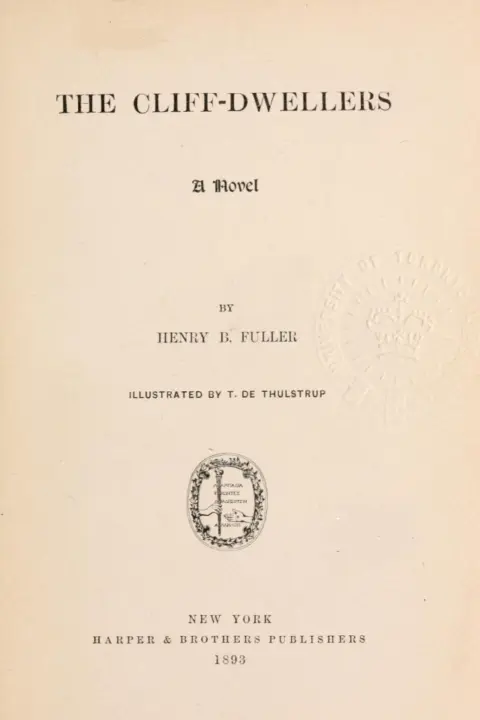
The Cliff-Dwellers: A Novel
Henry Blake Fuller
THE CLASSIC COLLECTION · 1918
"On the Stairs" by Henry Blake Fuller is a novel written in the early 20th century. The narrative unfolds the lives of two boys, Johnny McComas and Raymond Prince, exploring themes of social mobility, identity, and the contrasting paths they take in life. Beginning with their experiences in a school setting in the late 19th century, the story delves into how their social standings evolve over the years. The opening of the novel introduces us to Johnny and Raymond during their youth at Grant's Private Academy in 1873, and then shifts to 1916, highlighting their diverging trajectories. Johnny, who comes from humble beginnings, demonstrates a willingness to adapt and thrive in the business world. In contrast, Raymond, the son of a capitalist family, struggles with his identity and aspirations, feeling out of place in the expectations set by his family. Their relationship is pivotal as they navigate their challenges, with an emphasis on the societal pressures and personal choices that influence their respective fates.
Introduction adapted from the source catalogue; source summaries may be automatically generated.
Free to read · English · 45,794 words · No account needed
MAKE TIME FOR A GOOD BOOK
On by default. Untick to stop anonymous reading totals. Each page counts after 10 seconds in view. How this works.
Anonymous counting is on unless you have switched it off.
As a consequence of my call at Johnny McComas's office (or as a probable consequence), I received, some six months later, an invitation to his wedding. You will expect to hear that I was present, and perhaps acted as usher, or even as best man. Nothing of the sort was the case, however; I was absent at the time in the East. Nor are you to imagine me as continually following, at close range, the vicissitudes, major and minor, which made up his life, or made up Raymond's. An exact, perpetual attendance of fifty years is completely out of the question. Don't expect it.
Johnny married, I was told, a young woman living in his own suburb, the daughter of a manufacturer of some means. I met him about two months after his great step. He was still full of the new life, and full of the new wife.
"She's fine!" he declared. "Not too fine, but fine enough for me."
He cocked his hat to one side.
"Do you know, I talk to her just as I would to a man."
"Johnny!" I began, almost gasping.
"Well, what's wrong? Ever said anything much out of the way to you? Ever heard me say anything to any other fellow?"
"Why, no...." I was obliged to acknowledge.
"Then why the row? It's all easy as an old shoe. She likes it."
"I know. But--talking with a woman ... It isn't quite like...."
"Don't make any mistake. Just have the big things right, and they'll overlook lots of the little ones."
"H'm," I said doubtfully. "I supposed it was just the other way. Lay a lot of stress on certain little things, and larger shortcomings won't bother them. Bring her a bunch of flowers to-day, and she'll help you deed away the house and lot to-morrow."
"Fudge!" said Johnny. "I mean the really big things. There's only two. Ground to stand on and air to breathe."
"That is to say...?"
"A platform under her feet and an atmosphere about her. Well, she's got me to stand on and to surround her. She understands it. She likes it. Nothing else matters much."
"Ah!" said I.
"I'm her bedrock, and I'm her--How do they say it? I'm her--envelopment, as those painting fellows put it."
"See here, Johnny," I protested; "Don't get anachronistic. We are only in 1884. That expression won't reach America for ten or fifteen years. Have some regard for dates."
"It won't? Wasn't it in your friend's letter?"
"What friend?"
"Why, Prince; when he was in Paris. Didn't you read it to me?"
I remembered.
"Do you know," he went on, "I've been straight as a string--ever since. And I'm going to keep so."
Your reading position is saved on this browser. Take it to another device with a library code. Reading pages adapt to text, rather than matching a printed edition.
Henry Blake Fuller
Henry Blake Fuller
Henry Blake Fuller
Henry Blake Fuller
BEHIND THE BOOK
This eBook is for the use of anyone anywhere in the United States and most other parts of the world at no cost and with almost no restrictions whatsoever. You may copy it, give it away or re-use it under the terms of the Project Gutenberg License included with this eBook or online at www.gutenberg.org. If you are not located in the United States, you will have to check the laws of the country where you are located before using this eBook. Read the source licence.
The original source file, including credits and licence, is retained by this library. Request an original-format copy at no charge. Please include the book title and Project Gutenberg identifier #21613.
KEEP YOUR CURIOSITY GOING
Coulson Kernahan

Maurice Baring
Frances Wright
Cécile Tormay

Frederic Jesup Stimson

W. H. P. (William Henry Pope) Jarvis