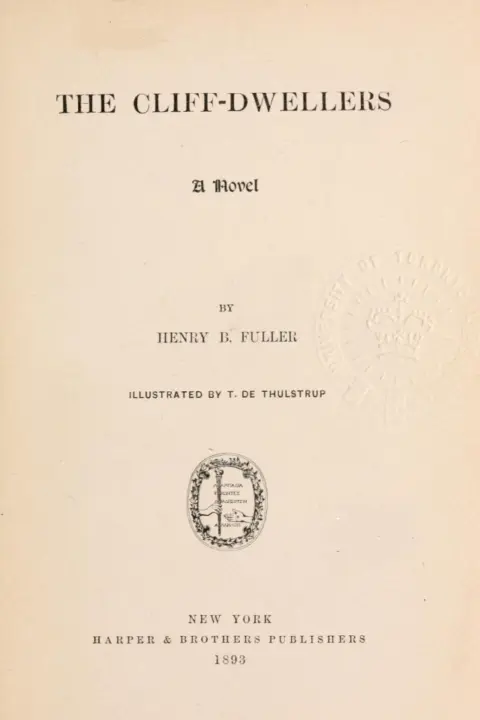
The Cliff-Dwellers: A Novel
Henry Blake Fuller
THE CLASSIC COLLECTION · 1918
"On the Stairs" by Henry Blake Fuller is a novel written in the early 20th century. The narrative unfolds the lives of two boys, Johnny McComas and Raymond Prince, exploring themes of social mobility, identity, and the contrasting paths they take in life. Beginning with their experiences in a school setting in the late 19th century, the story delves into how their social standings evolve over the years. The opening of the novel introduces us to Johnny and Raymond during their youth at Grant's Private Academy in 1873, and then shifts to 1916, highlighting their diverging trajectories. Johnny, who comes from humble beginnings, demonstrates a willingness to adapt and thrive in the business world. In contrast, Raymond, the son of a capitalist family, struggles with his identity and aspirations, feeling out of place in the expectations set by his family. Their relationship is pivotal as they navigate their challenges, with an emphasis on the societal pressures and personal choices that influence their respective fates.
Introduction adapted from the source catalogue; source summaries may be automatically generated.
Free to read · English · 45,794 words · No account needed
MAKE TIME FOR A GOOD BOOK
On by default. Untick to stop anonymous reading totals. Each page counts after 10 seconds in view. How this works.
Anonymous counting is on unless you have switched it off.
I dropped in on Raymond, one evening, at his private hotel. It was about four months after Albert's departure for the West. His quarters seemed as snugly comfortable as ever, and as completely adapted to his ultimately discovered personality and its peculiar requirements. Raymond master of a big house! Raymond leading a public life!
But he himself was perturbed. It was a letter from Albert--it was two or
three letters, in fact.
"He says he is going to marry her."
"Her?"
"Althea. Althea McComas."
Albert, in the West, had done well. He had taken hold immediately, decisively. The initiative which would never have developed under his father had been liberated during his war service and was now mounting to a still higher pitch among the mountains.
"He is going to do," McComas had told me, after the second month. "He is a wonder," he had said, later.
Be that as it may. McComas was doubtless inclined to the favorable view. He had determined in advance that Albert was to succeed. Albert was meeting, successfully, known expectations of success--as a young man may.
"He started so well," said his father. "And now...."
"And now?"
"Now he wants to marry the daughter of a stable-boy!"
"Raymond," I said; "drop the 'stable-boy.' That was never true; and if it were it would have no relevancy here and now."
"I should say not! Why, Albert--"
"You have told him? He knows your--He knows the--the legend?"
"He does. And as you see, it makes no difference to him."
"Why should it? Why should he care for early matters that were over and past long years before he was born? He sees what he sees. He feels what he feels."
"He feels McComas."
"Why shouldn't he? Who wouldn't?"
Raymond relapsed into a moody silence. I saw, presently, that he was trying to break from it. He had another consideration to offer.
"And then," he began, "about--his mother. He must have understood--something. He must know--by now."
"Know?" I returned. "If he does, he has the advantage over all the rest of us. I don't 'know.' You don't 'know.' Neither does anybody else. Another old matter--as well rectified as society and its usages can manage, and best left alone."
"Well, it's--it's indelicate. Albert ought to feel that."
"Raymond!" I protested. "We must leave it to the young to smooth over the rough old places and to salve the aching old sores. That's their great use and function."
"Not Albert's," he said stubbornly. "I don't want him to do it, and I don't want it done in that way."
Another silence. I could see that he was gathering force for still
another objection.
Your reading position is saved on this browser. Take it to another device with a library code. Reading pages adapt to text, rather than matching a printed edition.
Henry Blake Fuller
Henry Blake Fuller
Henry Blake Fuller
Henry Blake Fuller
BEHIND THE BOOK
This eBook is for the use of anyone anywhere in the United States and most other parts of the world at no cost and with almost no restrictions whatsoever. You may copy it, give it away or re-use it under the terms of the Project Gutenberg License included with this eBook or online at www.gutenberg.org. If you are not located in the United States, you will have to check the laws of the country where you are located before using this eBook. Read the source licence.
The original source file, including credits and licence, is retained by this library. Request an original-format copy at no charge. Please include the book title and Project Gutenberg identifier #21613.
KEEP YOUR CURIOSITY GOING
Coulson Kernahan

Maurice Baring
Frances Wright
Cécile Tormay

Frederic Jesup Stimson

W. H. P. (William Henry Pope) Jarvis