THE CLASSIC COLLECTION✦Building the pacific railwayCLASSIC FREE BOOKS
Building the pacific railway
Edwin L. (Edwin Legrand) Sabin
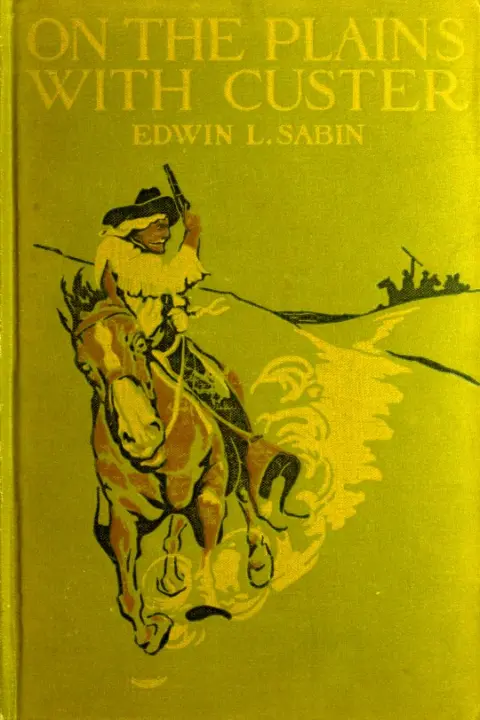
THE CLASSIC COLLECTION · 1913
"On the Plains with Custer" by Edwin L. Sabin is a historical account written in the early 20th century. The work centers around the life and experiences of the young bugler Ned Fletcher during the tumultuous years of the late 1860s and the 1870s when General George Armstrong Custer and the Seventh Cavalry played critical roles in the westward expansion of white civilization and the conflicts with Native American tribes. The narrative offers insights into both the military and everyday life on the American plains during a period of significant historical change. The opening of the book introduces us to Ned Fletcher, a young boy who has escaped from captivity with the Sioux and is navigating the vast and lonely Kansas prairie alone in search of safety and his lost sister. As he wanders, he encounters a herd of buffalo being chased by a horseman, who is revealed to be the famous General Custer. The interaction between Ned and Custer leads to a sense of hope for the boy, who expresses a desire to join the army and find his sister. The early chapters set the tone for an adventure filled with the realities of frontier life, the challenges faced by young soldiers, and the complex relations between white settlers and Native Americans, establishing the groundwork for Ned's journey alongside Custer and the Seventh Cavalry.
Introduction adapted from the source catalogue; source summaries may be automatically generated.
Free to read · English · 68,963 words · No account needed
MAKE TIME FOR A GOOD BOOK
On by default. Untick to stop anonymous reading totals. Each page counts after 10 seconds in view. How this works.
Anonymous counting is on unless you have switched it off.
Serves briefly with the Topographical Engineers, 1862.
Appointed aide-de-camp on the staff of General McClellan, June,
1862, with rank of Captain.
After McClellan’s removal is appointed first lieutenant, Fifth
Cavalry.
On waiting orders, at Monroe, winter of 1862–’63, woos and wins his future wife, Elizabeth Bacon.
Reports for duty as first lieutenant with M Company, Fifth Cavalry, Army of the Potomac, April, 1863.
Appointed aide-de-camp to General Pleasanton, commanding First Division, Cavalry Corps of the Army of the Potomac.
June, 1863, at the age of 23 appointed brigadier general of volunteers, in command of the Second Brigade (the “Michigan” Brigade), Third Division, Cavalry Corps, under General Kilpatrick, and distinguishes himself at the battle of Gettysburg. “The boy general with the golden locks.”
Slightly wounded at Culpepper, September, 1863.
Married, February 4, 1864, at Monroe, Michigan, to Elizabeth Bacon, daughter of Judge Daniel S. Bacon, and takes his bride with him to the brigade headquarters camp.
By Sheridan, the new cavalry commander, is given the advance in
the various raids.
Transferred to command of the Second Division of Cavalry, and finally September, 1864, to that of the Third Division.
October, 1864, aged 25 is brevetted major-general of volunteers, for gallantry. The youngest in the army.
Continues to lead the Third Division of cavalry, which is conspicuous for its discipline, its dash, and the long hair, cavalier hats and flying red neckties of its men, copied after the well-known Custer garb.
Eleven horses are shot under him, in battle. In six months his division captures 111 pieces of field artillery, 65 battle-flags, and 10,000 prisoners including seven generals. It does not lose a flag or a gun or meet defeat.
April 9, 1865, he receives flag of truce conveying the first word that General Lee is considering surrender. Thus “the boy general” has fought through from Bull Run to Appomattox.
At the close of the war is ordered with a division of cavalry
to Texas.
Offered the command of the cavalry of the army of General Juarez, Mexico, in the conflict with Emperor Maximilian; but by Congress is not permitted to accept.
In 1866 brevetted major-general in the regular army, for war
services.
October, 1866, appointed lieutenant-colonel to command the
Seventh United States Cavalry, and ordered to Fort Riley,
Kansas.
Five years of service, 1866–’71, on the plains of Kansas, Nebraska, Colorado and Indian Territory, resulting in the subjugation of the Kiowas, Arapahos, Cheyennes, Comanches and Apaches in that district.
From 1871 to 1873 stationed with his regiment in Kentucky.
Spring of 1873 ordered with his regiment to Fort Rice, Dakota,
for operations among the Sioux. Occupies the new post of Fort
Lincoln.
Engages in campaigns along the Yellowstone River, and explores
and exploits the Black Hills.
Your reading position is saved on this browser. Take it to another device with a library code. Reading pages adapt to text, rather than matching a printed edition.
Edwin L. (Edwin Legrand) Sabin

Edwin L. (Edwin Legrand) Sabin

Edwin L. (Edwin Legrand) Sabin

Edwin L. (Edwin Legrand) Sabin
BEHIND THE BOOK
This eBook is for the use of anyone anywhere in the United States and most other parts of the world at no cost and with almost no restrictions whatsoever. You may copy it, give it away or re-use it under the terms of the Project Gutenberg License included with this eBook or online at www.gutenberg.org. If you are not located in the United States, you will have to check the laws of the country where you are located before using this eBook. Read the source licence.
The original source file, including credits and licence, is retained by this library. Request an original-format copy at no charge. Please include the book title and Project Gutenberg identifier #60157.
KEEP YOUR CURIOSITY GOING
Cécile Tormay

Moritz Busch
Coulson Kernahan
John L. Ransom

Maurice Baring
Frances Wright