
Why not? A book for every woman
Horatio Robinson Storer
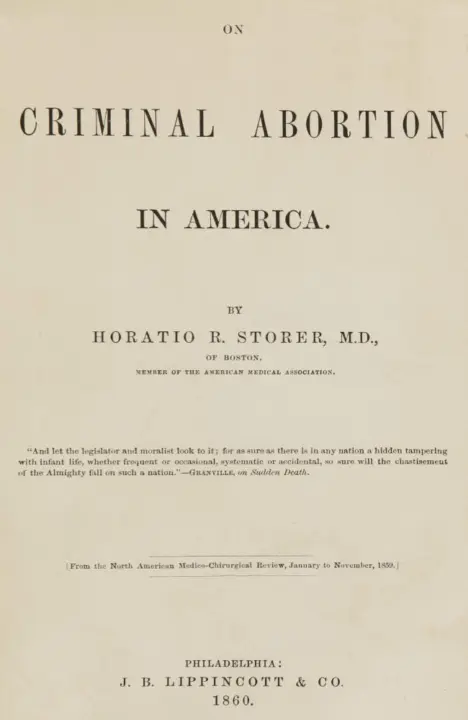
THE CLASSIC COLLECTION · 1860
"On Criminal Abortion in America" by Horatio Robinson Storer is a medical treatise written in the mid-19th century. The work critically examines the legal and moral issues surrounding abortion, highlighting its perceived status as a crime against fetal life that has largely been overlooked by existing laws. Storer argues for the need for a more robust legal framework that reflects society's moral responsibilities toward both mothers and their unborn children. The opening of the text lays the groundwork for a detailed investigation into the complexities and frequency of criminal abortion, outlining the initial assumptions and subsequent arguments necessary for the discourse. Storer addresses the legal ambiguities surrounding abortion, emphasizing that common law and many state codes largely ignore fetal life, positioning the crime as one primarily against the mother. He goes on to assert the necessity of evaluating the frequency and consequences of this practice, suggesting that the medical community has a pivotal role in shaping public sentiment and legal standards regarding abortion. Storer prepares the reader for an exploration of both the legislative deficiencies and the ethical imperative for medical professionals and society as a whole to confront this "great opprobrium of the law."
Introduction adapted from the source catalogue; source summaries may be automatically generated.
Free to read · English · 45,185 words · No account needed
MAKE TIME FOR A GOOD BOOK
On by default. Untick to stop anonymous reading totals. Each page counts after 10 seconds in view. How this works.
Anonymous counting is on unless you have switched it off.
In many countries of Europe, it has been ascertained that the “fecundity” of the population, or the rate of its annual increase, is rapidly diminishing.[9]
In Sweden, it has lessened by one-ninth in 61 years. In Prussia, by a third in 132 years. In Denmark, by a quarter in 82 years. In England, by two-sevenths in a century. In Russia, by an eighth in 28 years. In Spain, by a sixth in 30 years. In Germany, by a thirteenth in 17 years. In France, by a third in 71 years.[10]
Or, in other words:
In Sweden it has lessened by a fifth; in Prussia, by a fourth; in Denmark and England, by a third; and in Russia, Spain, Germany, and France by a half, in a single century.
For the sake of convenience, larger bodies of statistics existing concerning it, and from the fact that it represents the extreme of the alleged decrease, we take France for our comparisons.
In France at large, according to the official returns as analyzed by Legoyt, the increase of the population which, from 1801 to 1806, was at the rate of 1.28 per cent. annually, from 1806 to 1846 had fallen to about .5 per cent.[11] The exact ratio of decrease after this point is better shown by the figures themselves. The increase from 1841 to 1846 was 1,200,000; from 1846 to 1851, 380,000; from 1851 to 1856, 256,000.
In England, during this latter period, with a population of but one-half the size, the returns of the Registrar-General show a relative increase nine times greater.[12] In thirty-seven years, from 1817 to 1854, the mean annual increase in France was not more than 155,929, yet in five years, from 1846 to 1851, it had fallen to 76,000 yearly, and from 1851 to 1856, to 51,200, and this with a population ranging from twenty-nine to thirty-four millions.
A comparison of these facts, with those obtaining in other European States, will make the above still more evident. We now quote from Rau.[13]
Rate of Increase. Per Cent. Hungary, according to Rohrer 2.40 England, from 1811 to 1821 1.78 ” from 1821 to 1831 1.60 Prussia, from 1816 to 1827 1.54 ” from 1820 to 1830 1.37 ” from 1821 to 1831 1.27 Austria, (Rohrer) 1.30 Scotland, from 1821 to 1831 1.30 Netherlands, from 1821 to 1828 1.28 Saxony, from 1815 to 1830 1.15 Baden (Heunisch,) from 1820 to 1830 1.13 Bavaria, from 1814 to 1828 1.08 Naples, from 1814 to 1824 0.83 France (Mathieu,) from 1817 to 1827 0.63 France, more recently, (De Jonnés) 0.55
A similar and corroborative table, containing additional matter, is given by Quetelet;[14] its differences from the preceding are owing to its representing a series of different years.
Rate of Increase.
Per Cent.
Ireland 2.45
Hungary 2.40
Spain 1.66
England 1.65
Rhenish Prussia 1.33
Austria 1.30
Bavaria 1.08
Netherlands 0.94
Naples 0.83
France 0.63
And more recently, Legoyt brings up these results to the close of 1846.[15] As shown by the census, the rate of increase was, in
Per Cent.
Great Britain, exclusive of Ireland 1.95
Prussia 1.84
Saxony 1.45
Norway 1.36
Sardinia 1.08
Holland 0.90
Austria 0.85
Sweden 0.83
France 0.68
Your reading position is saved on this browser. Take it to another device with a library code. Reading pages adapt to text, rather than matching a printed edition.
Horatio Robinson Storer
BEHIND THE BOOK
This eBook is for the use of anyone anywhere in the United States and most other parts of the world at no cost and with almost no restrictions whatsoever. You may copy it, give it away or re-use it under the terms of the Project Gutenberg License included with this eBook or online at www.gutenberg.org. If you are not located in the United States, you will have to check the laws of the country where you are located before using this eBook. Read the source licence.
The original source file, including credits and licence, is retained by this library. Request an original-format copy at no charge. Please include the book title and Project Gutenberg identifier #65244.
KEEP YOUR CURIOSITY GOING

David Patterson (Spirit) Hatch
Cécile Tormay

Moritz Busch
Coulson Kernahan
John L. Ransom

Ralph Waldo Emerson