
Why not? A book for every woman
Horatio Robinson Storer
THE CLASSIC COLLECTION · 1860
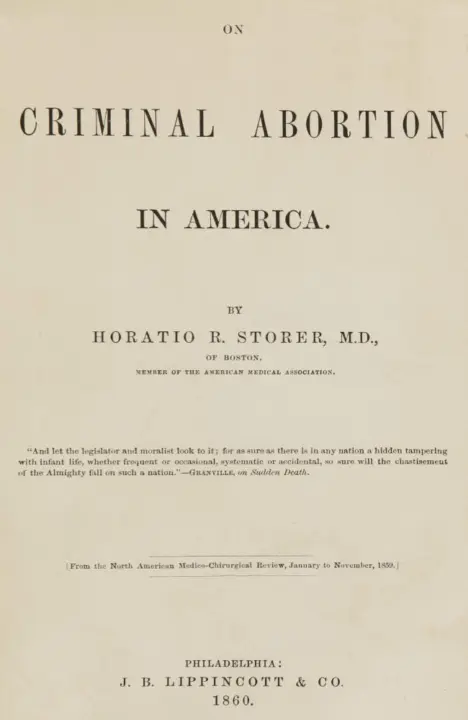
"On Criminal Abortion in America" by Horatio Robinson Storer is a medical treatise written in the mid-19th century. The work critically examines the legal and moral issues surrounding abortion, highlighting its perceived status as a crime against fetal life that has largely been overlooked by existing laws. Storer argues for the need for a more robust legal framework that reflects society's moral responsibilities toward both mothers and their unborn children. The opening of the text lays the groundwork for a detailed investigation into the complexities and frequency of criminal abortion, outlining the initial assumptions and subsequent arguments necessary for the discourse. Storer addresses the legal ambiguities surrounding abortion, emphasizing that common law and many state codes largely ignore fetal life, positioning the crime as one primarily against the mother. He goes on to assert the necessity of evaluating the frequency and consequences of this practice, suggesting that the medical community has a pivotal role in shaping public sentiment and legal standards regarding abortion. Storer prepares the reader for an exploration of both the legislative deficiencies and the ethical imperative for medical professionals and society as a whole to confront this "great opprobrium of the law."
Introduction adapted from the source catalogue; source summaries may be automatically generated.
Free to read · English · 45,185 words · No account needed
MAKE TIME FOR A GOOD BOOK
On by default. Untick to stop anonymous reading totals. Each page counts after 10 seconds in view. How this works.
Anonymous counting is on unless you have switched it off.
From foreign statistics on a large scale, it is found that the proportion of still-births, even allowing a wide margin for criminal causes, does not, in those countries, drop below 1 in 15, and this in France, ranging from that number up to 1 in 30 or 40 of the whole number of births reported. We have already given a table upon this point.
In Geneva, out of 10,925 births occurring from 1824 to 1833, 1221 of them being illegitimate, and therefore to be supposed liable to a large percentage of deaths from criminal causes, there were only 646 fœtal deaths; a proportion of 1 in 17.
In Belgium there were 29,574 illegitimate births from 1841 to 1843, and of these, 1766 were born still;[32] 1 in 16.8.
In New York, from 1854 to 1857, there were 48,323 births, and 5931 still-births, at the full time and prematurely; or in other words, 1 to every 8.1 was born dead.
The ratio of still-births in New York, including, as we have seen, abortions, is steadily increasing, as seen by the following table,[33] in which we have compared the still-births, supposable perhaps of accidental value, with the general mortality, whose value is at least as accidental, if not more so. The evidence, like that already furnished, is astounding.
Total mortality. Still-births. Ratio. 1804 to 1809 13,128 349 1 to 37.6 1809 to 1815 14,011 533 1 to 26.3 1815 to 1825 34,798 1,818 1 to 19.1 1825 to 1835 59,347 3,744 1 to 15.8 1835 to 1855 289,786 21,702 1 to 13.3 1856[34] 21,658 1,943 1 to 11.1
The frequency of abortions and premature births reported from the practice of physicians, and thus to a certain extent, but not entirely, likely to be of natural or accidental origin, is as follows:—
In 41,699 cases registered by Collins, Beatty, La Chapelle, Churchill, and others,[35] there were 530 abortions and miscarriages. Here all the abortions were known; their proportion was 1 in 78.5.
In New York, from 1854 to 1857, there were 48,323 births at the full time reported, and 1196 premature. Here all the abortions were not known, probably but a very small fraction of them; the proportion was 1 in 40.4.
Finally, we compare the recorded premature still-births of New York, with those still at the full time.
In the seventeen years from 1838 to 1855,[36] there were reported 17,237 still-births at the full time, and 2710 still prematurely; the last bearing the proportion of 1 to 6.3.
In the nine years, from 1838 to 1847, omitting 1842 for reasons stated below, there were 632 premature still-births, and 6445 still at the full time; a yearly average of 1 in 10.2.
In the eight years, from 1848 to 1855, there were 2078 premature still-births, and 10,792 still at the full time; an average of 1 in 5.
While in 1856 there were 387 still prematurely, and 1556 at the full
time; or 1 in 4.02.
Your reading position is saved on this browser. Take it to another device with a library code. Reading pages adapt to text, rather than matching a printed edition.
Horatio Robinson Storer
BEHIND THE BOOK
This eBook is for the use of anyone anywhere in the United States and most other parts of the world at no cost and with almost no restrictions whatsoever. You may copy it, give it away or re-use it under the terms of the Project Gutenberg License included with this eBook or online at www.gutenberg.org. If you are not located in the United States, you will have to check the laws of the country where you are located before using this eBook. Read the source licence.
The original source file, including credits and licence, is retained by this library. Request an original-format copy at no charge. Please include the book title and Project Gutenberg identifier #65244.
KEEP YOUR CURIOSITY GOING

David Patterson (Spirit) Hatch
Cécile Tormay

Moritz Busch
Coulson Kernahan
John L. Ransom

Ralph Waldo Emerson