
Why not? A book for every woman
Horatio Robinson Storer
THE CLASSIC COLLECTION · 1860
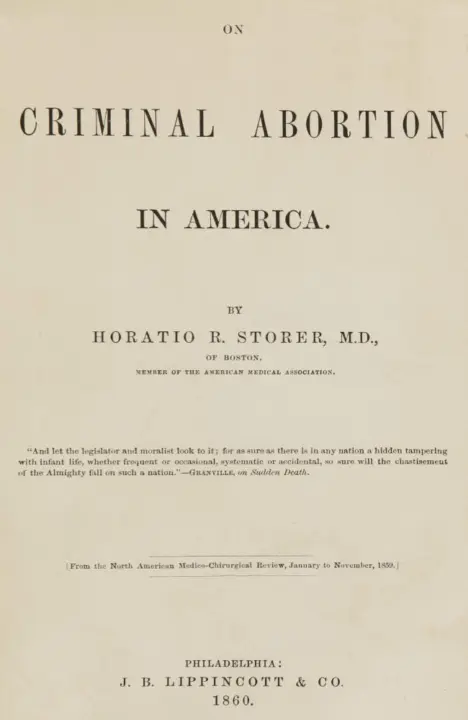
"On Criminal Abortion in America" by Horatio Robinson Storer is a medical treatise written in the mid-19th century. The work critically examines the legal and moral issues surrounding abortion, highlighting its perceived status as a crime against fetal life that has largely been overlooked by existing laws. Storer argues for the need for a more robust legal framework that reflects society's moral responsibilities toward both mothers and their unborn children. The opening of the text lays the groundwork for a detailed investigation into the complexities and frequency of criminal abortion, outlining the initial assumptions and subsequent arguments necessary for the discourse. Storer addresses the legal ambiguities surrounding abortion, emphasizing that common law and many state codes largely ignore fetal life, positioning the crime as one primarily against the mother. He goes on to assert the necessity of evaluating the frequency and consequences of this practice, suggesting that the medical community has a pivotal role in shaping public sentiment and legal standards regarding abortion. Storer prepares the reader for an exploration of both the legislative deficiencies and the ethical imperative for medical professionals and society as a whole to confront this "great opprobrium of the law."
Introduction adapted from the source catalogue; source summaries may be automatically generated.
Free to read · English · 45,185 words · No account needed
MAKE TIME FOR A GOOD BOOK
On by default. Untick to stop anonymous reading totals. Each page counts after 10 seconds in view. How this works.
Anonymous counting is on unless you have switched it off.
Again, of the 692 fœtuses of less than nine months, deposited at the Morgue during these eighteen years, 295 were between 1836 to 1845, an average, at that time, of 32.7 yearly; and from 1846 to 1855 there were 397, an average of 44.1. During the means of these periods the births in France were as follows[28]:—In 1841, 1,005,203, and in 1851, 1,037,040, from which it is evident that there was deposited at the Morgue, in 1841, one infant, dead from abortion, to every 30,700 births; and in 1851, one to every 23,500. The increased ratio is seen to be striking; it will hereafter become apparent that the increase is far greater in reality.
We turn now to our own country, to which the City of New York holds much the same relation, as respects public opinion no less than in other matters, that Paris holds to France.
Since 1805, when returns were first made to the Registry of New York, the number, proportionate as well as actual, of fœtal deaths, has steadily and rapidly increased. With a population at that time (1805) of 76,770, the number of still and premature births was 47; in 1849, with a population estimated at 450,000, the number had swelled to 1320.[29] Thus, while the population had increased only six times since 1805, the annual number of still and premature births had multiplied over twenty-seven times.
The following table shows the rapidity of this increase:—The ratio of fœtal deaths to the population, was in
1805 1 to 1633.40
1810 1 to 1025.24
1815 1 to 986.46
1820 1 to 654.52
1825 1 to 680.68
1830 1 to 597.60
1835 1 to 569.88
1840 1 to 516.02
1845 1 to 384.68
1849 1 to 340.90
In the three years preceding 1849, there were registered in New York 400 premature births, and 3139 children still-born; a total of 3539, representing at that time a yearly average of some 1200 fœtal deaths. While it will be shown hereafter that a large proportion of the reported premature births must always be from criminal causes, and that though almost all the still-births at the full time, even from infanticide, are necessarily registered, but a small proportion of the abortions and miscarriages occurring are ever reported to the proper authorities, it will immediately be made apparent that at the present moment the abortion statistics of New York are far above those of 1849.
In the three years preceding 1857, there were registered in New York 1196 premature, and 4735 still-births,[30] a total of 5931, representing a yearly average of some 2000 fœtal deaths; showing that in the short space of seven years, the number of fœtal deaths in New York, already enormous, had very nearly doubled.
Again, in 1856, the total number of births at the full time in New York, was 17,755; of these, 16,199 were living;[31] proving that of children at the full time alone, setting aside the great number of viable children born prematurely, and the innumerable earlier abortions not recorded, one in every 11.4 is born dead.
Your reading position is saved on this browser. Take it to another device with a library code. Reading pages adapt to text, rather than matching a printed edition.
Horatio Robinson Storer
BEHIND THE BOOK
This eBook is for the use of anyone anywhere in the United States and most other parts of the world at no cost and with almost no restrictions whatsoever. You may copy it, give it away or re-use it under the terms of the Project Gutenberg License included with this eBook or online at www.gutenberg.org. If you are not located in the United States, you will have to check the laws of the country where you are located before using this eBook. Read the source licence.
The original source file, including credits and licence, is retained by this library. Request an original-format copy at no charge. Please include the book title and Project Gutenberg identifier #65244.
KEEP YOUR CURIOSITY GOING

David Patterson (Spirit) Hatch
Cécile Tormay

Moritz Busch
Coulson Kernahan
John L. Ransom

Ralph Waldo Emerson