
Why not? A book for every woman
Horatio Robinson Storer
THE CLASSIC COLLECTION · 1860
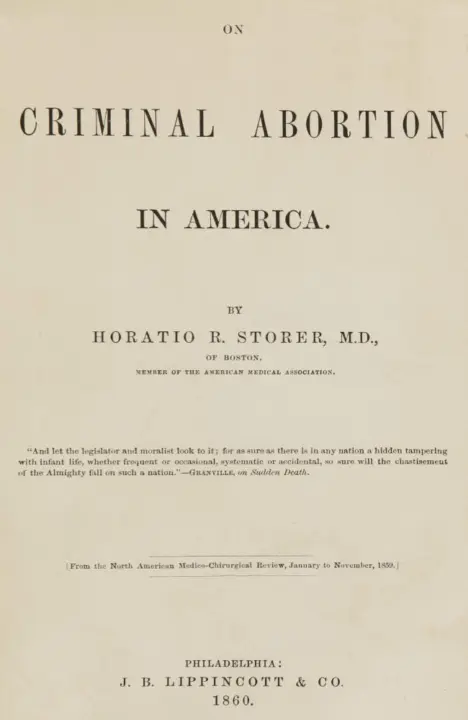
"On Criminal Abortion in America" by Horatio Robinson Storer is a medical treatise written in the mid-19th century. The work critically examines the legal and moral issues surrounding abortion, highlighting its perceived status as a crime against fetal life that has largely been overlooked by existing laws. Storer argues for the need for a more robust legal framework that reflects society's moral responsibilities toward both mothers and their unborn children. The opening of the text lays the groundwork for a detailed investigation into the complexities and frequency of criminal abortion, outlining the initial assumptions and subsequent arguments necessary for the discourse. Storer addresses the legal ambiguities surrounding abortion, emphasizing that common law and many state codes largely ignore fetal life, positioning the crime as one primarily against the mother. He goes on to assert the necessity of evaluating the frequency and consequences of this practice, suggesting that the medical community has a pivotal role in shaping public sentiment and legal standards regarding abortion. Storer prepares the reader for an exploration of both the legislative deficiencies and the ethical imperative for medical professionals and society as a whole to confront this "great opprobrium of the law."
Introduction adapted from the source catalogue; source summaries may be automatically generated.
Free to read · English · 45,185 words · No account needed
MAKE TIME FOR A GOOD BOOK
On by default. Untick to stop anonymous reading totals. Each page counts after 10 seconds in view. How this works.
Anonymous counting is on unless you have switched it off.
Or, as shown by the annual excess of births over deaths, and therefore
more reliable—
Per Cent.
Norway 1.30
Prussia 1.18
Sweden 1.14
Holland 1.03
Wurtemberg 1.00
Great Britain, exclusive of Ireland 1.00
Denmark 0.95
Austria 0.90
Saxony 0.90
Hanover 0.85
Belgium 0.76
Bavaria 0.71
Russia 0.61
France 0.50
In four departments of France, among which are two of the most thriving of Normandy, the deaths actually exceed the births.[16]
From the above facts, it would naturally be supposed that the percentage of births to the whole population must be smaller than in other European countries, and from the lessened annual rate of increase of the population, that the proportionate number of births must be decreasing in similar ratio. This is found, indeed, to be the case.
From large statistics furnished by De Jonnés, we have compiled the following table of the comparative ratios of births to the population in the principal countries of Europe:—
Ratio. Venice and Dependencies, 1827 1 to 23 Tuscany, 1834 ” Lombardy, 1828 1 to 24 Russia, 1835 1 to 25 Wurtemberg, 1821 to 1827 ” Prussia, 1836 ” Mecklenburg, 1826 1 to 26 Sardinia, 1820 ” Naples and Dependencies, 1830 ” Greece, 1828 ” Poland, 1830 1 to 27 Ireland, 1821 to 1831 ” Germany, 1828 ” Switzerland, 1828 ” Spain, 1826 ” Portugal, 1815 to 1819 1 to 27.5 Sweden, 1825 1 to 28 Holland, 1832 ” Austria, 1829 ” Belgium, 1836 ” Bavaria, 1825 ” Two Sicilies, 1831 ” Sweden and Norway, 1828 1 to 30 Denmark, 1833 ” Roman States, 1836 ” Turkey, 1835 ” Hanover, 1835 1 to 31 Sicily, 1832 ” Austria, 1828 to 1830 1 to 32 Great Britain, 1821 to 1831 ” Scotland, 1821 to 1831 1 to 34 England, 1821 to 1831 1 to 35 Norway, 1832 ” France, 1771 to 1851 1 to 25 to 1 to 37
In a total population, at different periods, of 232,673,000, there were 8,733,000 births; whence an average on the grand scale of one birth to every 26.6 individuals.
In France, however, the ratio has been steadily lessening, as seen by the
following table:—
Ratio of births.
1771 to 1775 1 to 25
1801 to 1810 1 to 30
1811 to 1825 1 to 32
1826 to 1836 1 to 33
1836 to 1840 1 to 34
1841 to 1845 1 to 35
1846 to 1850 1 to 37
The position of France, as compared with the rest of Europe, in respect to the ratio of births to the population at different periods, is made still more manifest by another table:—
Annual ratio of births. 1 to 23 Venetian Provinces, 1827; Tuscany, 1834. 1 to 23.5 Kingdom of Naples, 1822 to 1824. 1 to 24 Tuscany, 1818; Sicily, 1824; Lombardy, 1827 to 1828; Russia, 1831. 1 to 24.5 Prussia, 1825 to 1826. 1 to 25 France, 1781; Austria, 1827; Russia, 1835; Prussia, 1836. 1 to 26 Sardinia, 1820; Hanover, Wurtemberg and Mecklenburg, 1826; Greece, 1828; Naples, 1830. 1 to 27 Spain, 1826; Germany and Switzerland, 1828; Poland, 1830; Ireland, 1831. 1 to 27.5 Portugal, 1815 to 1819. 1 to 28 Holland, 1813 to 1824; Bavaria and Sweden, 1825; Austria, 1829; Belgium, 1836. 1 to 29 Canton Lucerne, 1810; Holland, 1832. 1 to 29.8 France, 1801. 1 to 30 Sweden and Norway, 1828; Belgium, 1832; Denmark, 1833; Turkey, 1835; States of the Church, 1836. 1 to 31 Sicily, 1832; Hanover, 1835. 1 to 31.4 France, 1811. 1 to 31.6 France, 1821. 1 to 32 Austria, 1830; Great Britain and Switzerland, 1831. 1 to 33 France, 1828 to 1831. 1 to 34 Norway and Holstein, 1826; Scotland, 1831; France, 1834 to 1841. 1 to 35 Denmark, 1810; England, 1831; Norway, 1832. 1 to 37 France, 1851.
Your reading position is saved on this browser. Take it to another device with a library code. Reading pages adapt to text, rather than matching a printed edition.
Horatio Robinson Storer
BEHIND THE BOOK
This eBook is for the use of anyone anywhere in the United States and most other parts of the world at no cost and with almost no restrictions whatsoever. You may copy it, give it away or re-use it under the terms of the Project Gutenberg License included with this eBook or online at www.gutenberg.org. If you are not located in the United States, you will have to check the laws of the country where you are located before using this eBook. Read the source licence.
The original source file, including credits and licence, is retained by this library. Request an original-format copy at no charge. Please include the book title and Project Gutenberg identifier #65244.
KEEP YOUR CURIOSITY GOING

David Patterson (Spirit) Hatch
Cécile Tormay

Moritz Busch
Coulson Kernahan
John L. Ransom

Ralph Waldo Emerson