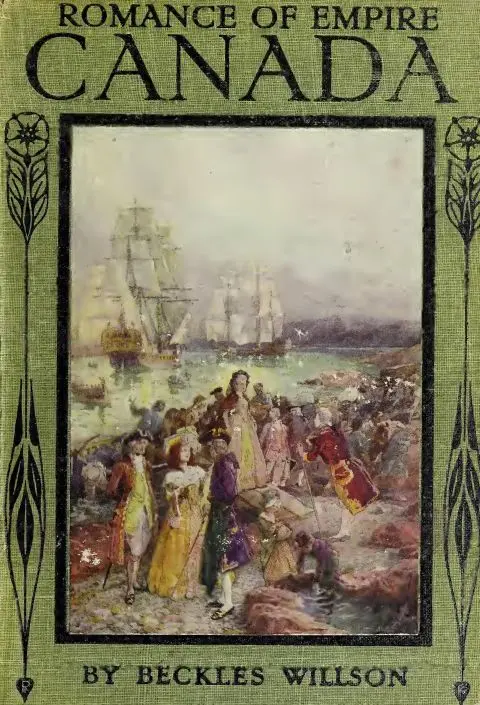
Canada
Beckles Willson
THE CLASSIC COLLECTION · 1911
"Nova Scotia" by Beckles Willson is a historical and travel account written in the early 20th century. The work offers a vivid portrait of the province’s past and present—its exploration and settlement, coastal and rural landscapes, towns and industries, and self-image—while advocating that immigrants and travelers consider this often-overlooked “front door” to Canada. Blending history, anecdote, and on-the-ground observation, it moves place by place (notably Halifax, the Annapolis Valley, Cape Breton, and Windsor) with illustrations and local color.
The opening of this work begins with an introduction by Nova Scotia’s premier praising the province’s resources, technical education, and promise for immigrants, followed by a provocative preface in which the author contrasts the West’s immigration boom with Nova Scotia’s steadier, more “British” character. It then shifts to a traveler’s approach by sea and an argument that the province has been “passed by” through lack of promotion, before launching into a brisk early history: Norse sightings, Cabot, French Acadia at Port Royal (with Champlain’s “Order of Good Time”), English raids, and the long Anglo-French struggle. A substantial section recounts Sir William Alexander’s charter, the Nova Scotia baronetcies, faltering Scottish settlement, and France’s temporary resurgence, leading to Britain’s eventual hold on the mainland and the later Loyalist influx. The narrative next sketches the province’s character—predominantly Scottish with Gaelic communities—then swiftly surveys its geography from rugged Atlantic shores to Fundy tides, the apple-rich Annapolis Valley, and Cape Breton’s Bras d’Or. It touches on identity and memory (“Blue-nose,” Joseph Howe, notable Nova Scotians), and turns to Halifax: its great harbour, garrison and naval heritage, Dickens’s admiring arrival, critiques of wooden architecture, the transition to Canadian control, St. Paul’s church, a debated new cathedral, and Sandford Fleming’s memorial tower. The opening also notes the rise of technical education and industry (the Technical College, dry dock), and acknowledges Black and Maroon communities around Halifax. It closes by turning inland to Windsor—home of King’s College and associated with “Sam Slick”—introducing its schools, setting, and genteel tone.
Introduction adapted from the source catalogue; source summaries may be automatically generated.
Free to read · English · 71,639 words · No account needed
MAKE TIME FOR A GOOD BOOK
On by default. Untick to stop anonymous reading totals. Each page counts after 10 seconds in view. How this works.
Anonymous counting is on unless you have switched it off.
Yet the Blue-nose is first and foremost a fisherman.
When all is said of Nova Scotia’s varied resources of farm and factory, and mine and forest, there is still to be told the tale garnished with adventure of the great and abiding interest of the peninsula and the island—the Nova Scotian fisheries. Of a total population of half a million souls in this province, over 40,000 men are engaged in the fisheries. This will seem a stupendous and utterly unreasonable proportion until I explain that the occupations of fisherman and farmer, fisherman and forester, even fisherman and miner, overlap in many districts, giving rise to a curious combination of characteristics in the same individual, which I had previously noticed amongst the fishermen-miners-farmers of Newfoundland.
The sea-coast of the Maritime Provinces from the Bay of Fundy to the strait of Belle Isle measures some 5600 miles, or about double that of the United Kingdom. In this magnificent fishing field the Nova Scotian is lord paramount, although others have at various times sought to share them with him.
The total fisheries of Canada, the largest in the world, are valued to-day at $25,500,000, of which Nova Scotia’s share is $7,632,330, or nearly one-third of the whole. All along this extensive sea-coast, in the bays, and harbours, and inlets from Cape North to Cape Sable, for generations boats have been putting out, manned by hardy stalwart men who go to brave the perils of the deep, and there are many perils in these latitudes, besides much cold and privation, in order to reap a harvest of cod, lobster, mackerel, haddock, and herring.[19]
Besides manning their own craft, the Nova Scotians, like the Newfoundlander, mans the vessels of other countries, especially American and British. The bulk of the product goes to America, although for nearly a century an important market has been found in the West Indies and South America, while the trade with Great Britain, France, Italy, Germany, and Portugal is increasing annually.
[Footnote 19: The following table shows the number of men reported as employed in the fisheries of Nova Scotia, and the value of boats and fishing material for the year 1910-11:—
Number. Value. Vessels (tons, 19,657) 630 $891,710 Boats (gasolene) 1,466} Boats (sail) 12,655} =781,724 Tugs and smacks 164 193,730 Gill nets (1,682,522 fathoms) ... 555,374 Seines (170,809 fathoms) ... 170,375 Trap and smelt nets 1,186 119,276 Weirs 144 25,145 Trawls 13,763 133,848 Hand lines 43,900 32,936 Lobster canneries 214 226,780 Lobster traps 720,577 606.851 Freezers and ice houses 345 321,040 Smoke and fish houses 5,705 488,203 Piers and wharves 2,326 787,100 —————— ——————— Total $5,334,083
Under the proposed Reciprocity Agreement with the United States the fishing industry of the Province would have been vitally affected, to Nova Scotia’s advantage.
Your reading position is saved on this browser. Take it to another device with a library code. Reading pages adapt to text, rather than matching a printed edition.
Beckles Willson
Beckles Willson
BEHIND THE BOOK
This eBook is for the use of anyone anywhere in the United States and most other parts of the world at no cost and with almost no restrictions whatsoever. You may copy it, give it away or re-use it under the terms of the Project Gutenberg License included with this eBook or online at www.gutenberg.org. If you are not located in the United States, you will have to check the laws of the country where you are located before using this eBook. Read the source licence.
The original source file, including credits and licence, is retained by this library. Request an original-format copy at no charge. Please include the book title and Project Gutenberg identifier #77572.
KEEP YOUR CURIOSITY GOING
Wilfrid Scawen Blunt
Wilfrid Scawen Blunt

E. W. (Edgar Watson) Howe
Francis Greenleaf Allinson & Anne C. E. (Anne Crosby Emery) Allinson
Cyrenus Cole

John Martineau