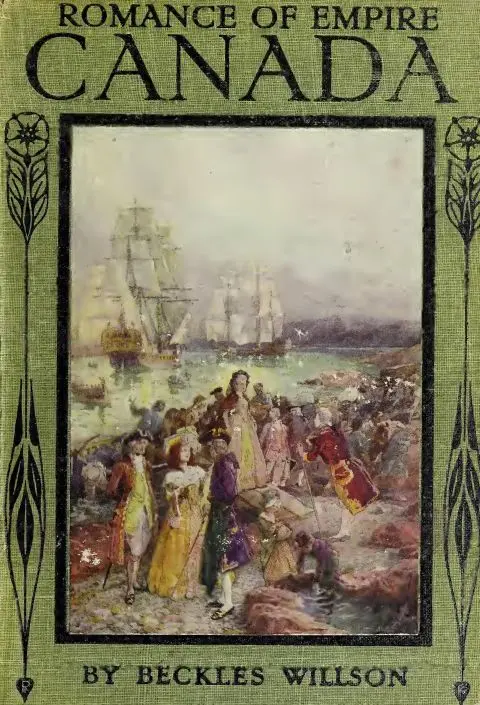
Canada
Beckles Willson
THE CLASSIC COLLECTION · 1911
"Nova Scotia" by Beckles Willson is a historical and travel account written in the early 20th century. The work offers a vivid portrait of the province’s past and present—its exploration and settlement, coastal and rural landscapes, towns and industries, and self-image—while advocating that immigrants and travelers consider this often-overlooked “front door” to Canada. Blending history, anecdote, and on-the-ground observation, it moves place by place (notably Halifax, the Annapolis Valley, Cape Breton, and Windsor) with illustrations and local color.
The opening of this work begins with an introduction by Nova Scotia’s premier praising the province’s resources, technical education, and promise for immigrants, followed by a provocative preface in which the author contrasts the West’s immigration boom with Nova Scotia’s steadier, more “British” character. It then shifts to a traveler’s approach by sea and an argument that the province has been “passed by” through lack of promotion, before launching into a brisk early history: Norse sightings, Cabot, French Acadia at Port Royal (with Champlain’s “Order of Good Time”), English raids, and the long Anglo-French struggle. A substantial section recounts Sir William Alexander’s charter, the Nova Scotia baronetcies, faltering Scottish settlement, and France’s temporary resurgence, leading to Britain’s eventual hold on the mainland and the later Loyalist influx. The narrative next sketches the province’s character—predominantly Scottish with Gaelic communities—then swiftly surveys its geography from rugged Atlantic shores to Fundy tides, the apple-rich Annapolis Valley, and Cape Breton’s Bras d’Or. It touches on identity and memory (“Blue-nose,” Joseph Howe, notable Nova Scotians), and turns to Halifax: its great harbour, garrison and naval heritage, Dickens’s admiring arrival, critiques of wooden architecture, the transition to Canadian control, St. Paul’s church, a debated new cathedral, and Sandford Fleming’s memorial tower. The opening also notes the rise of technical education and industry (the Technical College, dry dock), and acknowledges Black and Maroon communities around Halifax. It closes by turning inland to Windsor—home of King’s College and associated with “Sam Slick”—introducing its schools, setting, and genteel tone.
Introduction adapted from the source catalogue; source summaries may be automatically generated.
Free to read · English · 71,639 words · No account needed
MAKE TIME FOR A GOOD BOOK
On by default. Untick to stop anonymous reading totals. Each page counts after 10 seconds in view. How this works.
Anonymous counting is on unless you have switched it off.
Once again we approach a district of memories—the seat
of the long feud between French and English for the
mastery of Acadia.
In the county of Cumberland, on the south-western side of the narrow isthmus severing the Bay of Fundy from Northumberland Straits, and on the edge of the Province, surrounded by marshes, is the small and flourishing town of Amherst. Flourishes indeed, blossoms all the year round with an unconquerable prosperity—-the very type of “hustling,” boosting, busy little town one sees in the West, resolved never to look backward, and Mark Tapley like, to be cheerful and smiling under any and all circumstances. Such is the little town on the little Amherst River, named after the victor of Montreal, to whom the French surrendered Canada. “Busy Amherst,” as it likes to proclaim itself, even on the sign at the railway station.
Amherst, I was told, “claimed a population of 8000.” The “claim” really turned out to be short of the truth, perhaps to the surprise of Moncton and Frederickton across the border. For after all, had it been an exaggeration, one sees it is only a cheerful symptom and aspiration of growth. Here you find growth must not be spiritual, or intellectual, or artistic, but material. For has not the great apostle of Imperialism in our time told Canada, “Get population and all these things will be added unto you.” Of what value are the doubters here? And with what perplexity would an Amherstian hearken to the plaint my ears have heard in many English towns and villages, “Alas, I fear the town is growing. It is no longer what it was.” The vain sighers after a London or a Bexborough, “small, white, and clean,” would meet with scant sympathy in Amherst. But Amherst is still only in the first stages of its journey, and it is still, with all its aspirations towards Pittsburg or Lowell, still a pleasant country town filled with a pleasant people intensely attached to Amherst. Even politics are not taken seriously, otherwise how account for that bewildering phenomenon which met my eyes on the second floor of a handsome building in the heart of the town. Can you conceive of Mr. Pott of the Eatanswill Gazette and the editor of the Independent of the same town, not merely dwelling in unity under the same roof, but holding forth in the same office, even going to the incredible extent of assisting one another in the stress of production! Yet this is the case of the editors of the Amherst News, a Liberal organ, and the Amherst Courier, a Conservative organ. What a lesson in professional amity! It is not as if party feeling did not run high in the press of Nova Scotia. Alas, it runs as high and as tempestuously as ever it did at Eatanswill, if one is to judge from the columns of the two rival Halifax papers. One can imagine the weary editor of the News saying one evening to the editor of the Courier, “My dear sir, would you mind finishing this editorial for me? I am sorry I must run away to keep an appointment. Just go on from this sentence:—‘Borden, the leader of a discredited, disheartened, and disorganised gang of Tory office-seekers, is endeavouring to fling his disgraceful wiles over the Western farmers, but....’” “I’ll do it with pleasure,” returns the editor of the Courier. “Leave it to me, I see the point,” and taking up a pen he continues tranquilly, “but as the News has long since pointed out in our merciless exposé of Tory methods and Tory prevarication, these tactics are only laughed at by the sturdy commonsense yeomen of Manitoba, Saskatchewan,” &c., &c. Or, if it is the other way about, the News man boldly (but merely professionally) declares in the columns of the Courier that “Laurier and his renegade troop may extract what satisfaction they like from the howls and cheers of their Yankee, Armenian, Hungarian, and Doukhobor supporters in the north-west who masquerade as loyal Britons and Free-traders, but who, as we have so often shown,” &c.
Your reading position is saved on this browser. Take it to another device with a library code. Reading pages adapt to text, rather than matching a printed edition.
Beckles Willson
Beckles Willson
BEHIND THE BOOK
This eBook is for the use of anyone anywhere in the United States and most other parts of the world at no cost and with almost no restrictions whatsoever. You may copy it, give it away or re-use it under the terms of the Project Gutenberg License included with this eBook or online at www.gutenberg.org. If you are not located in the United States, you will have to check the laws of the country where you are located before using this eBook. Read the source licence.
The original source file, including credits and licence, is retained by this library. Request an original-format copy at no charge. Please include the book title and Project Gutenberg identifier #77572.
KEEP YOUR CURIOSITY GOING
Wilfrid Scawen Blunt
Wilfrid Scawen Blunt

E. W. (Edgar Watson) Howe
Francis Greenleaf Allinson & Anne C. E. (Anne Crosby Emery) Allinson
Cyrenus Cole

John Martineau