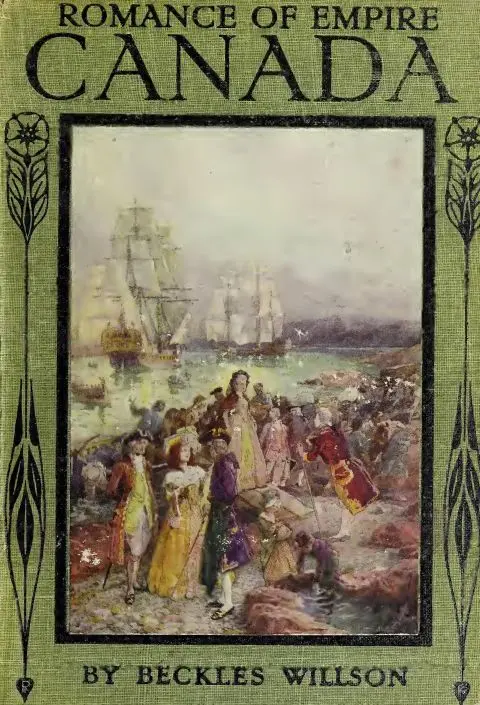
Canada
Beckles Willson
THE CLASSIC COLLECTION · 1911
"Nova Scotia" by Beckles Willson is a historical and travel account written in the early 20th century. The work offers a vivid portrait of the province’s past and present—its exploration and settlement, coastal and rural landscapes, towns and industries, and self-image—while advocating that immigrants and travelers consider this often-overlooked “front door” to Canada. Blending history, anecdote, and on-the-ground observation, it moves place by place (notably Halifax, the Annapolis Valley, Cape Breton, and Windsor) with illustrations and local color.
The opening of this work begins with an introduction by Nova Scotia’s premier praising the province’s resources, technical education, and promise for immigrants, followed by a provocative preface in which the author contrasts the West’s immigration boom with Nova Scotia’s steadier, more “British” character. It then shifts to a traveler’s approach by sea and an argument that the province has been “passed by” through lack of promotion, before launching into a brisk early history: Norse sightings, Cabot, French Acadia at Port Royal (with Champlain’s “Order of Good Time”), English raids, and the long Anglo-French struggle. A substantial section recounts Sir William Alexander’s charter, the Nova Scotia baronetcies, faltering Scottish settlement, and France’s temporary resurgence, leading to Britain’s eventual hold on the mainland and the later Loyalist influx. The narrative next sketches the province’s character—predominantly Scottish with Gaelic communities—then swiftly surveys its geography from rugged Atlantic shores to Fundy tides, the apple-rich Annapolis Valley, and Cape Breton’s Bras d’Or. It touches on identity and memory (“Blue-nose,” Joseph Howe, notable Nova Scotians), and turns to Halifax: its great harbour, garrison and naval heritage, Dickens’s admiring arrival, critiques of wooden architecture, the transition to Canadian control, St. Paul’s church, a debated new cathedral, and Sandford Fleming’s memorial tower. The opening also notes the rise of technical education and industry (the Technical College, dry dock), and acknowledges Black and Maroon communities around Halifax. It closes by turning inland to Windsor—home of King’s College and associated with “Sam Slick”—introducing its schools, setting, and genteel tone.
Introduction adapted from the source catalogue; source summaries may be automatically generated.
Free to read · English · 71,639 words · No account needed
MAKE TIME FOR A GOOD BOOK
On by default. Untick to stop anonymous reading totals. Each page counts after 10 seconds in view. How this works.
Anonymous counting is on unless you have switched it off.
A French officer reported that Louisbourg was so strong that it might be held against any assault by an army of women. Yet English prisoners who had dwelt in the fortress believed Louisbourg might be taken, and their hopes were eagerly seized upon and shared by Governor Shirley of Massachusetts, a lawyer by profession, full of energy and enterprise, who now resolved upon the capture of Louisbourg. Unless the English had control of the whole coast from Cape Sable to the mouth of the St. Lawrence, the safety, nay, the very existence of New England was in constant jeopardy. The discontent and bad discipline of the Louisbourg garrison, which consisted of 1300 men, was a promising factor. The ramparts were, moreover, said to be defective in more than one place, and, besides this, if the French ships which came over sea with provisions and reinforcements could be intercepted, Shirley felt there was no small chance of success. He wrote instantly to London asking the Government to help him with ships. Without waiting for a reply a little fleet was raised, and a land force of 4000 men, chiefly composed of artisans, farmers, fishermen, and labourers, commanded by a merchant named Pepperell, was mustered for the expedition. Although lacking military experience, Pepperell possessed courage and good judgment, and was anxious to distinguish himself. On the 24th March 1745 the ships left Boston, reaching Canso ten days later. Here they remained three weeks, waiting for the ice to melt in the bays and harbours. Here, too, they were joined by the English commodore, Warren, whom King George had sent to assist in the capture of Louisbourg.
The command of Louisbourg was in the hands of M. Duchambon. One night, just after a public ball, a captain, attired in his night-clothes, came rushing into the Governor’s chamber to report that a strange fleet had been sighted by the sentries entering Gabarus Bay, five miles distant. Soon the cannons were booming loudly from the walls, and a peal of bells rang through the town. Pepperell made a pretence of landing his troops at a certain point so as to deceive the French. A skirmish took place, in which the French were beaten back and some of them taken prisoners. Before nightfall 2000 of the New Englanders had planted foot on the shore, and the next day the siege of Louisbourg was begun. A hard and dangerous task was the landing of the artillery and stores, owing to the rolling surf. There being no wharf, the men had to wade through the sea to bring the guns, ammunition, and provisions on shore. This alone consumed an entire fortnight. Batteries were thrown up, in spite of sallies made from the town by French and Indians to prevent them. An outside battery was captured, mounted with twenty-eight heavy guns, which now belched forth shot and shell amongst the besieged. Warehouses and other places took fire, and great columns of smoke hid the fort from view for days at a time. The walls were at last seen to crumble, and when the guns of the Americans began to close up on the fortress, Duchambon summoned to surrender, replied that he would when forced to do so by the cannon of the foe. Upon the island battery being silenced, the English fleet entered the harbour and turned upon him its 500 guns. Duchambon’s supply of gunpowder being now exhausted, Louisbourg surrendered after a siege lasting forty-nine days.
Your reading position is saved on this browser. Take it to another device with a library code. Reading pages adapt to text, rather than matching a printed edition.
Beckles Willson
Beckles Willson
BEHIND THE BOOK
This eBook is for the use of anyone anywhere in the United States and most other parts of the world at no cost and with almost no restrictions whatsoever. You may copy it, give it away or re-use it under the terms of the Project Gutenberg License included with this eBook or online at www.gutenberg.org. If you are not located in the United States, you will have to check the laws of the country where you are located before using this eBook. Read the source licence.
The original source file, including credits and licence, is retained by this library. Request an original-format copy at no charge. Please include the book title and Project Gutenberg identifier #77572.
KEEP YOUR CURIOSITY GOING
Wilfrid Scawen Blunt
Wilfrid Scawen Blunt

E. W. (Edgar Watson) Howe
Francis Greenleaf Allinson & Anne C. E. (Anne Crosby Emery) Allinson
Cyrenus Cole

John Martineau