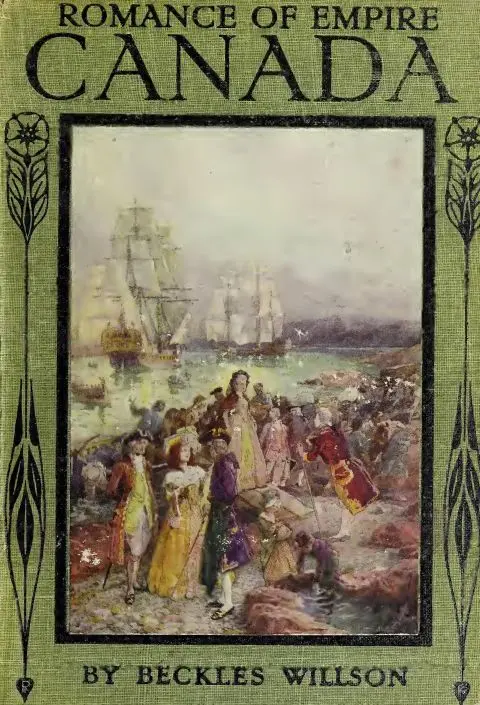
Canada
Beckles Willson
THE CLASSIC COLLECTION · 1911
"Nova Scotia" by Beckles Willson is a historical and travel account written in the early 20th century. The work offers a vivid portrait of the province’s past and present—its exploration and settlement, coastal and rural landscapes, towns and industries, and self-image—while advocating that immigrants and travelers consider this often-overlooked “front door” to Canada. Blending history, anecdote, and on-the-ground observation, it moves place by place (notably Halifax, the Annapolis Valley, Cape Breton, and Windsor) with illustrations and local color.
The opening of this work begins with an introduction by Nova Scotia’s premier praising the province’s resources, technical education, and promise for immigrants, followed by a provocative preface in which the author contrasts the West’s immigration boom with Nova Scotia’s steadier, more “British” character. It then shifts to a traveler’s approach by sea and an argument that the province has been “passed by” through lack of promotion, before launching into a brisk early history: Norse sightings, Cabot, French Acadia at Port Royal (with Champlain’s “Order of Good Time”), English raids, and the long Anglo-French struggle. A substantial section recounts Sir William Alexander’s charter, the Nova Scotia baronetcies, faltering Scottish settlement, and France’s temporary resurgence, leading to Britain’s eventual hold on the mainland and the later Loyalist influx. The narrative next sketches the province’s character—predominantly Scottish with Gaelic communities—then swiftly surveys its geography from rugged Atlantic shores to Fundy tides, the apple-rich Annapolis Valley, and Cape Breton’s Bras d’Or. It touches on identity and memory (“Blue-nose,” Joseph Howe, notable Nova Scotians), and turns to Halifax: its great harbour, garrison and naval heritage, Dickens’s admiring arrival, critiques of wooden architecture, the transition to Canadian control, St. Paul’s church, a debated new cathedral, and Sandford Fleming’s memorial tower. The opening also notes the rise of technical education and industry (the Technical College, dry dock), and acknowledges Black and Maroon communities around Halifax. It closes by turning inland to Windsor—home of King’s College and associated with “Sam Slick”—introducing its schools, setting, and genteel tone.
Introduction adapted from the source catalogue; source summaries may be automatically generated.
Free to read · English · 71,639 words · No account needed
MAKE TIME FOR A GOOD BOOK
On by default. Untick to stop anonymous reading totals. Each page counts after 10 seconds in view. How this works.
Anonymous counting is on unless you have switched it off.
The town of Pictou is situate upon the north side of a capacious harbour, into which three rivers empty, the harbour’s mouth being three miles from the town. It is certainly very much in its disfavour that in winter the basin is closed by ice and is therefore inaccessible between December and April. Pictou was once the second town in the Province, to-day it has been left far behind; yet it enjoys a peculiar old-world character of its own, and is the most Scottish town in all New Scotland. In this district the French had made certain settlements before the Peace of 1763. On the conquest of New France these were deserted, and their farms were again overgrown with forest. In 1765 one Doctor Weatherspoon became the leading spirit of the Philadelphia Company, and, obtaining an extensive grant in the Pictou district, sent hither a number of Maryland families. By way of bounty each of these received a farm-lot, and a supply of provisions.
Following these came thirty families from the Scottish Highlands, who were landed here in the good ship Hector, late in 1773, without sufficient food to carry them through the winter, with the natural result that they nearly starved, many making their way across the forest primeval to the Basin of Minas for assistance. But the settlement struggled on; it was later joined by further families from Dumfries, and gained a great addition to its numbers in 1784, after the American Revolution, by the immigration of many disbanded troopers, who, however, being rather wild and dissolute, greatly shocked the simple-minded, God-fearing pioneers. Not until 1786 did the first pastor, Dr. M’Gregor, arrive to administer to the flock and to preach the Gospel in Gaelic. In the decade following several other ministers arrived at Pictou and the district put forth a great store of grain and godliness. More shiploads of Highlanders landed in Pictou Harbour, and an Academy was founded, which flourishes to this day. But the corner-stone of the first house in Pictou town was not laid until 1789. Once started the growth to a village and then to a town was rapid. It became the resort of coasting vessels from all parts of the Gulf of St. Lawrence, and the quantity of oil and fish brought thither annually being large, the exports to the West Indies increased proportionately. More than a century ago at least 100 ships left Pictou loaded with timber for Great Britain, worth, together with other exports, £100,000. Houses of well-to-do merchants went up—houses of stone—which are as staunch to-day as the day they were built. “The air of the place,” wrote a traveller nearly ninety years ago, “strikes a stranger’s eye as peculiarly Scotch. Keen-looking fellows in bob-tailed coats, à la Joseph, of many colours, stand in knots about the streets discussing in broad Scotch or pure Gaelic the passing topics of the day; while in the distance, a long scarlet robe floating gaudily in the wind, as if in mockery of the sedate air of the student who bears it, carries us back to the classic precincts of Aberdeen or Glasgow. The Academy, to which these students to the number of about fifteen belong, is an ordinary wooden building neatly painted outside, but not yet finished within, and contains nothing remarkable if we except the learned professor and his little museum consisting (chiefly) of native animals.”
Your reading position is saved on this browser. Take it to another device with a library code. Reading pages adapt to text, rather than matching a printed edition.
Beckles Willson
Beckles Willson
BEHIND THE BOOK
This eBook is for the use of anyone anywhere in the United States and most other parts of the world at no cost and with almost no restrictions whatsoever. You may copy it, give it away or re-use it under the terms of the Project Gutenberg License included with this eBook or online at www.gutenberg.org. If you are not located in the United States, you will have to check the laws of the country where you are located before using this eBook. Read the source licence.
The original source file, including credits and licence, is retained by this library. Request an original-format copy at no charge. Please include the book title and Project Gutenberg identifier #77572.
KEEP YOUR CURIOSITY GOING
Wilfrid Scawen Blunt
Wilfrid Scawen Blunt

E. W. (Edgar Watson) Howe
Francis Greenleaf Allinson & Anne C. E. (Anne Crosby Emery) Allinson
Cyrenus Cole

John Martineau