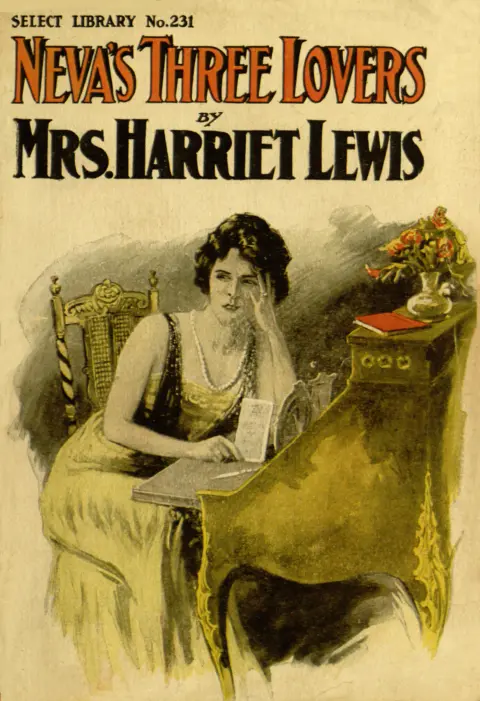
Neva’s three lovers: a novel
Harriet Lewis
THE CLASSIC COLLECTION · 1871
"Neva's Choice" by Harriet Lewis is a novel written in the late 19th century. The story serves as a sequel to "Neva's Three Lovers" and explores themes of love, betrayal, and choice as it follows Neva Wynde, the daughter of a wealthy baronet, who finds herself entangled in a web of familial intrigue and romantic obligation. As she navigates her feelings for potential suitors, including Rufus Black and Lord Towyn, Neva must confront the manipulations of her new stepmother and others who threaten her autonomy and well-being. The opening of this tale sets the stage for a dramatic conflict surrounding Neva's situation. We are introduced to her complex relationships—particularly with her stepmother, Mrs. Craven Black, and her enemies, who conspire to ensure she marries Rufus Black. Through conversations filled with tension and emotional undercurrents, Neva expresses her final rejection of Rufus and her growing discomfort with the intentions of the Blacks. As she embarks on a journey with them under the guise of visiting Wynde Heights, Neva begins to realize that she may be falling victim to an insidious plot, which is marked by her mounting unease and suspicion about the authenticity of a letter from her deceased father that purportedly dictates her future choices.
Introduction adapted from the source catalogue; source summaries may be automatically generated.
Free to read · English · 75,777 words · No account needed
MAKE TIME FOR A GOOD BOOK
On by default. Untick to stop anonymous reading totals. Each page counts after 10 seconds in view. How this works.
Anonymous counting is on unless you have switched it off.
The gentlemen entered the vehicle and hastened back to the Langham. Atkins was very thoughtful and silent during the journey, but as they drove up to the hotel he said:
“We are tired Lord Towyn, and must have rest. I propose that we sleep here to-night, and go on to Dover and Ostend in the morning. I know how anxious and impatient you are, but we must not overtask our strength. You look quite worn out.”
“It is with anxiety then,” said the young earl. “I am eager to go on, Mr. Atkins, but will wait till morning as you counsel.”
The three gentlemen ascended to their private parlor which they shared in common. As they entered the room, a man who was standing at one of the windows, looking out, turned and came forward to meet them.
He was the steward of Lord Towyn’s marine place.
“You here, Sewel?” exclaimed the young earl. “Is anything the matter?”
The steward, an elderly man, with a rugged countenance, as gnarled as an old oak, yet full of kindly warmth, shook his head as he answered:
“There’s nothing wrong, my lord; but you ordered any letters to be sent to you, and knowing how anxious you were, I feared the letter might miscarry, and here it is. I brought it myself.”
“A letter!” cried the three gentlemen in chorus, having no thought of any letter save the one they so much desired.
“It’s in a lady’s hand, and that’s why I brought it,” said the steward.
He took out his pocket-book and drew from it a small square envelope, daintily addressed and sealed.
Lord Towyn uttered a cry of joy, recognizing the handwriting at once.
“It is from Neva!” he ejaculated.
He hurried with it to a window, turning his back on his friends, and tore open the envelope, disclosing a four-page letter, signed with the name of Neva Wynde.
“Ah!” he cried aloud. “It is dated Brussels.”
“We were on the right track then,” said Atkins exultantly.
The young earl perused his letter with a glad heart.
It was very tender and very sweet, full of delicate allusions to their betrothal, and was indeed such a letter as only a woman could write, yet the young lover was not satisfied. The letter lacked the straightforward simplicity that distinguished Neva, and it seemed to Lord Towyn to lack also sincerity. It had been written from the head rather than from the heart, and his first great joy and gladness gave way to a sudden and terrible sense of disappointment.
The steward, seeing that he was not wanted, went quietly from the room, intent upon securing his dinner.
Your reading position is saved on this browser. Take it to another device with a library code. Reading pages adapt to text, rather than matching a printed edition.
Harriet Lewis
BEHIND THE BOOK
This eBook is for the use of anyone anywhere in the United States and most other parts of the world at no cost and with almost no restrictions whatsoever. You may copy it, give it away or re-use it under the terms of the Project Gutenberg License included with this eBook or online at www.gutenberg.org. If you are not located in the United States, you will have to check the laws of the country where you are located before using this eBook. Read the source licence.
The original source file, including credits and licence, is retained by this library. Request an original-format copy at no charge. Please include the book title and Project Gutenberg identifier #68439.
KEEP YOUR CURIOSITY GOING
Coulson Kernahan

Maurice Baring
Frances Wright
Cécile Tormay

Frederic Jesup Stimson

W. H. P. (William Henry Pope) Jarvis