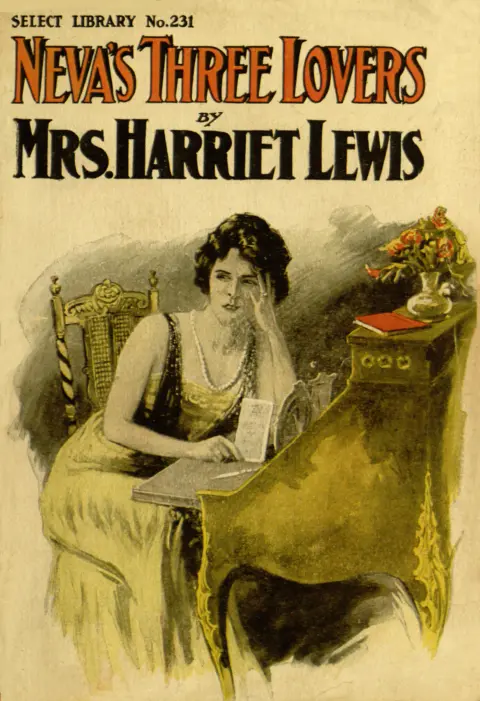
Neva’s three lovers: a novel
Harriet Lewis
THE CLASSIC COLLECTION · 1871
"Neva's Choice" by Harriet Lewis is a novel written in the late 19th century. The story serves as a sequel to "Neva's Three Lovers" and explores themes of love, betrayal, and choice as it follows Neva Wynde, the daughter of a wealthy baronet, who finds herself entangled in a web of familial intrigue and romantic obligation. As she navigates her feelings for potential suitors, including Rufus Black and Lord Towyn, Neva must confront the manipulations of her new stepmother and others who threaten her autonomy and well-being. The opening of this tale sets the stage for a dramatic conflict surrounding Neva's situation. We are introduced to her complex relationships—particularly with her stepmother, Mrs. Craven Black, and her enemies, who conspire to ensure she marries Rufus Black. Through conversations filled with tension and emotional undercurrents, Neva expresses her final rejection of Rufus and her growing discomfort with the intentions of the Blacks. As she embarks on a journey with them under the guise of visiting Wynde Heights, Neva begins to realize that she may be falling victim to an insidious plot, which is marked by her mounting unease and suspicion about the authenticity of a letter from her deceased father that purportedly dictates her future choices.
Introduction adapted from the source catalogue; source summaries may be automatically generated.
Free to read · English · 75,777 words · No account needed
MAKE TIME FOR A GOOD BOOK
On by default. Untick to stop anonymous reading totals. Each page counts after 10 seconds in view. How this works.
Anonymous counting is on unless you have switched it off.
“We are much obliged to you ma’am,” he said, “and now we must hasten back to London. If you hear from your mistress, be kind enough to drop me a line at my address. There’s my card. But it’s not likely you will hear from Mrs. Black before we do.”
The visitors bade the housekeeper good morning, and hurried back to the railway station in their cab, catching the down train, and speeding on their way to London.
“I don’t believe our party is in England,” said Atkins musingly, as they steamed swiftly down the line to the southward. “It would be like the Blacks, if they had any game afoot, to make for the Continent. Our next point is to make inquiries at the docks, or at the railway stations.”
They arrived in London in the morning, and hastened to the Langham hotel, where they had an interview with Sir John Freise, who was looking worn and ill under all this suspense and anxiety. The three gentlemen devoted the day to visiting the various railway stations and offices of the Continental boats. They visited also the foreign packet-boats lying in dock, and toward evening learned from the steward of an Ostend boat, that a party such as was described, consisting of two ladies and one gentleman, had crossed the Channel to Ostend at about the time indicated by Atkins.
“Thank Heaven! We are on the track!” breathed Sir John.
“Atkins and I will start for Ostend by way of Dover this very night,” said Lord Towyn, all ardor and impatience.
Atkins drew out a golden sovereign, which he held tantalizingly before
the eyes of the steward.
“Answer a few more questions,” said the attorney, “and this is yours, my good fellow. Describe the gentleman who accompanied the two ladies.”
The steward hesitated, eyeing the coin with greedy eyes.
“He was tall and fair, with mustaches,” he said slowly, as if fearing the description would not suit his interlocutor, “and he was dressed in black.”
“That would describe Craven Black well enough,” murmured Sir John.
“And the ladies?” questioned Atkins. “How did they look?”
“One was some years older than the other, and was dark, with black eyes. The young lady had lighter hair. They were going on to Brussels, and I took it that the elder lady and gentleman were newly married,” said the steward, “they were that sickish, begging your pardon.”
“There’s no doubt we are on the right track,” cried Sir John, in a tone
of relief.
Atkins paid the steward the promised sovereign, and led the way ashore
and to the waiting cab.
“To the hotel,” he ordered.
Your reading position is saved on this browser. Take it to another device with a library code. Reading pages adapt to text, rather than matching a printed edition.
Harriet Lewis
BEHIND THE BOOK
This eBook is for the use of anyone anywhere in the United States and most other parts of the world at no cost and with almost no restrictions whatsoever. You may copy it, give it away or re-use it under the terms of the Project Gutenberg License included with this eBook or online at www.gutenberg.org. If you are not located in the United States, you will have to check the laws of the country where you are located before using this eBook. Read the source licence.
The original source file, including credits and licence, is retained by this library. Request an original-format copy at no charge. Please include the book title and Project Gutenberg identifier #68439.
KEEP YOUR CURIOSITY GOING
Coulson Kernahan

Maurice Baring
Frances Wright
Cécile Tormay

Frederic Jesup Stimson

W. H. P. (William Henry Pope) Jarvis