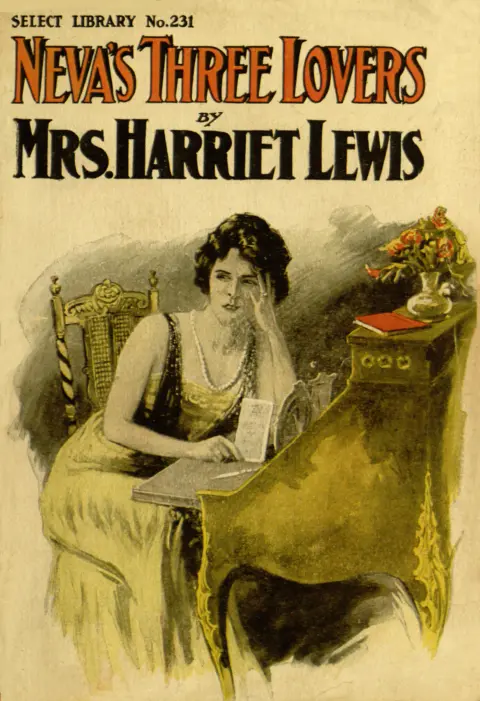
Neva’s three lovers: a novel
Harriet Lewis
THE CLASSIC COLLECTION · 1871
"Neva's Choice" by Harriet Lewis is a novel written in the late 19th century. The story serves as a sequel to "Neva's Three Lovers" and explores themes of love, betrayal, and choice as it follows Neva Wynde, the daughter of a wealthy baronet, who finds herself entangled in a web of familial intrigue and romantic obligation. As she navigates her feelings for potential suitors, including Rufus Black and Lord Towyn, Neva must confront the manipulations of her new stepmother and others who threaten her autonomy and well-being. The opening of this tale sets the stage for a dramatic conflict surrounding Neva's situation. We are introduced to her complex relationships—particularly with her stepmother, Mrs. Craven Black, and her enemies, who conspire to ensure she marries Rufus Black. Through conversations filled with tension and emotional undercurrents, Neva expresses her final rejection of Rufus and her growing discomfort with the intentions of the Blacks. As she embarks on a journey with them under the guise of visiting Wynde Heights, Neva begins to realize that she may be falling victim to an insidious plot, which is marked by her mounting unease and suspicion about the authenticity of a letter from her deceased father that purportedly dictates her future choices.
Introduction adapted from the source catalogue; source summaries may be automatically generated.
Free to read · English · 75,777 words · No account needed
MAKE TIME FOR A GOOD BOOK
On by default. Untick to stop anonymous reading totals. Each page counts after 10 seconds in view. How this works.
Anonymous counting is on unless you have switched it off.
Miss Neva Wynde, on finding herself confronted by Artress at the very door of Mr. Black’s wild Highland retreat, comprehended in one swift flash that she had been betrayed by her enemies, and caught in a snare, as we have said--that, in short, she was virtually their prisoner.
But after her first wild start of amazement, after the first wild glance at her enemies, she sternly repressed all signs of terror or surprise, and although her pure, proud face was paler than usual, yet she did not otherwise betray her fears.
“Mrs. Artress here!” she said. “This is a surprise. You said, Mrs. Black, that she was staying with friends in London, did you not?”
An evil smile played about the full sensual lips of Octavia Black, and she looked at Neva keenly as she answered, with affected carelessness:
“I did say so, I believe. But I intended to surprise you. You are so fond of Mrs. Artress, Neva, that I wished her to be of our party. I am glad you are so pleased.”
Neva did not reply, but she drew up her slight figure with a sudden haughtiness, and her pale, proud face wore an expression of sternness before which Mrs. Black ought to have quailed. But Octavia only laughed, and as Neva thought, mockingly.
“Come into the drawing-room, good people,” cried Mrs. Artress. “I have made the house habitable, and I want you to compliment me upon my handiwork.”
Mrs. Black went into the room, and Neva followed her, Craven Black coming last like a body-guard. Neva had an uncomfortable feeling that she was already a prisoner.
The drawing-room at the Wilderness was a long barrack-like apartment, with bare white walls, upon which were hung a few engravings. The furniture was old, but well kept, being a combination of mahogany and black haircloth. The six windows were curtained with faded damask of the color of mahogany, and an old book-case, containing a few old and worn volumes, completed the list of furniture.
“It’s a perfect old barrack, Craven!” said Mrs. Black, with a shudder. “But I suppose it must be fearfully difficult to get furniture and such things up the cliff. However, if we make a shooting box of this place, decent furniture and pictures and things have got to be brought here. This room is like a draughty old barn.”
“So is the whole house,” said Mrs. Artress. “But the place is so delightfully romantic, and secluded and hidden, you know, that one can put up with drawbacks. I have had my hands full, I assure you, since I arrived here. How do you like the Wilderness, Miss Wynde?”
Your reading position is saved on this browser. Take it to another device with a library code. Reading pages adapt to text, rather than matching a printed edition.
Harriet Lewis
BEHIND THE BOOK
This eBook is for the use of anyone anywhere in the United States and most other parts of the world at no cost and with almost no restrictions whatsoever. You may copy it, give it away or re-use it under the terms of the Project Gutenberg License included with this eBook or online at www.gutenberg.org. If you are not located in the United States, you will have to check the laws of the country where you are located before using this eBook. Read the source licence.
The original source file, including credits and licence, is retained by this library. Request an original-format copy at no charge. Please include the book title and Project Gutenberg identifier #68439.
KEEP YOUR CURIOSITY GOING
Coulson Kernahan

Maurice Baring
Frances Wright
Cécile Tormay

Frederic Jesup Stimson

W. H. P. (William Henry Pope) Jarvis