THE CLASSIC COLLECTION✦An outlaw’s diary: the CommuneCLASSIC FREE BOOKS
An outlaw’s diary: the Commune
Cécile Tormay
THE CLASSIC COLLECTION · 1904
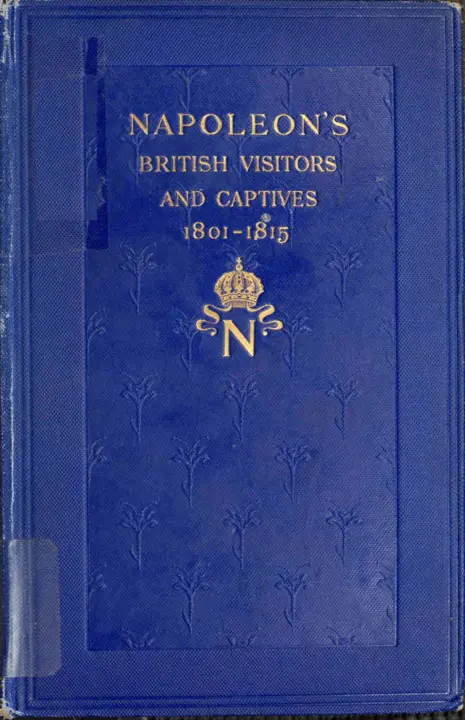
"Napoleon's British Visitors and Captives, 1801-1815" by John Goldworth Alger is a historical account written in the early 20th century. The book explores the interactions and experiences of British visitors and captives in France during the tumultuous period of Napoleon's rise and reign. Alger delves into the social dynamics, political undertones, and personal stories that emerged as Englishmen navigated their relationships with French citizens amid shifting allegiances and changing circumstances. The opening of the work sets the stage for a comprehensive examination of the vast impact of the French Revolution, highlighting the notable dislocation of individuals across Europe, particularly among the French nobility and other political figures. Alger outlines how the Peace of Amiens in 1802 marked a significant uptick in British travel to France after a decade of hostilities, with numerous English visitors eager to witness the transformative atmosphere of post-revolutionary France. The introductory chapter establishes a backdrop of historical context, emphasizing the social and political exchanges that occurred not only between British visitors and French society but also amidst the hardships faced by those who found themselves unexpectedly detained under Napoleon's regime.
Introduction adapted from the source catalogue; source summaries may be automatically generated.
Free to read · English · 89,397 words · No account needed
MAKE TIME FOR A GOOD BOOK
On by default. Untick to stop anonymous reading totals. Each page counts after 10 seconds in view. How this works.
Anonymous counting is on unless you have switched it off.
[276] An octogenarian, who in 1838, three months a widower, married Catherine Stevens, the vocalist, whose age was forty-four.
[277] Letters of Lady Burghersh.
[278] National Archives, Paris, A. A. 40.
[279] A Visit to Paris in 1814. Scott went again after Waterloo.
[280] Letters from a Lady to her Sister.
[281] Beattie, Life of Campbell.
[284] Paris in 1802 and 1814.
[285] Retiring in 1822, he lived till 1846. His co-proprietor, Daniel
Stuart, died in 1847.
[287] Mon Journal de Huit Jours.
[288] Visit to Paris in June 1814.
[289] Tour through Some Parts of France.
[290] Letters to the Bishop of Llandaff.
[291] Memoirs of Moriolles, p. 157.
[292] Livi, Napoleon a Elba, 1888; Siècle, August 23,
1887.
[293] Quotidienne, February 6, 1815.
[294] Temple Bar, October 1903.
[295] Ibid.
[296] Nuova Antologia, January 1887.
[297] Pons de l’Hérault, Souvenirs d’Elbe, edited by Pelissier,
1897.
[298] Ebrington’s Memorandum of Two Conversations, published in 1823 as a pamphlet of thirty-one pages and never reprinted.
[299] Earl Russell, Recollections. See Appendix C.
[300] Souvenirs de l’ile d’Elbe.
[301] We know how Napoleon as a youth detested France, regarding Corsica alone as his country, but he doubtless got to consider himself a real Frenchman.
[302] According to an English account Napoleon, on the band striking up the National Anthem, hummed the tune. (Temple Bar, October 1903.)
[303] Sir Neil Campbell, Napoleon at Fontainebleau and Elba,
1869.
[304] As it was, the Marquis Wellesley (Wellington’s brother), the Duke of Sussex (the Prince Regent’s brother), Lords Lansdowne, Grey, Byron, Lauderdale, Guilford, Bessborough, and three other peers voted in his favour, as also Mackintosh, Romilly, Whitbread, Tierney, Lord Morpeth, Sir Timothy Shelley (the poet’s grandfather), Lord Stanley (father of the ‘Rupert of Debate’), Lord Duncannon, and twenty-nine other members of the Lower House.
[305] Mackenzie, History of Newcastle, 1827.
[306] Philip Dormer Stanhope had settled in France or Belgium about 1790, and during the war procured remittances from England through the Paris bankers Perregaux and Laffitte. Was he a son of Lord Chesterfield’s illegitimate son? If so, the latter was a father at the age of nineteen, for he was born in 1732, and this Philip Dormer Stanhope gave his age in September 1814 on applying for domicile in France as sixty-three. Possibly, however, this last figure is a misprint in the Bulletin des Lois.
[307] He seems to be the visitor who registered himself as Lord John
Stuart.
[308] A dandy famous for his collection of snuff-boxes, said to number
365.
[309] Subject to orthographic errors in French records.
Transcriber’s Notes:
1. Obvious printers’, punctuation and spelling errors have been
corrected silently.
2. Where hyphenation is in doubt, it has been retained as in the
original.
3. Some hyphenated and non-hyphenated versions of the same words have been retained as in the original.
Your reading position is saved on this browser. Take it to another device with a library code. Reading pages adapt to text, rather than matching a printed edition.
BEHIND THE BOOK
This eBook is for the use of anyone anywhere in the United States and most other parts of the world at no cost and with almost no restrictions whatsoever. You may copy it, give it away or re-use it under the terms of the Project Gutenberg License included with this eBook or online at www.gutenberg.org. If you are not located in the United States, you will have to check the laws of the country where you are located before using this eBook. Read the source licence.
The original source file, including credits and licence, is retained by this library. Request an original-format copy at no charge. Please include the book title and Project Gutenberg identifier #70408.
KEEP YOUR CURIOSITY GOING
Cécile Tormay

Moritz Busch
John L. Ransom
Frances Wright
Cécile Tormay

Mabel Potter Daggett