
Life of Harriet Beecher Stowe Compiled From Her Letters and Journals by Her Son Charles Edward Stowe
Harriet Beecher Stowe
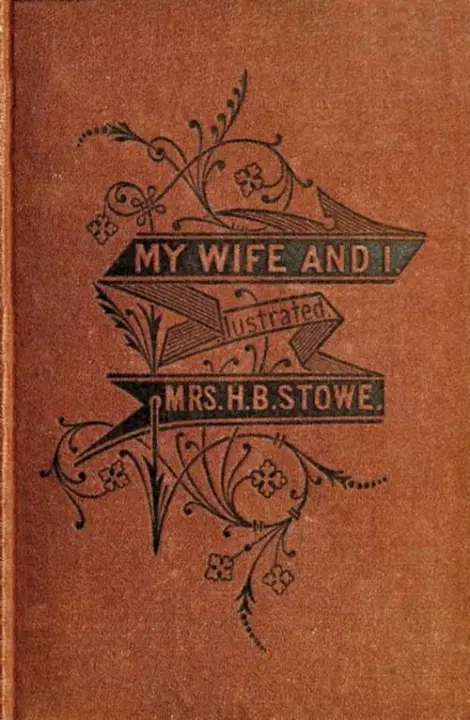
THE CLASSIC COLLECTION · 1871
"My Wife and I: Or, Harry Henderson's History" by Harriet Beecher Stowe is a novel written in the late 19th century. The story centers around Harry Henderson, a reflective young man from New Hampshire, as he navigates the complexities of love, marriage, and personal growth. Through Harry's experiences, the author explores themes of childhood innocence, romantic ideals, and the evolution of human relationships against the backdrop of societal changes. The opening of the novel introduces Harry's childhood and his longing for companionship, particularly focusing on his deep connection with a girl named Susie. From a young age, Harry feels isolated in his large family and finds solace in his imaginary relationship with Susie, whom he considers his "child-wife." This chapter recounts the purity and joys of their childhood friendship, highlighting key moments filled with innocence and adventure as they navigate the challenges of growing up. Harry's strong feelings for Susie are soon complicated by the harsh realities of life, marked by her untimely death, which profoundly impacts his perspective on love and the bonds that define our lives. Thus, the story begins with a poignant reflection on the simplicity of young love, setting the stage for Harry's journey into adulthood.
Introduction adapted from the source catalogue; source summaries may be automatically generated.
Free to read · English · 163,597 words · No account needed
MAKE TIME FOR A GOOD BOOK
On by default. Untick to stop anonymous reading totals. Each page counts after 10 seconds in view. How this works.
Anonymous counting is on unless you have switched it off.
"I have told mamma, Harry," whispered Eva, "and she is beginning to get
over it."
Mrs. Van Arsdel received me with an air of patient endurance, as if I had been the toothache or any of the other inevitable inflictions of life, Miss Alice was distant and reserved, and only Ida was cordial.
I found Mr. Van Arsdel dry, cold, and wary, not in the least encouraging any sentimental effusion, and therefore I proceeded to speak to him with as matter-of-fact directness as if the treaty related to a bag of wool.
"Mr. Van Arsdel, I love your daughter. She has honored me so far as to accept of my love, and I have her permission to ask your consent to our marriage."
He took off his spectacles, wiped them deliberately while I was
speaking, and coughed drily.
"Mr. Henderson," he said, "I have always had a great respect for you so far as I knew you, but I must confess I don't know why I should want to give you my daughter."
"Simply, sir, because in the order of nature you must give her to somebody, and I have the honor to be chosen by her."
"Eva could do better, her mother thinks."
"I am aware that Miss Van Arsdel could marry a man with more money than I have, but none who would love her more or be more devoted to her happiness. Besides I have the honor to be the man of her choice, and perhaps you may be aware that Miss Eva is a young lady of very decided preferences."
He smiled drily, and looked at me with a funny twinkle in his eye.
"Eva has always been used to having her own way," he remarked.
"Then, my dear sir, I must beg leave to say that the choice of a companion for life is a place where a lady has a good right to insist on her own way."
"Well, Mr. Henderson, you may be right. But perhaps her parents ought to insist that she shall not make an imprudent marriage."
"Mr. Van Arsdel, I do not conceive that I am proposing an imprudent marriage. I have not wealth to offer, it is true, but I have a reasonable prospect of being able to support a wife and family. I have good firm health, I have good business habits, I have a profession which already assures me a certain income, and an influential position in society."
"What do you call your profession?"
"Literature," I replied.
He looked skeptical, and I added--"Yes, Mr. Van Arsdel, in our day
literature is a profession in which one may hope for both fame and
money."
Your reading position is saved on this browser. Take it to another device with a library code. Reading pages adapt to text, rather than matching a printed edition.
Harriet Beecher Stowe

Harriet Beecher Stowe
Harriet Beecher Stowe

Harriet Beecher Stowe
BEHIND THE BOOK
This eBook is for the use of anyone anywhere in the United States and most other parts of the world at no cost and with almost no restrictions whatsoever. You may copy it, give it away or re-use it under the terms of the Project Gutenberg License included with this eBook or online at www.gutenberg.org. If you are not located in the United States, you will have to check the laws of the country where you are located before using this eBook. Read the source licence.
The original source file, including credits and licence, is retained by this library. Request an original-format copy at no charge. Please include the book title and Project Gutenberg identifier #47874.
KEEP YOUR CURIOSITY GOING
Coulson Kernahan

Maurice Baring
Frances Wright
Cécile Tormay

Frederic Jesup Stimson

W. H. P. (William Henry Pope) Jarvis