
Life of Harriet Beecher Stowe Compiled From Her Letters and Journals by Her Son Charles Edward Stowe
Harriet Beecher Stowe
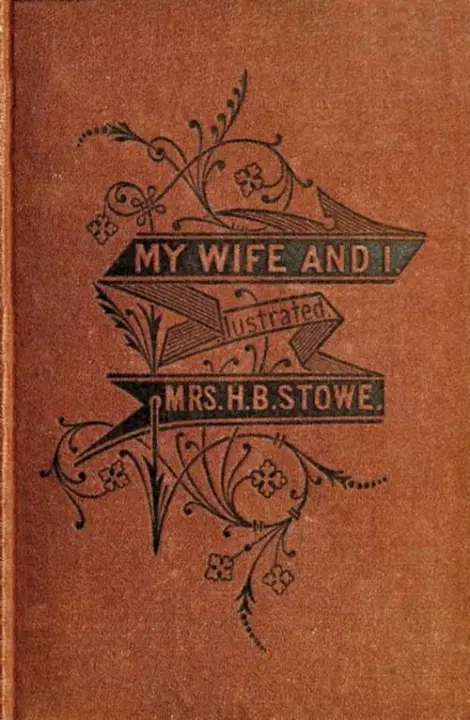
THE CLASSIC COLLECTION · 1871
"My Wife and I: Or, Harry Henderson's History" by Harriet Beecher Stowe is a novel written in the late 19th century. The story centers around Harry Henderson, a reflective young man from New Hampshire, as he navigates the complexities of love, marriage, and personal growth. Through Harry's experiences, the author explores themes of childhood innocence, romantic ideals, and the evolution of human relationships against the backdrop of societal changes. The opening of the novel introduces Harry's childhood and his longing for companionship, particularly focusing on his deep connection with a girl named Susie. From a young age, Harry feels isolated in his large family and finds solace in his imaginary relationship with Susie, whom he considers his "child-wife." This chapter recounts the purity and joys of their childhood friendship, highlighting key moments filled with innocence and adventure as they navigate the challenges of growing up. Harry's strong feelings for Susie are soon complicated by the harsh realities of life, marked by her untimely death, which profoundly impacts his perspective on love and the bonds that define our lives. Thus, the story begins with a poignant reflection on the simplicity of young love, setting the stage for Harry's journey into adulthood.
Introduction adapted from the source catalogue; source summaries may be automatically generated.
Free to read · English · 163,597 words · No account needed
MAKE TIME FOR A GOOD BOOK
On by default. Untick to stop anonymous reading totals. Each page counts after 10 seconds in view. How this works.
Anonymous counting is on unless you have switched it off.
My Shadow Wife! Is there then substance in shadow? Yea, there may be. A shadow--a spiritual presence--may go with us where mortal footsteps cannot go; walk by our side amid the roar of the city: talk with us amid the sharp clatter of voices; come to us through closed doors, as we sit alone over our evening fire; counsel, bless, inspire us; and though the figure cannot be clasped in mortal arms--though the face be veiled--yet this wife of the future may have a power to bless, to guide, to sustain and console. Such was the dream-wife of my youth.
Whence did she come? She rose like a white, pure mist from that little grave. She formed herself like a cloud-maiden from the rain and dew of those first tears.
When we look at the apparent recklessness with which great sorrows seem to be distributed among the children of the earth, there is no way to keep our faith in a Fatherly love, except to recognize how invariably the sorrows that spring from love are a means of enlarging and dignifying a human being. Nothing great or good comes without birth-pangs, and in just the proportion that natures grow more noble, their capacities of suffering increase.
The bitter, silent, irrepressible anguish of that childish bereavement was to me the awakening of a spiritual nature. The little creature who, had she lived, might have grown up perhaps into a common-place woman, became a fixed star in the heaven-land of the ideal, always drawing me to look upward. My memories of her were a spring of refined and tender feeling, through all my early life. I could not then write; but I remember that the overflow of my heart towards her memory required expression, and I taught myself a strange kind of manuscript, by copying the letters of the alphabet. I bought six cents' worth of paper and a tallow candle at the store, which I used to light surreptitiously when I had been put to bed nights, and, sitting up in my little night-gown, I busied myself with writing my remembrances of her. I could not, for the world, have asked my mother to let me have a candle in my bed-room after eight o'clock. I would have died sooner than to explain why I wanted it. My purchase of paper and candle was my first act of independent manliness. The money, I reflected, was mine, because I earned it myself, and the paper was mine, and the candle was mine, so that I was not using my father's property in an unwarrantable manner, and thus I gave myself up to my inspirations. I wrote my remembrances of her, as she stood among the daisies and the golden lilies. I wrote down her little words of wisdom and grave advice, in the queerest manuscript that ever puzzled a wise man of the East. If one imagines that all this was spelt phonetically, and not at all in the unspeakable and astonishing way in which the English language is conventionally spelt, one may truly imagine that it was something rather peculiar in the way of literature. But the heart-comfort, the utter abandonment of soul that went into it, is something that only those can imagine who have tried the like and found the relief of it. My little heart was like the Caspian sea, or some other sea which I read about, which had found a secret channel by which its waters could pass off under ground. When I had finished, every evening, I used to extinguish my candle, and put it and my manuscript inside of the straw bed on which I slept, which had a long pocket hole in the centre, secured by buttons, for the purpose of stirring the straw. Over this I slept in conscious security, every night; sometimes with blissful dreams of going to brighter meadows, when I saw my Daisy playing with whole troops of beautiful children, fair as water lilies on the shore of a blue lake. Thus, while I seemed to be like any other boy, thinking of nothing but my sled, and my bat and ball, and my mittens, I began to have a little withdrawing room of my own; another land in which I could walk and take a kind of delight that nothing visible gave me. But one day my oldest sister, in making the bed, with domestic thoroughness, disemboweled my whole store of manuscripts and the half consumed fragment of my candle.
Your reading position is saved on this browser. Take it to another device with a library code. Reading pages adapt to text, rather than matching a printed edition.
Harriet Beecher Stowe

Harriet Beecher Stowe
Harriet Beecher Stowe

Harriet Beecher Stowe
BEHIND THE BOOK
This eBook is for the use of anyone anywhere in the United States and most other parts of the world at no cost and with almost no restrictions whatsoever. You may copy it, give it away or re-use it under the terms of the Project Gutenberg License included with this eBook or online at www.gutenberg.org. If you are not located in the United States, you will have to check the laws of the country where you are located before using this eBook. Read the source licence.
The original source file, including credits and licence, is retained by this library. Request an original-format copy at no charge. Please include the book title and Project Gutenberg identifier #47874.
KEEP YOUR CURIOSITY GOING
Coulson Kernahan

Maurice Baring
Frances Wright
Cécile Tormay

Frederic Jesup Stimson

W. H. P. (William Henry Pope) Jarvis