
Life of Harriet Beecher Stowe Compiled From Her Letters and Journals by Her Son Charles Edward Stowe
Harriet Beecher Stowe
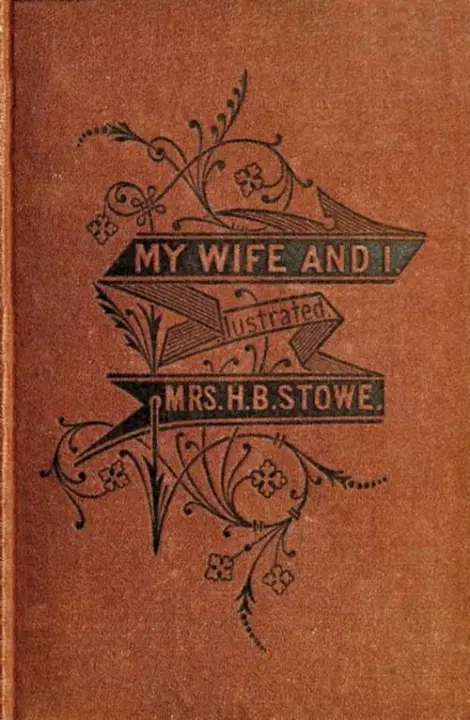
THE CLASSIC COLLECTION · 1871
"My Wife and I: Or, Harry Henderson's History" by Harriet Beecher Stowe is a novel written in the late 19th century. The story centers around Harry Henderson, a reflective young man from New Hampshire, as he navigates the complexities of love, marriage, and personal growth. Through Harry's experiences, the author explores themes of childhood innocence, romantic ideals, and the evolution of human relationships against the backdrop of societal changes. The opening of the novel introduces Harry's childhood and his longing for companionship, particularly focusing on his deep connection with a girl named Susie. From a young age, Harry feels isolated in his large family and finds solace in his imaginary relationship with Susie, whom he considers his "child-wife." This chapter recounts the purity and joys of their childhood friendship, highlighting key moments filled with innocence and adventure as they navigate the challenges of growing up. Harry's strong feelings for Susie are soon complicated by the harsh realities of life, marked by her untimely death, which profoundly impacts his perspective on love and the bonds that define our lives. Thus, the story begins with a poignant reflection on the simplicity of young love, setting the stage for Harry's journey into adulthood.
Introduction adapted from the source catalogue; source summaries may be automatically generated.
Free to read · English · 163,597 words · No account needed
MAKE TIME FOR A GOOD BOOK
On by default. Untick to stop anonymous reading totals. Each page counts after 10 seconds in view. How this works.
Anonymous counting is on unless you have switched it off.
"I certainly shall do so," said I, rising to take my leave, with much the same sort of eagerness with which one rises from a dentist's chair, after having his nerves picked at. As at this moment the voices of the returning party broke up our interview, I immediately arose, and excusing myself with the plea of an article to finish, left the house and walked home in a state of mind as disagreeable as my worst enemy could have wished. Like all delicate advisers who are extremely fearful of hurting your feelings, Mrs. Van Arsdel had told me nothing definite, and yet had said enough to make me supremely uncomfortable. What did she mean, and how much did she mean? Had there been reports? Was this to be received as an intimation from Eva herself? Had she discovered the state of my feelings, and was she, through her mother, warning me of my danger?
All my little romance seemed disenchanted. These illusions of love are like the legends of hidden treasures guarded by watchful spirits which disappear from you if you speak a word; or like an enchanting dream, which vanishes if you start and open your eyes. I tossed to and fro restlessly all night, and resolved to do precisely the most irrational thing that I could have done, under the circumstances, and that was to give up going to the Van Arsdel house, and to see Eva no more.
The next morning, however, showed me that I could not make so striking a change in my habits without subjecting myself to Jim Fellows' remarks and inquiry. I resolved on a course of gradual emancipation and detachment.
[Eva Van Arsdel to Isabel Convers.]
My Dearest Belle:--Since I wrote to you last there have been the strangest changes. I scarcely know what to think. You remember I told you all about Easter Eve, and a certain person's appearance, and about the stolen glove and all that. Your theory of accounting for all this was precisely mine; in fact I could think of no other. And, Belle, if I could only see you I could tell you of a thousand little things that make me certain that he cares for me more than in the way of mere friendship. I thought I could not be mistaken in that. There has been scarcely a day since our acquaintance began when I have not in some way seen him or heard from him; you know all those early services, when he was as constant as the morning, and always walked home with me; then, he and Jim Fellows always spend at least one evening in a week at our house, and there are no end of accidental meetings. For example, when we take our afternoon drives at Central Park we are sure to see them sitting on the benches watching us go by, and it came to be quite a regular thing when we stopped the carriage at the terrace and got out to walk to find them there, and then Alice would go off with Jim Fellows, and Mr. H. and I would stroll up and down among the lilac hedges and in all those lovely little nooks and dells that are so charming. I'm quite sure I never explored the treasures of the Park as I have this Spring. We have rambled everywhere--up hill and down dale--it certainly is the loveliest and most complete imitation of wild nature that ever art perfected. One could fancy one's self deep in the country in some parts of it; far from all the rush and whirl and frivolity of this great, hot, dizzy New York. You may imagine that with all this we have had opportunity to become very intimate. He has told me all about himself, all the history of his life, all about his mother, and his home; it seems hardly possible that one friend could speak more unreservedly to another, and I, dear Belle, have found myself speaking with equal frankness to him. We know each other so perfectly that there has for a long time seemed to be only a thin impalpable cob-web barrier between us; but you know, Belle, that airy filmy barrier is something that one would not by a look or a word disturb. For weeks I have felt every day that surely the next time we meet all this must come to a crisis. That he would say in words what he says in looks--in involuntary actions--what in fact I am perfectly sure of. Till he speaks I must be guarded. I must hold myself back from showing him the kindly interest I really feel. For I am proud, as you know, Belle, and have always held the liberty of my heart as a sacred treasure. I have always felt a secret triumph in the consciousness that I did not care for anybody, and that my happiness was wholly in my own hands, and I mean to keep it so. Our friendship is a pleasant thing enough, but I am not going to let it become too necessary, you understand. It isn't that I care so very much, but my curiosity is really excited to know just what the real state of the case is; one wants to investigate interesting phenomena you know. When I saw that little glove movement on Easter Eve I confess I thought the game all in my own hands, and that I could quietly wait to say "checkmate" in due form and due time; but after all nothing came of it; that is, nothing decisive; and I confess I didn't know what to think. Sometimes I have fancied some obstacle or entanglement or commitment with some other woman--this Cousin Caroline perhaps--but he talks about her to me in the most open and composed manner. Sometimes I fancy he has heard the report of my engagement to Sydney. If he has, why doesn't he ask me about it? I have no objection to telling him, but I certainly shall not open the subject myself. Perhaps, as Ida thinks, he is proud and poor and not willing to be a suitor to a rich young good-for-nothing. Well, that can't be helped, he must be a suitor if he wins me, for I shan't be; he must ask me, for I certainly shan't ask him, that's settled. If he would "ask me pretty," now, who knows what nice things he might hear? I would tell him, perhaps, how much more one true noble heart is worth in my eyes than all that Wat Sydney has to give. Sometimes I am quite provoked with him that he should look so much, and yet say no more, and I feel a naughty wicked inclination to flirt with somebody else just to make him open those "grands yeux" of his a little wider and to a little better purpose. Sometimes I begin to feel a trifle vindictive and as if I should like to give him a touch of the claw. The claw, my dear, the little pearly claw that we women keep in reserve in the "patte de velours," our only and most sacred weapon of defense.
Your reading position is saved on this browser. Take it to another device with a library code. Reading pages adapt to text, rather than matching a printed edition.
Harriet Beecher Stowe

Harriet Beecher Stowe
Harriet Beecher Stowe

Harriet Beecher Stowe
BEHIND THE BOOK
This eBook is for the use of anyone anywhere in the United States and most other parts of the world at no cost and with almost no restrictions whatsoever. You may copy it, give it away or re-use it under the terms of the Project Gutenberg License included with this eBook or online at www.gutenberg.org. If you are not located in the United States, you will have to check the laws of the country where you are located before using this eBook. Read the source licence.
The original source file, including credits and licence, is retained by this library. Request an original-format copy at no charge. Please include the book title and Project Gutenberg identifier #47874.
KEEP YOUR CURIOSITY GOING
Coulson Kernahan

Maurice Baring
Frances Wright
Cécile Tormay

Frederic Jesup Stimson

W. H. P. (William Henry Pope) Jarvis