THE CLASSIC COLLECTION✦The old English dramatistsCLASSIC FREE BOOKS
The old English dramatists
James Russell Lowell

THE CLASSIC COLLECTION · 1899
"My Study Windows" by James Russell Lowell is a collection of essays written in the late 19th century. The work draws from the author's reflections and experiences over a span of years, presenting a range of topics that encompass nature, literature, and personal musings. It hints at a thoughtful exploration of the beauty of the natural world, alongside cultural commentary, making it appealing for readers interested in nuanced observations about life and the environment. The opening of the book sets the stage with a prefatory note where Lowell introduces the collection, explaining that the essays included were composed over the last fifteen years. He expresses his intention to compile these writings as a means of 'shutting them between two covers' to make space for new thoughts. The initial essay, "My Garden Acquaintance," begins with the author reminiscing about the joy he found in reading Gilbert White's "Natural History of Selborne," drawing parallels between White's observations of nature and his own experiences. Lowell invokes a vivid portrayal of his garden and its inhabitants, offering insights into the interplay between humanity and nature, which will be a recurring theme throughout the collection.
Introduction adapted from the source catalogue; source summaries may be automatically generated.
Free to read · English · 137,668 words · No account needed
MAKE TIME FOR A GOOD BOOK
On by default. Untick to stop anonymous reading totals. Each page counts after 10 seconds in view. How this works.
Anonymous counting is on unless you have switched it off.
“This word does not appear to have any very exact meaning. See Halliwell’s Dictionary of Archaic Words, art. Posse, and Worcester’s Dict., ibid., &c. The context here requires to turn sharply or quickly.”
The “ibid., &c.” is delightful; in other words, “find out the meaning of posse for yourself.” Though dark to Mr. Hazlitt, the word has not the least obscurity in it. It is only another form of push, nearer the French pousser, from Latin pulsare, and “the context here requires” nothing more than that an editor should read a poem if he wish to understand it. The plain meaning is,--
“But, as she heard Lucasta, smiles
Possess her round.”
That is, when she heard the name Lucasta,--for thus far in the poem she has passed under the pseudonyme of Amarantha. “Possess her round” is awkward, but mildly so for Lovelace, who also spells “commandress” in the same way with a single s. Process is spelt prosses in the report of those who absented themselves from Church in Stratford.
“O thou, that swing’st upon the waving eare, Of some well-filled oaten beard.” (p. 94.)
Mr. Hazlitt, for some inscrutable reason, has changed “haire” to “eare” in the first line, preferring the ear of a beard to its hair!
Mr. Hazlitt prints,--
“Poor verdant foole! and now green ice, thy joys Large and as lasting as thy peirch of grass, Bid us lay in ’gainst winter raine and poize Their flouds with an o’erflowing glasse.” (p. 95.)
Surely we should read:--
“Poor verdant foole and now green ice, thy joys,
Large and as lasting as thy perch of grass,
Bid,” &c.
i. e. “Poor fool now frozen, the shortness of thy joys, who mad’st no provision against winter, warns us to do otherwise.”
“The radiant gemme was brightly set
In as divine a carkanet;
Of which the clearer was not knowne
Her minde or her complexion.” (p. 101.)
The original reads rightly “for which,” &c., and, the passage being rightly pointed, we have,--
“For which the clearer was not known,
Her mind or her complexion.”
Of course “complexion” had not its present limited meaning.
“ ... my future daring bayes
Shall bow itself.” (p. 107.)
“We should read themselves,” says Mr. Hazlitt’s note authoritatively. Of course a noun ending in s is plural! Not so fast. In spite of the dictionaries, bays was often used in the singular.
“Do plant a sprig of cypress, not of bays,”
says Robert Randolph in verses prefixed to his brother’s poems; and Fe11tham in “Jonsonus Virbius,”
“A greener bays shall crown Ben Jonson’s name.”
But we will cite Mr. Bayes himself:--
Your reading position is saved on this browser. Take it to another device with a library code. Reading pages adapt to text, rather than matching a printed edition.
James Russell Lowell
James Russell Lowell

James Russell Lowell
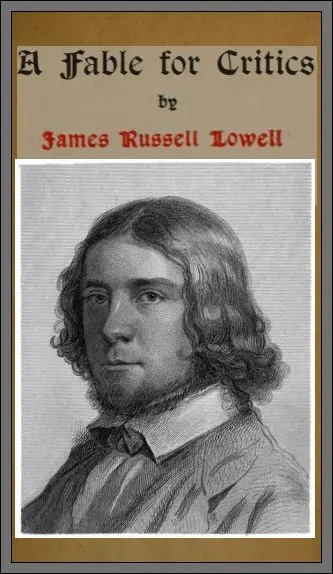
James Russell Lowell
BEHIND THE BOOK
This eBook is for the use of anyone anywhere in the United States and most other parts of the world at no cost and with almost no restrictions whatsoever. You may copy it, give it away or re-use it under the terms of the Project Gutenberg License included with this eBook or online at www.gutenberg.org. If you are not located in the United States, you will have to check the laws of the country where you are located before using this eBook. Read the source licence.
The original source file, including credits and licence, is retained by this library. Request an original-format copy at no charge. Please include the book title and Project Gutenberg identifier #73710.
KEEP YOUR CURIOSITY GOING

David Patterson (Spirit) Hatch

David Patterson (Spirit) Hatch

David Patterson (Spirit) Hatch

Ralph Waldo Emerson

Maurice Baring

Oscar Wilde & James McNeill Whistler