THE CLASSIC COLLECTION✦The old English dramatistsCLASSIC FREE BOOKS
The old English dramatists
James Russell Lowell

THE CLASSIC COLLECTION · 1899
"My Study Windows" by James Russell Lowell is a collection of essays written in the late 19th century. The work draws from the author's reflections and experiences over a span of years, presenting a range of topics that encompass nature, literature, and personal musings. It hints at a thoughtful exploration of the beauty of the natural world, alongside cultural commentary, making it appealing for readers interested in nuanced observations about life and the environment. The opening of the book sets the stage with a prefatory note where Lowell introduces the collection, explaining that the essays included were composed over the last fifteen years. He expresses his intention to compile these writings as a means of 'shutting them between two covers' to make space for new thoughts. The initial essay, "My Garden Acquaintance," begins with the author reminiscing about the joy he found in reading Gilbert White's "Natural History of Selborne," drawing parallels between White's observations of nature and his own experiences. Lowell invokes a vivid portrayal of his garden and its inhabitants, offering insights into the interplay between humanity and nature, which will be a recurring theme throughout the collection.
Introduction adapted from the source catalogue; source summaries may be automatically generated.
Free to read · English · 137,668 words · No account needed
MAKE TIME FOR A GOOD BOOK
On by default. Untick to stop anonymous reading totals. Each page counts after 10 seconds in view. How this works.
Anonymous counting is on unless you have switched it off.
“And though he sees it full of wounds,
Cruel one, still he wounds it. (p. 34.)
Here the original reads, “Cruel still on,” and the only correction needed was a comma after “cruel.”
“And by the glorious light
Of both those stars, which of their spheres bereft,
Only the jelly’s left.” (p. 41.)
The original has “of which,” and rightly, for “their spheres bereft” is parenthetic, and the sense is “of which only the jelly’s left.” Lovelace is speaking of the eyes of a mistress who has grown old, and his image, confused as it is, is based on the belief that stars shooting from their spheres fell to the earth as jellies,--a belief, by the way, still to be met with in New England.
Lovelace, describing a cow (and it is one of the few pretty passages in
the volume), says,--
“She was the largest, goodliest beast
That ever mead or altar blest,
Round as her udder, and more white
Than is the Milky-Way in night.” (p. 64.)
Mr. Hazlitt changes to “Round was her udder,” thus making that white instead of the cow, as Lovelace intended. On the next page we read,--
“She takes her leave o’ th’ mournful neat,
Who, by her toucht, now prizeth her life,
Worthy alone the hollowed knife.”
Compare Chapman (Iliads, xviii. 480):--
“Slew all their white fleec’d sheep and neat.”
The original was “prize their life,” and the use of “neat” as a singular in this way is so uncommon, if not unprecedented, and the verse as corrected so halting, that we have no doubt Lovelace so wrote it. Of course “hollowed” should be “hallowed,” though the broader pronunciation still lingers in our country pulpits.
“What need she other bait or charm
But look? or angle but her arm?” (p. 65.)
So the original, which Mr. Hazlitt, missing the sense, has changed to
“what hook or angle.”
“Fly Joy on wings of Popinjays
To courts of fools where as your plays
Die laught at and forgot.” (p. 67.)
The original has “there.” Read,--
“Fly, Joy, on wings of popinjays
To courts of fools; there, as your plays,
Die,” &c.
“Where as,” as then used, would make it the “plays” that were to die.
“As he Lucasta nam’d, a groan
Strangles the fainting passing tone;
But as she heard, Lucasta smiles,
Posses her round; she’s slipt meanwhiles
Behind the blind of a thick bush.” (p. 68.)
Mr. Hazlitt’s note on “posses” could hardly be matched by any member of the posse comitatus taken at random:--
Your reading position is saved on this browser. Take it to another device with a library code. Reading pages adapt to text, rather than matching a printed edition.
James Russell Lowell
James Russell Lowell

James Russell Lowell
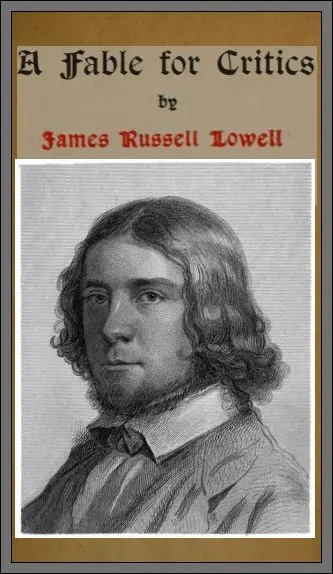
James Russell Lowell
BEHIND THE BOOK
This eBook is for the use of anyone anywhere in the United States and most other parts of the world at no cost and with almost no restrictions whatsoever. You may copy it, give it away or re-use it under the terms of the Project Gutenberg License included with this eBook or online at www.gutenberg.org. If you are not located in the United States, you will have to check the laws of the country where you are located before using this eBook. Read the source licence.
The original source file, including credits and licence, is retained by this library. Request an original-format copy at no charge. Please include the book title and Project Gutenberg identifier #73710.
KEEP YOUR CURIOSITY GOING

David Patterson (Spirit) Hatch

David Patterson (Spirit) Hatch

David Patterson (Spirit) Hatch

Ralph Waldo Emerson

Maurice Baring

Oscar Wilde & James McNeill Whistler