THE CLASSIC COLLECTION✦The old English dramatistsCLASSIC FREE BOOKS
The old English dramatists
James Russell Lowell

THE CLASSIC COLLECTION · 1899
"My Study Windows" by James Russell Lowell is a collection of essays written in the late 19th century. The work draws from the author's reflections and experiences over a span of years, presenting a range of topics that encompass nature, literature, and personal musings. It hints at a thoughtful exploration of the beauty of the natural world, alongside cultural commentary, making it appealing for readers interested in nuanced observations about life and the environment. The opening of the book sets the stage with a prefatory note where Lowell introduces the collection, explaining that the essays included were composed over the last fifteen years. He expresses his intention to compile these writings as a means of 'shutting them between two covers' to make space for new thoughts. The initial essay, "My Garden Acquaintance," begins with the author reminiscing about the joy he found in reading Gilbert White's "Natural History of Selborne," drawing parallels between White's observations of nature and his own experiences. Lowell invokes a vivid portrayal of his garden and its inhabitants, offering insights into the interplay between humanity and nature, which will be a recurring theme throughout the collection.
Introduction adapted from the source catalogue; source summaries may be automatically generated.
Free to read · English · 137,668 words · No account needed
MAKE TIME FOR A GOOD BOOK
On by default. Untick to stop anonymous reading totals. Each page counts after 10 seconds in view. How this works.
Anonymous counting is on unless you have switched it off.
“And, where he took it up, resigns the bays.”
“But we (defend us!) are divine,
[Not] female, but madam born, and come
From a right-honorable wombe.” (p. 115.)
Here Mr. Hazlitt has ruined both sense and metre by his unhappy “not.” We should read “Female, but madam-born,” meaning clearly enough “we are women, it is true, but of another race.”
“In every hand [let] a cup be found
That from all hearts a health may sound.” (p. 121.)
Wrong again, and the inserted “let” ruinous to the measure. Is it possible that Mr. Hazlitt does not understand so common an English construction as this?
“First told thee into th’ ayre, then to the ground.” (p. 141.)
Mr. Hazlitt inserts the “to,” which is not in the original, from another version. Lovelace wrote “ayër.” We have noted two other cases (pp. 203 and 248) where he makes the word a dissyllable. On the same page we have “shewe’s” changed to “shew” because Mr. Hazlitt did not know it meant “show us” and not “shows.” On page 170, “their” is substituted for “her,” which refers to Lucasta, and could refer to nothing else.
Mr. Hazlitt changes “quarrels the student Mercury” to “quarrels with,” not knowing that quarrels was once used as a transitive verb. (p. 189.)
Wherever he chances to notice it, Mr. Hazlitt changes the verb following two or more nouns connected by an “and” from singular to plural. For instance:--
“You, sir, alone, fame, and all conquering rhyme
File the set teeth,” &c. (p. 224.)
for “files.” Lovelace commonly writes so;--on p. 181, where it escaped Mr. Hazlitt’s grammatical eye, we find,--
“But broken faith, and th’ cause of it,
All damning gold, was damned to the pit.”
Indeed, it was usual with writers of that day. Milton in one of his
sonnets has,--
“Thy worth and skill exempts thee from the throng,”--
and Leigh Hunt, for the sake of the archaism, in one of his, “Patience and Gentleness is power.”
Weariness, and not want of matter, compels us to desist from further examples of Mr. Hazlitt’s emendations. But we must also give a few specimens of his notes, and of the care with which he has corrected the punctuation.
Your reading position is saved on this browser. Take it to another device with a library code. Reading pages adapt to text, rather than matching a printed edition.
James Russell Lowell
James Russell Lowell

James Russell Lowell
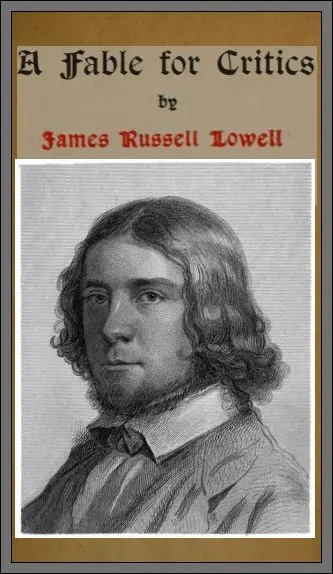
James Russell Lowell
BEHIND THE BOOK
This eBook is for the use of anyone anywhere in the United States and most other parts of the world at no cost and with almost no restrictions whatsoever. You may copy it, give it away or re-use it under the terms of the Project Gutenberg License included with this eBook or online at www.gutenberg.org. If you are not located in the United States, you will have to check the laws of the country where you are located before using this eBook. Read the source licence.
The original source file, including credits and licence, is retained by this library. Request an original-format copy at no charge. Please include the book title and Project Gutenberg identifier #73710.
KEEP YOUR CURIOSITY GOING

David Patterson (Spirit) Hatch

David Patterson (Spirit) Hatch

David Patterson (Spirit) Hatch

Ralph Waldo Emerson

Maurice Baring

Oscar Wilde & James McNeill Whistler