THE CLASSIC COLLECTION✦A dead man’s diaryCLASSIC FREE BOOKS
A dead man’s diary
Coulson Kernahan
THE CLASSIC COLLECTION · 1899
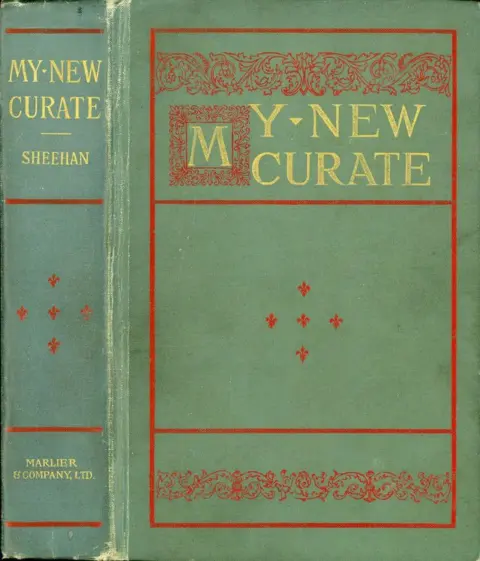
"My New Curate" by Patrick Augustine Sheehan is a novel written in the early 20th century. The story centers around Father Dan, a parish priest in an Irish village, and his experiences as he receives a new curate, Father Letheby, whose modern and energetic approach to ministry contrasts sharply with Father Dan's more traditional and resigned existence. The narrative explores themes of faith, the hardships of rural life, and the relationship between clergy and their parishioners. At the start of the book, the reader is introduced to the emotional departure of Father Dan’s old curate, Father Laverty, who leaves the parish for a new assignment. The accompanying sadness sets the tone for Father Dan's reflections on his life and the challenges that lie ahead with a new, unknown curate. Father Letheby arrives with enthusiasm and a passion to invigorate the parish, and his modern ideas quickly clash with the established leniency of the local community. This friction in expectations creates an engaging dynamic, hinting at the transformation both priests may undergo as they navigate their differences and the realities of their shared responsibilities.
Introduction adapted from the source catalogue; source summaries may be automatically generated.
Free to read · English · 107,499 words · No account needed
MAKE TIME FOR A GOOD BOOK
On by default. Untick to stop anonymous reading totals. Each page counts after 10 seconds in view. How this works.
Anonymous counting is on unless you have switched it off.
"Now, Father Irwin," said the chairman, addressing a smart, keen-looking young priest who sat at the end of the table, "you have just come back to us from Australia; of course, everything is perfect there. What do you think--are the particles in a ciborium, left by inadvertence, outside the corporal during consecration consecrated? Now, just reflect for a moment, for it is an important matter."
"Unquestionably they are," said the young priest confidently.
"They are not," replied the chairman. "The whole consensus of
theologians is against you."
"For example?" said Father Irwin coolly.
"Wha-at?" said the chairman, taken quite aback.
"I doubt if all theologians are on your side," said Father Irwin. "Would you be pleased to name a few?"
"Certainly," said the chairman, with a pitying smile at this young man's presumption. "What do you think of Benedict XIV., Suarez, and St. Alphonsus?"
The young man didn't seem to be much crushed under the avalanche.
"They held that there should be reconsecration?"
"Certainly."
"Let me see. Do I understand you aright? The celebrant intends from the beginning to consecrate those particles?"
"Yes."
"The intention perseveres to the moment of consecration?"
"Yes!"
"And, the materia being quite right, he intends to consecrate that objective, that just lies inadvertently outside the corporal?"
"Quite so."
"And you say that Benedict XIV., Suarez, and St. Alphonsus maintain the necessity of reconsecration?"
"Yes."
"Then I pity Benedict XIV., Suarez, and St. Alphonsus."
There was consternation. The bishop looked grave. The old men gaped in surprise and horror. The young men held down their heads and smiled.
"I consider that a highly improper remark, as applied to the very leading lights of theological science," said the chairman, with a frown. And when the chairman frowned it was not pleasant. The bishop's face, too, was growing tight and stern.
"Perhaps I should modify it," said the young priest airily. "Perhaps I should have rather said that modern theologians and right reason are dead against such an opinion."
"Quote one modern theologian that is opposed to the common and universal teaching of theologians on the matter!"
"Well, Ballerini, for example, and the Salmanticenses--"
"Psha! Ballerini. Ballerini is to upset everything, I suppose?"
"Ballerini has the Missal and common sense on his side."
"The Missal?"
"Yes. Read this--or shall I read it?
"'Quidquid horum deficit, scilicet materia debita, forma cum intentione, et ordo sacerdotalis, non conficitur Sacramentum; et his existentibus, quibuscunque aliis deficientibus, veritas adest Sacramenti.'"
Your reading position is saved on this browser. Take it to another device with a library code. Reading pages adapt to text, rather than matching a printed edition.
BEHIND THE BOOK
This eBook is for the use of anyone anywhere in the United States and most other parts of the world at no cost and with almost no restrictions whatsoever. You may copy it, give it away or re-use it under the terms of the Project Gutenberg License included with this eBook or online at www.gutenberg.org. If you are not located in the United States, you will have to check the laws of the country where you are located before using this eBook. Read the source licence.
The original source file, including credits and licence, is retained by this library. Request an original-format copy at no charge. Please include the book title and Project Gutenberg identifier #20295.
KEEP YOUR CURIOSITY GOING
Coulson Kernahan

Maurice Baring
Frances Wright
Cécile Tormay

Frederic Jesup Stimson

W. H. P. (William Henry Pope) Jarvis