THE CLASSIC COLLECTION✦A dead man’s diaryCLASSIC FREE BOOKS
A dead man’s diary
Coulson Kernahan
THE CLASSIC COLLECTION · 1899
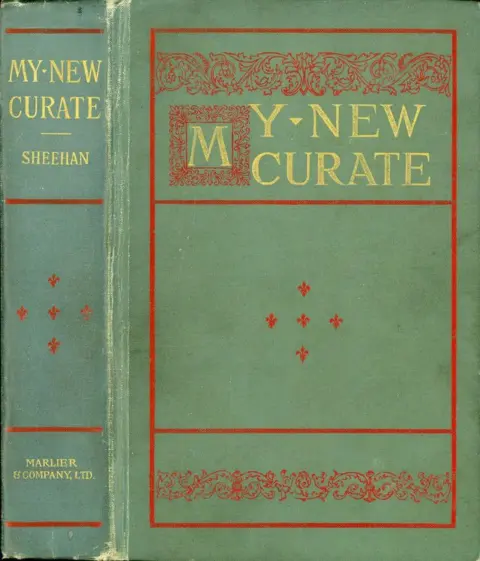
"My New Curate" by Patrick Augustine Sheehan is a novel written in the early 20th century. The story centers around Father Dan, a parish priest in an Irish village, and his experiences as he receives a new curate, Father Letheby, whose modern and energetic approach to ministry contrasts sharply with Father Dan's more traditional and resigned existence. The narrative explores themes of faith, the hardships of rural life, and the relationship between clergy and their parishioners. At the start of the book, the reader is introduced to the emotional departure of Father Dan’s old curate, Father Laverty, who leaves the parish for a new assignment. The accompanying sadness sets the tone for Father Dan's reflections on his life and the challenges that lie ahead with a new, unknown curate. Father Letheby arrives with enthusiasm and a passion to invigorate the parish, and his modern ideas quickly clash with the established leniency of the local community. This friction in expectations creates an engaging dynamic, hinting at the transformation both priests may undergo as they navigate their differences and the realities of their shared responsibilities.
Introduction adapted from the source catalogue; source summaries may be automatically generated.
Free to read · English · 107,499 words · No account needed
MAKE TIME FOR A GOOD BOOK
On by default. Untick to stop anonymous reading totals. Each page counts after 10 seconds in view. How this works.
Anonymous counting is on unless you have switched it off.
"Quite so. The whole point turns on the words cum intentione. The Church forbids, under pain of mortal sin, to consecrate outside the corporal; consequently, the priest cannot be presumed to have the intention of committing a grave just at the moment of consecration; and, therefore, he cannot be supposed to have the intention of consecrating."
"Pardon me, if I say, sir," replied the young priest, "that that is the weakest and most fallacious argument I ever heard advanced. That reasoning supposes the totally inadmissible principle that there never is a valid consecration when, inadvertently, the priest forgets some Rubric that is binding under pain of mortal sin. If, for example, the priest used fermented bread, if the corporal weren't blessed, in which case the chalice and paten would be outside the corporal, as well as the ciborium; if the chalice itself weren't consecrated, there would be no sacrifice and no consecration. Besides, if you once commence interpreting intention in this manner, you should hold that if the ciborium were covered on the corporal, there would be no consecration--"
"That's only a venial sin," said the chairman.
"A priest, when celebrating," said Father Irwin sweetly, "is no more supposed to commit a venial than a mortal sin. Besides--"
"I'm afraid our time is running short," said the bishop; "I'll remember your arguments, which are very ingenious, Father Irwin. But, as the chairman says, the consensus is against you. Now, for the main Conference, de textibus Sacræ Scripturæ."
"Father Duff will read his paper, my Lord, and then we'll discuss it."
"Very good. Now, Father Duff!"
Father Duff was another representation of the new dispensation, with a clear-cut, smooth-shaven face, large blue-black eyes, which, however, were not able to fulfil their duties, for, as he took out a large roll of manuscript from his pocket, he placed a gold-rimmed pince-nez to his eyes, and looking calmly around, he began to read in a slow, rhythmic voice. It was a wonderful voice, too, for its soft, purring, murmurous intonation began to have a curious effect on the brethren. One by one they began to be seized by its hypnotic influence, and to yield to its soft, soporific magic, until, to my horror and disgust, they bowed their heads on their breasts, and calmly slept. Even the Master of Conference, and the bishop himself, gently yielded, after a severe struggle. "I shall have it all to myself," I said, "and if I don't profit much by its historical aspects, I shall at least get a few big rocks of words, unusual or obsolete, to fling at my curate." And so I did. Codex Alexandrinus, and Codex Sinaiticus, and Codex Bezæ, and Codex Vaticanus rang through my bewildered brain. Then I have a vague recollection that he actually laughed at the idea of six literal days of creation, which made an old priest, out of his dreams, turn over to me and whisper: "He's an infidel"; then, again, he ridiculed the idea of the recognized authorship of the Pentateuch; spoke of Chaldean and Babylonian interpolations; knocked on the head the Davidical origin of the Psalms; made the Book of Daniel half-apocryphal; introduced the Book of Job, as a piece of Arabian poetry, like the songs of some man called Hafiz; talked about Johannine Gospels and Pauline Epistles; and, altogether, left us to think that, by something called Ritschlian interpretations, the whole Bible was knocked into a cocked hat. Then he began to build up what he had thrown down; and on he went, in his rhythmical, musical way, when just as he declared that "the basal document on which everything is founded is the ur-evangelium, which is the underlying cryptic element of the Synoptic Gospels,"--just as he reached that point, and was going on about Tatian's "Diatessaron," a deep stertorous sound, like the trumpeting of an elephant, reverberated through the conference room. They all woke up, smiling at me, and as they did not seem inclined to apologize to Father Duff for their misbehavior, I said gravely and most angrily:--
Your reading position is saved on this browser. Take it to another device with a library code. Reading pages adapt to text, rather than matching a printed edition.
BEHIND THE BOOK
This eBook is for the use of anyone anywhere in the United States and most other parts of the world at no cost and with almost no restrictions whatsoever. You may copy it, give it away or re-use it under the terms of the Project Gutenberg License included with this eBook or online at www.gutenberg.org. If you are not located in the United States, you will have to check the laws of the country where you are located before using this eBook. Read the source licence.
The original source file, including credits and licence, is retained by this library. Request an original-format copy at no charge. Please include the book title and Project Gutenberg identifier #20295.
KEEP YOUR CURIOSITY GOING
Coulson Kernahan

Maurice Baring
Frances Wright
Cécile Tormay

Frederic Jesup Stimson

W. H. P. (William Henry Pope) Jarvis